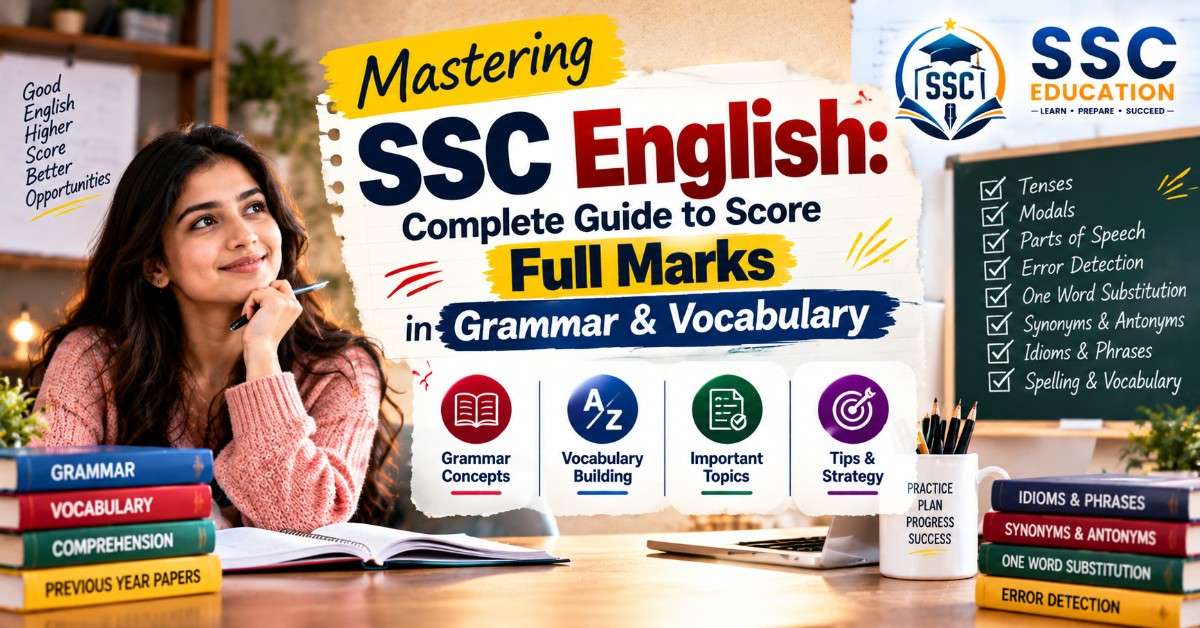
Mastering SSC English: Complete Guide to Score Full Marks in Grammar & Vocabulary
Rahul Kumar
SSC Exam Expert & Content Editor
Table of Contents
- 1.SSC English: Topic-Wise Breakdown
- 2.Grammar Rules Asked Most Often
- 3.Building Vocabulary Systematically
- 4.Reading Comprehension: A Simple 3-Step Method
- 5.Active-Passive and Narration: Rule-Based, Not Random
- 6.Common Mistakes in SSC English Preparation
- 7.Related Reading
- 8.Conclusion
- 9.Frequently Asked Questions
- 10.Commonly Confused Word Pairs in SSC Exams
- 11.Sample Error-Spotting Walkthrough
A complete SSC English preparation guide — topic breakdown, the grammar rules asked most often, a systematic vocabulary-building method, and a simple 3-step reading comprehension approach.
SSC English can become your highest-scoring, most time-efficient section because unlike Maths or Reasoning, most questions test recall and rule application rather than multi-step problem solving. This guide covers the exact topic breakdown, the grammar rules asked most often, and a practical vocabulary-building system to help you aim for full or near-full marks.
SSC English: Topic-Wise Breakdown
| Topic | What It Tests |
|---|---|
| Error Spotting / Sentence Correction | Grammar rules applied to full sentences |
| Fill in the Blanks / Cloze Test | Vocabulary and contextual grammar |
| Reading Comprehension | Passage understanding and inference |
| Synonyms & Antonyms | Vocabulary range |
| One-Word Substitution | Precise vocabulary knowledge |
| Idioms & Phrases | Common English expressions and their meaning |
| Spelling Correction | Commonly confused/misspelled words |
| Active-Passive Voice | Sentence transformation rules |
| Direct-Indirect Speech (Narration) | Reported speech transformation rules |
| Para Jumbles (Tier 2) | Logical sentence ordering |
Grammar Rules Asked Most Often
A small set of grammar rules covers the vast majority of SSC error-spotting and sentence-correction questions. Master these first:
1. Subject-Verb Agreement
The verb must match the number of the subject. Watch for tricky cases: collective nouns (the team is), "each/every" (each boy runs), and phrases between subject and verb that don't affect agreement (the box of chocolates is on the table).
2. Tenses
Focus on correct tense sequencing — especially since/for with present perfect, "if" conditional sentences, and reported speech tense shifts. Most SSC tense errors involve mixing past and present incorrectly within one sentence.
3. Articles (a, an, the)
Use "an" before vowel sounds (not just vowel letters — "an hour," "a university"). "The" is used for specific, previously mentioned, or unique things.
4. Prepositions
Many SSC errors involve fixed preposition usage with specific verbs/adjectives (e.g., "married to," "different from," "good at"). Build a list of 40–50 common preposition combinations and revise it weekly.
5. Conjunctions and Parallelism
Paired conjunctions (either...or, neither...nor, not only...but also) must maintain grammatical parallelism on both sides.
6. Countable vs Uncountable Nouns
Watch for "much/many," "fewer/less," and "amount/number" usage errors — a frequent, easy-to-spot SSC error type once you know the rule.
Building Vocabulary Systematically
- Learn 10–15 new words daily with their synonym, antonym, and one example sentence — not just the meaning in isolation.
- Study root words. Knowing common Latin/Greek roots (like "bene" = good, "mal" = bad) helps you guess the meaning of unfamiliar words in the exam itself.
- Maintain a rotating revision list. Revisit words learned 3, 7, and 21 days ago — spaced repetition dramatically improves long-term recall over one-time reading.
- Learn one-word substitutions and idioms in themed batches (e.g., words related to law, government, or personality traits) rather than as one giant random list.
Reading Comprehension: A Simple 3-Step Method
- Skim the passage first (60–90 seconds) to understand the overall theme and tone, without trying to memorise details.
- Read the questions to know exactly what information to look for.
- Scan back into the passage for each answer rather than relying purely on memory — SSC RC questions are usually directly traceable to specific lines.
Avoid the common trap of reading the passage word-by-word first and then re-reading it fully for each question — this wastes valuable exam time.
Active-Passive and Narration: Rule-Based, Not Random
Both topics follow fixed transformation rules (subject-object swap for voice; tense-shift and pronoun-change rules for narration). Rather than memorising hundreds of example sentences, learn the underlying rule table once and practice applying it to 20–30 varied sentences — the pattern becomes automatic quickly.
Common Mistakes in SSC English Preparation
- Learning grammar rules in isolation without practicing them on actual SSC-style sentences, which are often trickier than textbook examples.
- Building vocabulary through random word lists instead of thematic, spaced-repetition-based learning.
- Skipping error-spotting practice because it "feels hard," even though it's one of the highest-weightage topics in the section.
- Not timing Reading Comprehension practice, leading to time overruns on exam day. For a broader look at preparation pitfalls, see our SSC preparation mistakes guide.
Related Reading
- Latest SSC CGL Syllabus and Exam Pattern
- How to Increase Mock Test Scores in SSC CGL
- SSC Previous Year Question Papers
Conclusion
SSC English rewards consistent, rule-based preparation more than any other section. Master the handful of grammar rules that appear repeatedly, build vocabulary through spaced repetition rather than cramming, and practice Reading Comprehension with a timed, question-first approach. Done consistently, English can become the section where you score closest to full marks.
Frequently Asked Questions
1. How can I improve my English for SSC CGL?
Focus on mastering a core set of frequently-tested grammar rules, build vocabulary through daily spaced-repetition practice, and read passages using a timed, question-first approach for comprehension.
2. Which grammar topics are most important for SSC exams?
Subject-verb agreement, tenses, articles, prepositions, conjunctions/parallelism, and countable-uncountable noun usage cover the majority of SSC error-spotting questions.
3. How many new words should I learn daily for SSC vocabulary?
10–15 new words daily, each with its synonym, antonym, and an example sentence, revised at spaced intervals (3, 7, and 21 days) for long-term retention.
4. Is Reading Comprehension difficult in SSC CGL?
Not usually — SSC RC answers are typically directly traceable to specific lines in the passage, so a question-first reading approach makes most RC questions quick to solve.
5. How do I master Active-Passive Voice and Narration questions?
Learn the underlying transformation rule table once, then practice applying it to 20–30 varied sentences rather than memorising individual example sentences.
6. What is the best way to prepare for error spotting?
Practice on actual SSC-style sentences rather than only textbook grammar examples, since SSC questions often frame common rules in trickier, less obvious ways.
7. Are idioms and one-word substitutions important for SSC CGL?
Yes, they form a consistent part of the vocabulary section every year — learning them in themed batches makes recall significantly easier than random lists.
8. How much time should I give to English daily during preparation?
At least 45–60 minutes daily split between grammar practice, vocabulary building, and comprehension, to build steady, compounding improvement.
9. Can English become my highest-scoring SSC section?
Yes — since English questions are largely rule and recall-based rather than multi-step problems, consistent preparation can make it one of the fastest and highest-scoring sections.
10. Where can I practice SSC English questions from real papers?
You can solve English sections from actual previous year SSC papers in our SSC Previous Year Question Papers section.
Commonly Confused Word Pairs in SSC Exams
| Word | Meaning | Often Confused With |
|---|---|---|
| Affect | To influence (verb) | Effect (a result, noun) |
| Stationary | Not moving | Stationery (writing materials) |
| Complement | To complete/enhance | Compliment (praise) |
| Principal | Head of institution / main | Principle (a rule) |
| Illicit | Not legally permitted | Elicit (to draw out) |
Questions built around these confusing pairs appear almost every year in spelling correction and error-spotting sections, so keeping a running list of such pairs is high-value preparation.
Sample Error-Spotting Walkthrough
Sentence: "Each of the students have submitted their assignment."
Error: "have" should be "has," since "each" is singular and takes a singular verb, regardless of the plural noun ("students") that follows it.
Corrected: "Each of the students has submitted their assignment."
This is a textbook subject-verb agreement trap — SSC frequently tests exactly this pattern by placing a plural noun between "each/every" and the verb to mislead candidates who read too quickly.
Rahul Kumar
SSC Exam Expert & Content Editor
Rahul is a senior SSC exam strategist with 8+ years of experience helping aspirants crack CGL, CHSL and MTS exams. He writes in-depth notification breakdowns, exam pattern guides and preparation strategies.