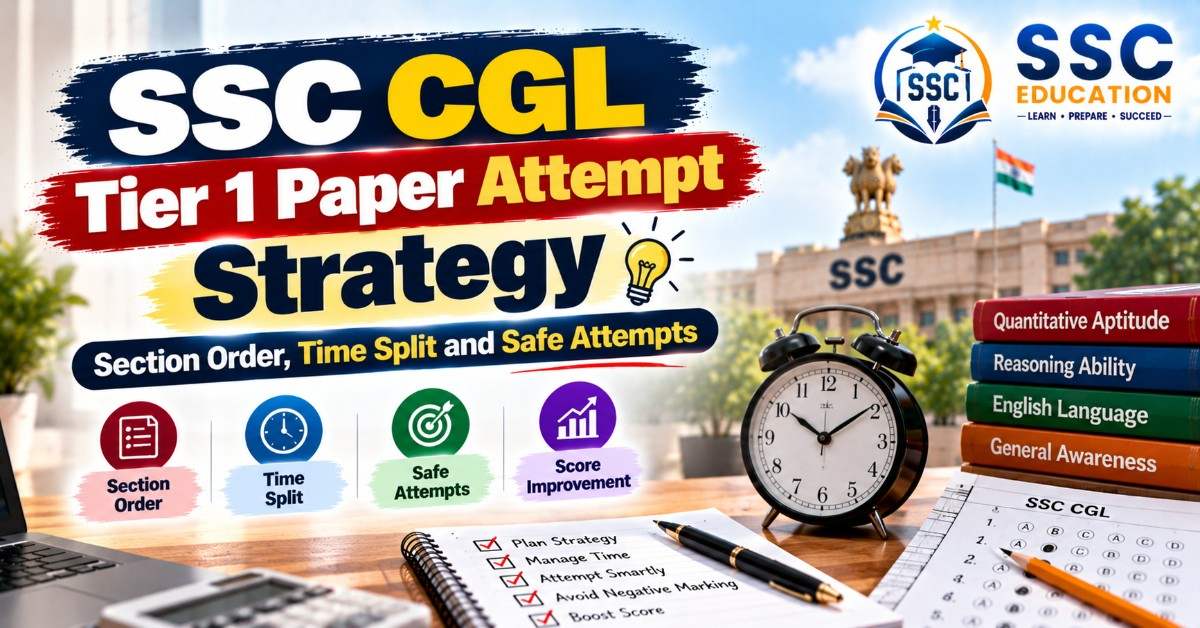
SSC CGL Tier 1 Paper Attempt Strategy: Section Order, Time Split and Safe Attempts
Rahul Kumar
SSC Exam Expert & Content Editor
Table of Contents
- 1.SSC CGL Tier 1 Pattern Recap
- 2.Best Order of Sections
- 3.Time Split Table
- 4.The Two-Round Approach
- 5.How Many Questions Should You Attempt?
- 6.Handling Negative Marking
- 7.Practice Plan for the Strategy
- 8.Sample Attempt Plans for Different Types of Candidates
- 9.How to Avoid Common Time Traps in the Paper
- 10.Section-Wise Accuracy Targets
- 11.Mindset on the Exam Day
- 12.A Small Case Study of a Smart Attempt
- 13.Frequently Asked Questions (FAQs)
Plan your SSC CGL Tier 1 attempt: the best section order, time split across 100 questions, how many questions to attempt, how to handle negative marking and a first-round and second-round approach.
Two students with the same knowledge can score very different marks in SSC CGL Tier 1 because of their attempt strategy. The paper has 100 questions in 60 minutes, so you have less than a minute for each question and negative marking for wrong answers. This guide explains a simple strategy: the best order of sections, how to split your time, how many questions to attempt and how to use two rounds in the paper.
SSC CGL Tier 1 Pattern Recap
| Section | Questions | Marks |
|---|---|---|
| General Intelligence and Reasoning | 25 | 50 |
| General Awareness | 25 | 50 |
| Quantitative Aptitude | 25 | 50 |
| English Comprehension | 25 | 50 |
| Total | 100 | 200 |
- Duration: 60 minutes in total.
- Each correct answer gives 2 marks and each wrong answer reduces 0.50 mark.
- If your notification mentions a different time rule (for example sectional timing), follow the notification and adjust this plan.
Best Order of Sections
There is no single best order for every student, but this order works well for many:
- General Awareness (about 5 to 6 minutes): it needs only recall. Attempt only the questions that you are sure about.
- English (about 12 to 13 minutes): quick grammar and vocabulary questions first, then the comprehension passage.
- Reasoning (about 15 minutes): attempt the quick types (analogy, series, coding-decoding) and leave puzzles for the second round.
- Quantitative Aptitude (about 22 to 25 minutes): it takes more time, so start it when your mind is fresh and you have a clear idea about the remaining time.
If you are very strong in maths, you can start with maths. Practise different orders in mocks and choose the one that gives you the best score.
Time Split Table
| Section | Suggested time | Target attempts |
|---|---|---|
| General Awareness | 5 to 6 minutes | 15 to 20 (with good accuracy) |
| English | 12 to 13 minutes | 20 to 22 |
| Reasoning | 13 to 15 minutes | 20 to 23 |
| Quantitative Aptitude | 22 to 25 minutes | 18 to 22 |
These are only guidelines. Change them according to your strengths and your mock test results.
The Two-Round Approach
- Round 1: Go through each section and attempt only the questions that you can solve within 40 to 60 seconds. Mark the other questions for review.
- Round 2: Return to the marked questions and attempt the ones that need a little more time, but keep a time limit of about 90 seconds.
- Final minutes: Use the last 2 to 3 minutes to check the marked answers and the questions that you left blank, and make a smart guess only after elimination.
How Many Questions Should You Attempt?
- The number depends on your accuracy. A rough target for most serious candidates is 80 to 90 attempts with 85% accuracy or more.
- A wrong answer gives -0.50 instead of 0 for skipping, and it is 2.5 marks less than a correct answer, so every careless attempt hurts.
- Do not attempt a question just to increase the count. Attempt it only if you are fairly sure or you can eliminate two options.
Handling Negative Marking
- Do not guess in the sections where you have very low confidence.
- Use elimination: if two options can be removed, the chance of a correct guess is 50%, which gives a positive expected value.
- Mark the questions for review so that you can revisit them if time remains.
- Keep an eye on accuracy during mocks and aim to reduce wrong attempts every week.
Practice Plan for the Strategy
- Take 10 mocks with different orders of sections and record your scores.
- Choose the order that gives the highest average with the lowest negative marks.
- Practise the two-round approach in every mock.
- Take 5 final mocks in the exam shift timing with your final strategy.
Sample Attempt Plans for Different Types of Candidates
| Candidate type | Suggested order | Notes |
|---|---|---|
| Strong in maths | Maths, Reasoning, English, GA | Use the first 25 minutes for maths; keep GA for the end |
| Strong in English and GA | GA, English, Reasoning, Maths | Finish the easy sections in 20 minutes and keep 40 minutes for the rest |
| Balanced candidate | Reasoning, English, GA, Maths | Start with a quick section to build confidence |
| Weak in maths | English, Reasoning, GA, then Maths | Attempt only easy and medium maths questions |
The best plan is the one that gives the highest average score in your mock tests. Try each plan in 4 to 5 mocks before you decide.
How to Avoid Common Time Traps in the Paper
- Lengthy calculation questions: if a question needs more than 90 seconds, mark it and move on.
- Reading passages: do not read the entire passage again and again; read the questions first.
- Puzzles and arrangements: they look attractive but can take 3 to 4 minutes; attempt them only at the end.
- Overthinking GA questions: if you do not know the answer in 15 seconds, skip or eliminate and move.
- Checking the answers too many times: use the last 2 minutes for review, not the whole paper.
Section-Wise Accuracy Targets
| Section | Attempts | Accuracy target |
|---|---|---|
| Reasoning | 20 to 23 | 90% or more |
| General Awareness | 15 to 20 | 85% or more |
| English | 20 to 22 | 90% or more |
| Maths | 18 to 22 | 85% or more |
If you reach these targets in your mocks, your total score can cross 160 to 170, which is a competitive range in most years. The actual cut off varies, so always compare with the previous year data.
Mindset on the Exam Day
A good strategy works only if you stay calm and follow it in the exam hall. Remember that you do not have to solve every question; you need to solve the right questions in the right order. If a section does not go as per your plan, do not let it disturb the next section. Reset your mind with a deep breath and start the next section with a fresh focus. This attitude can save you 5 to 10 marks in an exam.
A Small Case Study of a Smart Attempt
Imagine a candidate who attempts 90 questions and gets 74 correct and 16 wrong. The score is 74 x 2 minus 16 x 0.5, which is 148 minus 8, giving 140 marks. Another candidate attempts 80 questions and gets 72 correct and 8 wrong. The score is 144 minus 4, giving 140 marks. Both candidates get the same score, but the second candidate took less risk and had a better accuracy. This example shows that you should not attempt questions just to increase the count; a sharper selection of questions gives the same result with less stress.
Frequently Asked Questions (FAQs)
1. How many questions should I attempt in SSC CGL Tier 1?
A good target is 80 to 90 questions with high accuracy. The number depends on your strengths and the difficulty of the paper.
2. Which section should I attempt first in SSC CGL Tier 1?
Many candidates start with General Awareness or English and keep Maths for when they are fresh. Choose the order that gives you the best score in mocks.
3. How much time should I give to each section?
Roughly 5 to 6 minutes for GA, 12 to 13 for English, 13 to 15 for reasoning and 22 to 25 for maths.
4. Is negative marking a big problem in SSC CGL?
Yes. Each wrong answer takes away 0.50 mark, so accuracy matters as much as attempts.
5. Should I guess in SSC CGL Tier 1?
Guess only after eliminating at least two options.
6. What is a good score in SSC CGL Tier 1?
A good score depends on the year and the category. Check the previous year cut offs and aim for a safe margin above them.
7. Is the SSC CGL Tier 1 paper tough?
The difficulty is moderate, but the time is short. The key to a high score is accuracy and smart selection of questions.
8. How can I improve my attempt strategy?
Take regular mocks, analyse your time and accuracy per section and adjust the order and the time split.
9. Should I attempt all 25 questions of every section?
Not necessarily. Attempt as many as you can with good accuracy and avoid forced attempts.
10. Where can I practise SSC CGL Tier 1 questions?
You can use the previous year papers and topic-wise practice papers on SSC Education.
Rahul Kumar
SSC Exam Expert & Content Editor
Rahul is a senior SSC exam strategist with 8+ years of experience helping aspirants crack CGL, CHSL and MTS exams. He writes in-depth notification breakdowns, exam pattern guides and preparation strategies.