How to Increase Mock Test Scores in SSC CGL: 5 Data-Backed Tips to Boost Speed and Accuracy
Rahul Kumar
SSC Exam Expert & Content Editor
Table of Contents
- 1.Why Mock Test Quantity Isn't the Answer
- 2.Tip 1: Track Accuracy Percentage, Not Just Raw Score
- 3.Tip 2: Categorise Every Wrong Answer
- 4.Tip 3: Run a Section-Wise Time Audit
- 5.Tip 4: Calibrate Attempt-Rate Using Negative Marking Data
- 6.Tip 5: Apply Spaced Repetition to Recurring Weak Topics
- 7.A Simple Mock Test Analysis Template
- 8.Common Mock Test Mistakes to Avoid
- 9.Related Reading
- 10.Conclusion
- 11.Frequently Asked Questions
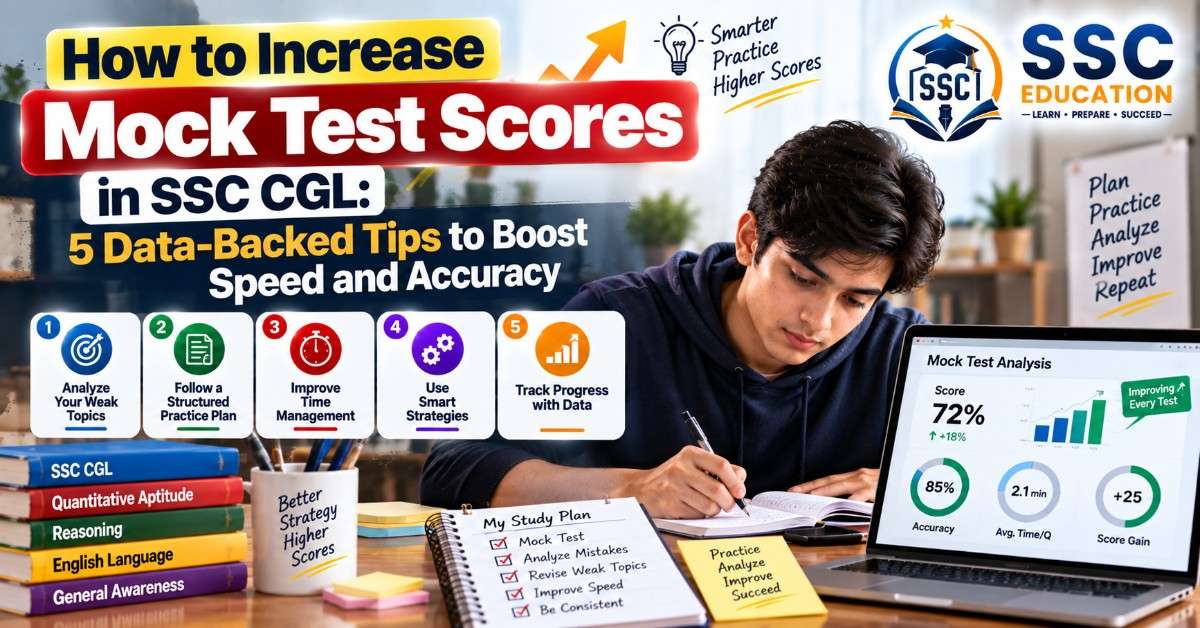
Five data-backed tips to raise your SSC CGL mock test scores — tracking accuracy, categorising errors, auditing time usage, calibrating attempt-rate, and fixing recurring weak topics.
Taking more mock tests doesn't reliably raise your SSC CGL score — analysing them the right way does. The candidates who improve fastest track five specific data points after every mock: accuracy percentage, error type, section-wise time spent, attempt-rate versus negative marking, and recurring weak topics. Here's exactly how to apply each one.
Why Mock Test Quantity Isn't the Answer
It's common to see aspirants take 3–4 mock tests a week for months while their score barely moves. The reason is simple: a mock test only shows you where you're losing marks — it's the post-test analysis that tells you why, and only fixing the "why" actually raises your score. Without analysis, you're just repeating the same mistakes at a slightly faster pace.
Tip 1: Track Accuracy Percentage, Not Just Raw Score
Two candidates scoring the same raw marks can have very different accuracy rates depending on how many questions they attempted. Calculate accuracy as (correct answers ÷ attempted questions) × 100 for each section separately.
- Accuracy below 60% in a section usually signals a concept gap — you're attempting questions you don't fully understand.
- Accuracy above 85% with a low attempt count usually signals excessive caution — you likely have room to attempt more.
Tracking this weekly shows you whether to focus on learning more concepts or on building confidence to attempt more.
Tip 2: Categorise Every Wrong Answer
After each mock, sort every incorrect answer into one of three buckets:
| Category | What It Means | Fix |
|---|---|---|
| Concept Gap | You didn't know how to solve it | Revisit that topic from basics |
| Calculation/Silly Mistake | You knew the method but erred in execution | Practice speed and accuracy drills |
| Guessed Wrong | You attempted without real knowledge | Reassess your attempt-rate strategy |
Over 4–5 mocks, this reveals a clear pattern — most candidates find one category dominates, and that becomes their single highest-leverage fix.
Tip 3: Run a Section-Wise Time Audit
Note the time you spend on each section during a mock (most mock platforms show this automatically). Compare it against your section-wise plan — for example, if you planned 15 minutes for Quant but consistently take 20, that's a time leak worth investigating.
- Identify which specific topics within a section eat up disproportionate time.
- Practice those topics in isolation with a strict timer until your per-question time drops.
- Re-test the full section only after isolated practice shows improvement — this avoids reinforcing slow habits in a full mock.
Tip 4: Calibrate Attempt-Rate Using Negative Marking Data
Instead of guessing how many questions to attempt, calculate it from your own accuracy data. If your accuracy in a section is consistently above 75%, you can safely push your attempt rate higher. If it's below 60%, attempting fewer, more certain questions will likely raise your net score despite a lower attempt count. Review our SSC preparation mistakes guide for more on common negative marking errors.
Tip 5: Apply Spaced Repetition to Recurring Weak Topics
If the same topic shows up in your "concept gap" list across 3 or more mocks, generic revision isn't working for it. Apply spaced repetition specifically to that topic: revisit it after 1 day, then 3 days, then 7 days, solving fresh questions each time rather than re-reading notes. This method is significantly more effective for stubborn weak areas than one-off revision sessions.
A Simple Mock Test Analysis Template
Use a simple table like this after every mock — it takes 10 minutes to fill and compounds into powerful insights over a month:
| Section | Attempted | Correct | Accuracy % | Time Taken | Top Error Type |
|---|---|---|---|---|---|
| Quant | |||||
| Reasoning | |||||
| English | |||||
| GA |
Maintain this in a simple spreadsheet across all your mocks — the trend lines across weeks matter far more than any single test's result.
Common Mock Test Mistakes to Avoid
- Taking mocks without a fixed weekly schedule, which makes it hard to track genuine progress over time.
- Reviewing only wrong answers and skipping questions you guessed correctly — these are just as important since they reveal knowledge gaps you got lucky on.
- Switching mock test series too frequently, which prevents you from building a consistent baseline to measure improvement against.
- Not simulating real exam conditions (same time of day, no pausing, no distractions), which limits how well mock performance predicts real exam performance.
Related Reading
- Top 5 Mistakes to Avoid During SSC Preparation
- How to Score 45+ in SSC CGL Maths
- Free SSC Mock Tests & Practice Tools
Conclusion
Raising your SSC CGL mock test score isn't about taking more tests — it's about extracting more insight from each one. Track accuracy alongside raw score, categorise every mistake, audit your time usage, calibrate your attempt-rate with real data, and apply spaced repetition to topics that keep resurfacing as weaknesses. This data-backed approach turns mock tests from a scorekeeping exercise into your most powerful preparation tool.
Frequently Asked Questions
1. How can I increase my mock test score in SSC exams?
Track accuracy percentage per section, categorise every wrong answer by cause, audit your section-wise time usage, calibrate your attempt-rate using real accuracy data, and apply spaced repetition to recurring weak topics.
2. How many mock tests should I take per week?
2–4 full-length or sectional mock tests per week is generally sufficient, provided each one is followed by thorough analysis — quality of review matters more than raw quantity of tests.
3. What is a good accuracy percentage in SSC mock tests?
Accuracy above 75–80% per section is generally considered strong and usually supports a higher attempt-rate without excessive risk from negative marking.
4. How do I know if I'm attempting too many or too few questions?
Compare your section-wise accuracy against your attempt count — consistently high accuracy with a low attempt count suggests you can safely attempt more, while low accuracy suggests you should attempt more selectively.
5. Should I review questions I guessed correctly?
Yes, correct guesses often hide real knowledge gaps, so reviewing them is just as important as reviewing wrong answers.
6. What is the best way to fix recurring weak topics?
Apply spaced repetition — revisit the topic after 1 day, 3 days, and 7 days, solving fresh practice questions each time rather than simply re-reading notes.
7. Does simulating real exam conditions during mocks actually help?
Yes, taking mocks at a consistent time of day, without pausing or distractions, makes your mock performance a much more reliable predictor of your actual exam-day performance.
8. Should I switch between different mock test series frequently?
It's better to stick with one or two consistent mock test series so you can reliably track improvement over time, rather than switching frequently and losing a stable baseline.
9. How long should I spend analysing a single mock test?
As a general guideline, spend at least as much time analysing a mock test as you spent taking it, to properly extract insights from your errors.
10. Can data-based mock test analysis really replace more content revision?
It doesn't replace content revision, but it makes your revision far more targeted — instead of revising everything equally, you focus your limited time on the specific gaps your mock data reveals.
Rahul Kumar
SSC Exam Expert & Content Editor
Rahul is a senior SSC exam strategist with 8+ years of experience helping aspirants crack CGL, CHSL and MTS exams. He writes in-depth notification breakdowns, exam pattern guides and preparation strategies.