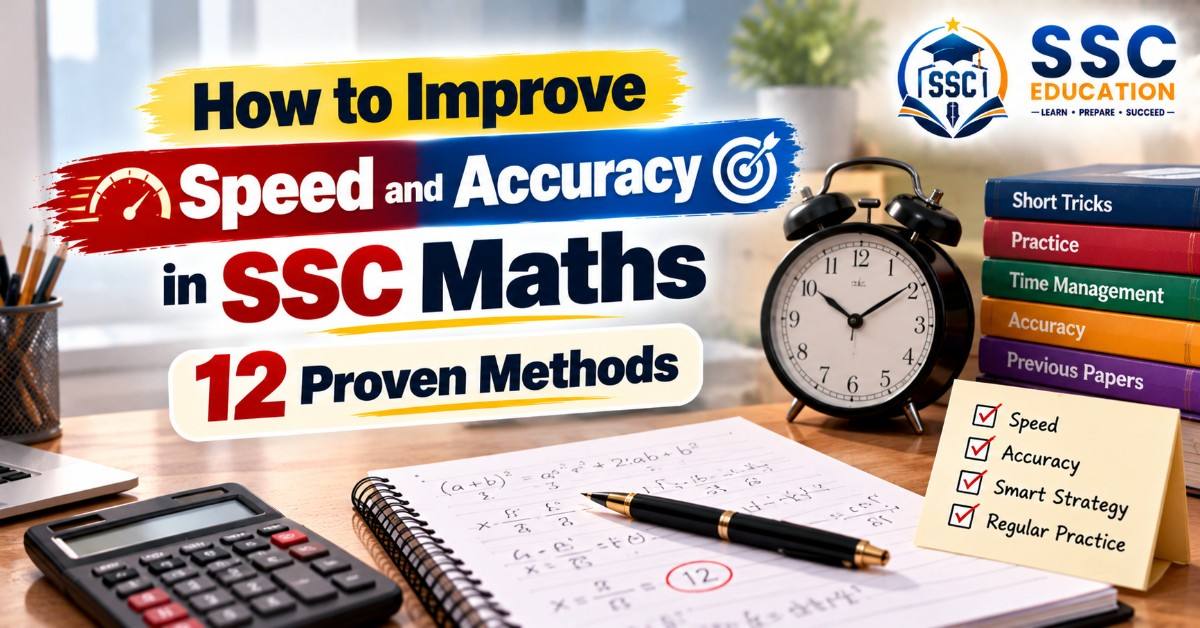
How to Improve Speed and Accuracy in SSC Maths: 12 Proven Methods
Rahul Kumar
SSC Exam Expert & Content Editor
Table of Contents
- 1.Why Speed and Accuracy Matter in SSC Maths
- 2.12 Methods to Improve Speed and Accuracy
- 3.Weekly Speed-Building Plan
- 4.A Simple Rule for the Exam: Select the Right Questions
- 5.Common Mistakes to Avoid
- 6.Mental Maths Practice Routine (15 Minutes a Day)
- 7.Common Calculation Shortcuts You Should Know
- 8.How to Reduce Silly Mistakes
- 9.How to Handle Time Pressure in the Maths Section
- 10.A 30-Day Challenge to Improve Your Maths Speed
- 11.Frequently Asked Questions (FAQs)
12 proven methods to improve speed and accuracy in SSC maths: calculation tricks, tables and squares, topic order, timed practice, error notebook and a weekly speed-building plan.
In SSC exams, maths is not only about knowing the formula; it is about solving the question in 40 to 60 seconds without a calculator. Many candidates know the concepts but lose marks because of slow calculation or silly mistakes. This guide gives you 12 proven methods to improve your speed and accuracy in SSC maths, with a weekly plan that you can start from today.
Why Speed and Accuracy Matter in SSC Maths
- In SSC CGL Tier 1, you get around 60 minutes for 100 questions, so you have less than one minute per question on average.
- Negative marking reduces your score for every wrong answer, so accuracy is as important as speed.
- A candidate who solves 20 questions with 90% accuracy usually scores more than one who attempts 25 questions with 70% accuracy.
12 Methods to Improve Speed and Accuracy
1. Memorise Tables, Squares, Cubes and Fractions
Learn tables up to 20, squares up to 30, cubes up to 15 and fraction-percentage equivalents (1/8 = 12.5%, 1/6 = 16.67%). This single step can cut your calculation time by half.
2. Learn Calculation Shortcuts
- Multiply by 5 as x10 / 2, by 25 as x100 / 4 and by 125 as x1000 / 8.
- Use the (a + b)(a - b) identity for numbers like 48 x 52.
- Square a number ending in 5 quickly: 35^2 = 3 x 4 | 25 = 1225.
3. Use the Multiplier Method in Percentage
A 20% increase means multiplying by 1.2 and a 20% decrease means multiplying by 0.8. Successive changes become simple multiplications.
4. Use the LCM Method in Time and Work
Taking the LCM as total work converts fractions into whole numbers and saves a lot of time.
5. Do Not Skip Concept Building
Shortcuts work only when the concept is clear. Spend the first phase understanding concepts and the second phase building speed.
6. Practise Topic-Wise With a Timer
Solve 20 questions in 15 minutes and note the time per question. Improve the target by one minute every week.
7. Maintain an Error Notebook
Write every wrong question with the correct method and the reason for the mistake (concept, calculation or reading). Revise it every week.
8. Read the Question Carefully
Many mistakes happen because you miss a word like "not", "except" or "difference". Underline the key data before you start.
9. Use Options and Approximation
When the options are far apart, round the numbers and eliminate. Use the options in algebra and ages questions to avoid long equations.
10. Solve in Rough Work Neatly
Write numbers in a clear and orderly way. A bad handwriting in rough work leads to silly calculation errors.
11. Take Sectional and Full Mocks Weekly
Timed mocks teach you to choose the right questions and skip time-consuming ones.
12. Revise Formulas Daily
Spend 10 minutes every morning on a formula sheet. Revision keeps your recall speed high.
Weekly Speed-Building Plan
| Day | Activity |
|---|---|
| Monday to Thursday | Learn or revise one topic and solve 40 timed questions |
| Friday | Practise calculation: tables, squares and fractions for 30 minutes and solve a mixed 25-question set |
| Saturday | Sectional test of 25 questions in 20 minutes and error analysis |
| Sunday | Full mock or previous year paper and revision of the error notebook |
A Simple Rule for the Exam: Select the Right Questions
- Attempt the questions that you can solve in less than a minute in the first round.
- Leave lengthy questions (like complex data interpretation) for the second round.
- Do not insist on solving one question for more than 90 seconds.
- Make one smart guess only when you can eliminate two options.
Common Mistakes to Avoid
- Learning too many shortcuts without understanding them.
- Solving only easy questions and avoiding the weak topics.
- Not timing the practice.
- Taking mocks but not analysing them.
- Ignoring the basic calculations of fractions and decimals.
Practise topic-wise with the free sets in the Practice Paper section and previous year papers in PYQ.
Mental Maths Practice Routine (15 Minutes a Day)
Mental calculation is a skill that improves with a small but regular routine. Spend the first five minutes on tables and squares, the next five on multiplication and division of two-digit numbers, and the last five on fraction and percentage conversions. Do not use a calculator or a pen during this time. After two weeks, you will see that you recognise answers faster, and after two months, your speed in the exam improves a lot. Use a small timer to track the improvement and write your score in a notebook.
- Practise squares and cubes with flash cards.
- Multiply two-digit numbers by 11, 25 and 99 with shortcuts.
- Convert fractions like 3/8, 5/12 and 7/16 into percentages.
- Do five quick additions and subtractions of three-digit numbers every day.
Common Calculation Shortcuts You Should Know
| Situation | Shortcut |
|---|---|
| Multiply by 9 | Multiply by 10 and subtract the number |
| Multiply by 99 | Multiply by 100 and subtract the number |
| Multiply by 11 | Add adjacent digits; for two-digit numbers (ab x 11) = a (a + b) b |
| Square of numbers near 50 | Use (50 + x)^2 = 2500 + 100x + x^2 |
| Percentage of a number | Use x% of y = y% of x when it is easier |
| Division by 5 | Multiply by 2 and divide by 10 |
How to Reduce Silly Mistakes
- Write the question data in a small list before solving.
- Copy numbers carefully from the question to your rough work.
- Check the unit of the final answer.
- Re-check the last step in difficult questions, especially the sign and the decimal.
- After each mock, count how many mistakes were due to silly errors and set a target to reduce them by half in the next test.
How to Handle Time Pressure in the Maths Section
When the clock is running, many students panic and start making mistakes. Control the pressure by setting mini goals: for example, 8 questions in the first 8 minutes, then another 8 in the next 8 minutes. If you are behind the target, skip the heavy questions and attempt the quick ones. In the last 3 minutes, review the questions you marked and do not start a new long question. Practise this routine in mocks so that it becomes automatic on the exam day.
A 30-Day Challenge to Improve Your Maths Speed
| Week | Goal |
|---|---|
| Week 1 | Memorise tables, squares and cubes and finish 15 minutes of mental maths daily |
| Week 2 | Learn percentage and ratio shortcuts and solve 40 timed questions daily |
| Week 3 | Practise time and work, TSD and profit and loss with a timer and track your average time per question |
| Week 4 | Take 6 sectional tests and 2 full mocks and compare your speed and accuracy with week 1 |
At the end of 30 days, you should see a clear improvement in your speed. Write the result in your notebook and plan the next 30 days in the same way.
Frequently Asked Questions (FAQs)
1. How can I increase my speed in SSC maths?
Memorise tables, squares and fractions, learn shortcut methods, practise topic-wise with a timer and take mock tests every week.
2. How many maths questions should I attempt in SSC CGL Tier 1?
Aim to attempt 20 to 23 of the 25 questions with at least 85 to 90% accuracy. The target depends on your level and the paper difficulty.
3. How much time should I spend on one maths question?
About 40 to 60 seconds on average. Skip the question if you need more than 90 seconds.
4. Are shortcuts enough to score well in SSC maths?
No. You need clear concepts first and then shortcuts for speed.
5. What is the best way to improve calculation speed?
Daily practice of tables, squares, cubes and fraction-percentage conversions along with mental math.
6. How can I reduce silly mistakes in maths?
Read the question carefully, write neatly in rough work and maintain an error notebook.
7. How many mock tests are needed to improve speed?
At least 30 to 40 mock tests with proper analysis before the exam.
8. Is it good to use a calculator while practising?
No. Practise without a calculator because it is not allowed in the exam.
9. Which topics should I practise first for speed?
Start with percentage, ratio, average, profit and loss and time and work because they give quick marks.
10. Where can I find topic-wise maths practice sets?
You can use the maths practice papers and previous year papers on SSC Education.
Rahul Kumar
SSC Exam Expert & Content Editor
Rahul is a senior SSC exam strategist with 8+ years of experience helping aspirants crack CGL, CHSL and MTS exams. He writes in-depth notification breakdowns, exam pattern guides and preparation strategies.