
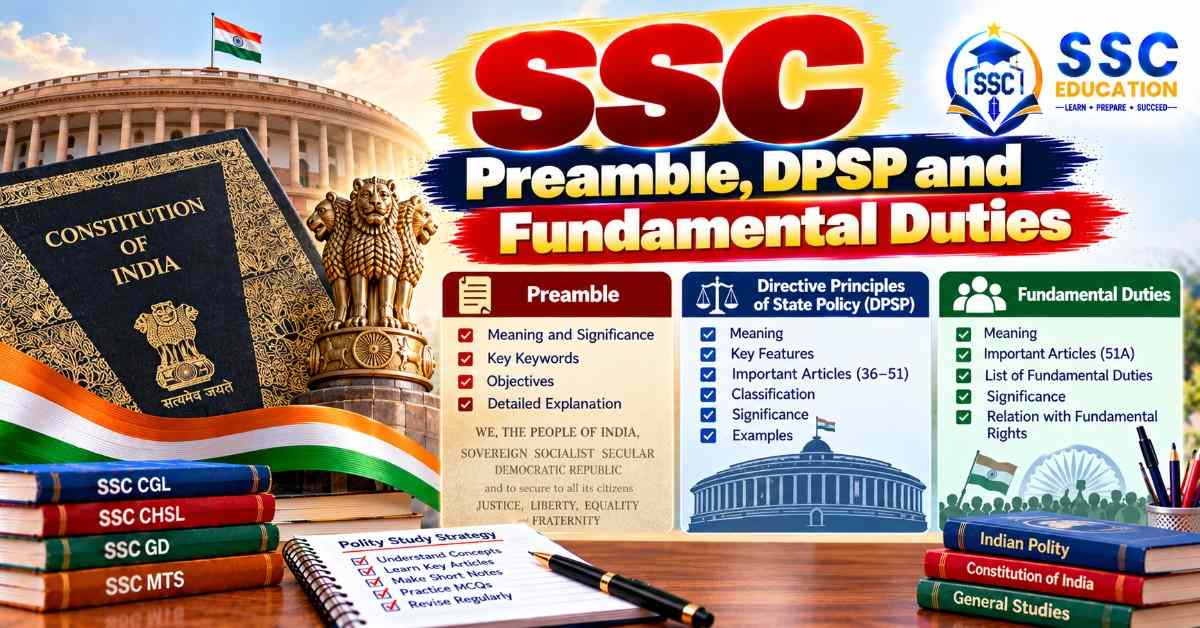
SSC Preamble, DPSP and Fundamental Duties Questions with Answers
Rahul Kumar
SSC Exam Expert & Content Editor
Table of Contents
- 1.Key Facts About the Preamble
- 2.Quick Fact Table
- 3.Fundamental Duties: What Do They Say?
- 4.Set 1: The Preamble (Q1–Q7)
- 5.Set 2: DPSP (Q8–Q14)
- 6.Set 3: Fundamental Duties (Q15–Q21)
- 7.Common Mistakes in Preamble, DPSP and Duties
- 8.How to Practice These 21 Questions
- 9.Related Topics to Study Next
- 10.Frequently Asked Questions
Practice 21 SSC polity questions on the Preamble, Directive Principles of State Policy and Fundamental Duties with answers, article numbers and a fact table for CGL, CHSL, MTS and GD.
The Preamble, the Directive Principles of State Policy (DPSP) and the Fundamental Duties are favourite polity topics in SSC exams. Questions ask for article numbers, amendments and the source of each idea. This practice paper gives you a fact table and 21 questions with answers and short explanations.
Key Facts About the Preamble
- The Preamble begins with "We, the people of India" and declares India a Sovereign, Socialist, Secular, Democratic Republic.
- The words Socialist, Secular and Integrity were added by the 42nd Amendment (1976).
- The Constitution was adopted on 26 November 1949 and came into force on 26 January 1950.
- The Supreme Court held in the Kesavananda Bharati case (1973) that the Preamble is a part of the Constitution.
Quick Fact Table
| Topic | Fact |
|---|---|
| Directive Principles | Part IV, Articles 36 to 51 |
| Fundamental Duties | Part IV-A, Article 51A |
| Fundamental Duties added by | 42nd Amendment (1976), on the recommendation of the Swaran Singh Committee |
| Number of Fundamental Duties | 11 (the 11th was added by the 86th Amendment, 2002) |
| Fundamental Duties borrowed from | The Constitution of the USSR |
| DPSP borrowed from | The Constitution of Ireland |
| Article 40 | Organisation of village panchayats |
| Article 44 | Uniform Civil Code |
| Article 45 | Early childhood care and education for children below six years |
| Article 48A | Protection of the environment and wildlife (added by the 42nd Amendment) |
| Article 50 | Separation of the judiciary from the executive |
| Article 51 | Promotion of international peace and security |
| Fundamental Rights are | Justiciable, while DPSP are non-justiciable |
| Part III of the Constitution | Fundamental Rights (Articles 12 to 35) |
| Right to Education (Article 21A) | Added by the 86th Amendment, for children aged 6 to 14 |
Fundamental Duties: What Do They Say?
- To abide by the Constitution and respect the national flag and the national anthem.
- To cherish the noble ideals of the freedom struggle.
- To uphold the sovereignty, unity and integrity of India.
- To defend the country and render national service when called upon.
- To promote harmony and renounce practices derogatory to women.
- To preserve the rich heritage of our composite culture.
- To protect and improve the natural environment.
- To develop scientific temper, humanism and the spirit of inquiry.
- To safeguard public property and abjure violence.
- To strive towards excellence in individual and collective activity.
- To provide opportunities for education to a child between the ages of 6 and 14 years (11th duty).
Remember that Fundamental Duties are meant for citizens only and are not enforceable by courts. Students often confuse them with Fundamental Rights, so keep the difference in mind: rights are claims we can enforce, and duties are obligations we should follow.
Set 1: The Preamble (Q1–Q7)
Q1. Which words were added to the Preamble by the 42nd Amendment?
Answer: Socialist, Secular and Integrity
Solution: This was done in 1976.
Q2. On which date was the Constitution adopted?
Answer: 26 November 1949
Solution: It came into force on 26 January 1950.
Q3. Which case held that the Preamble is a part of the Constitution?
Answer: Kesavananda Bharati case (1973)
Solution: The earlier Berubari case had said it was not.
Q4. How does the Preamble describe India?
Answer: Sovereign, Socialist, Secular, Democratic Republic
Solution: These are the five key words.
Q5. Who is the source of authority of the Constitution according to the Preamble?
Answer: The people of India
Solution: It begins with "We, the people of India".
Q6. What are the four objectives mentioned in the Preamble?
Answer: Justice, Liberty, Equality and Fraternity
Solution: They are the ideals of the Constitution.
Q7. Who is called the Chairman of the Drafting Committee?
Answer: Dr. B. R. Ambedkar
Solution: The Constituent Assembly adopted the Constitution in 1949.
Set 2: DPSP (Q8–Q14)
Q8. In which part of the Constitution are the Directive Principles given?
Answer: Part IV
Solution: Articles 36 to 51.
Q9. From which country were the DPSP borrowed?
Answer: Ireland
Solution: The idea came from the Irish Constitution.
Q10. Which article provides for a Uniform Civil Code?
Answer: Article 44
Solution: It is a Directive Principle.
Q11. Which article provides for the organisation of village panchayats?
Answer: Article 40
Solution: It is a Directive Principle.
Q12. Which article deals with the separation of the judiciary from the executive?
Answer: Article 50
Solution: It is a Directive Principle.
Q13. Which article was added by the 42nd Amendment for the protection of the environment?
Answer: Article 48A
Solution: It also covers wildlife.
Q14. Are the Directive Principles enforceable by courts?
Answer: No, they are non-justiciable
Solution: They guide the state in making laws.
Set 3: Fundamental Duties (Q15–Q21)
Q15. In which part and article are the Fundamental Duties given?
Answer: Part IV-A, Article 51A
Solution: They are listed in one article.
Q16. Which amendment added the Fundamental Duties?
Answer: The 42nd Amendment (1976)
Solution: On the recommendation of the Swaran Singh Committee.
Q17. From which constitution were the Fundamental Duties borrowed?
Answer: The USSR
Solution: The idea came from the Soviet constitution.
Q18. How many Fundamental Duties are there at present?
Answer: 11
Solution: The 11th was added in 2002.
Q19. Which amendment added the 11th Fundamental Duty (education for children aged 6 to 14)?
Answer: The 86th Amendment (2002)
Solution: It also added Article 21A.
Q20. Are the Fundamental Duties enforceable by courts?
Answer: No, they are non-justiciable
Solution: They are moral obligations.
Q21. Which article ensures free and compulsory education for children aged 6 to 14?
Answer: Article 21A
Solution: It was added in 2002.
Common Mistakes in Preamble, DPSP and Duties
- Mixing the 42nd and the 44th Amendments.
- Confusing Part III (rights), Part IV (DPSP) and Part IV-A (duties).
- Writing the wrong source country (Ireland for DPSP, USSR for duties).
- Forgetting the article numbers of the key DPSP.
- Confusing the date of adoption with the date of commencement.
- Thinking the Fundamental Duties are enforceable.
How to Practice These 21 Questions
- Learn the fact table and the 11 duties.
- Make a chart of parts and articles.
- Solve one set daily.
- Revise mistakes weekly.
Related Topics to Study Next
- Fundamental Rights Practice Test
- 200 Indian History and Polity Questions
- SSC CGL Tier 1 Mini Mock
- SSC Static GK Questions
Frequently Asked Questions
Which amendment added the words Socialist and Secular?
The 42nd Amendment, 1976.
Where are the Directive Principles given?
Part IV, Articles 36 to 51.
Where are the Fundamental Duties given?
Part IV-A, Article 51A.
How many Fundamental Duties are there?
Eleven.
From which country were the DPSP borrowed?
Ireland.
From which country were the Fundamental Duties borrowed?
The USSR.
Which article provides for the Uniform Civil Code?
Article 44.
Are DPSP enforceable?
No, they are non-justiciable.
When did the Constitution come into force?
On 26 January 1950.
Is the Preamble a part of the Constitution?
Yes, as held in the Kesavananda Bharati case.
How many such questions come in SSC exams?
One to three polity questions in General Awareness.
How should I prepare this topic for SSC exams?
Learn the tables, revise article numbers and practise questions.
Rahul Kumar
SSC Exam Expert & Content Editor
Rahul is a senior SSC exam strategist with 8+ years of experience helping aspirants crack CGL, CHSL and MTS exams. He writes in-depth notification breakdowns, exam pattern guides and preparation strategies.