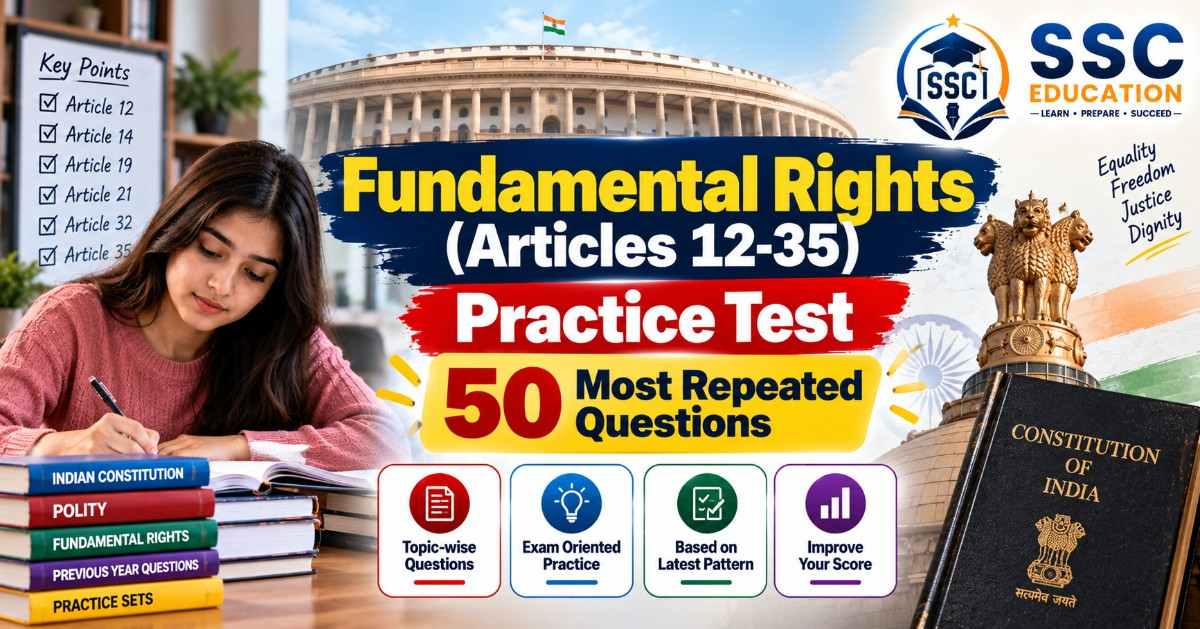
Fundamental Rights (Articles 12-35) Practice Test: 50 Most Repeated Questions
Rahul Kumar
SSC Exam Expert & Content Editor
Table of Contents
The 50 most repeated SSC Fundamental Rights questions (Articles 12-35) with answers — covering every Article, writs, exceptions, and landmark cases in one practice set.
Fundamental Rights (Articles 12–35, Part III of the Constitution) are one of the highest-yield topics in SSC General Awareness, with questions repeating almost every year in slightly different forms. This practice set covers the 50 most frequently asked Fundamental Rights questions — from Article-wise provisions to writs, exceptions, and landmark cases — presented as a simple question-and-answer table you can use for quick daily revision.
How to Use This Practice Set
- Cover the answer column and try to answer each question from memory before checking.
- Group questions by Article number in your own notes — SSC often asks "which Article deals with X" in a different phrasing each year.
- Revise this set at least 3 times before your exam; repeated exposure is what converts these into instant recall on exam day.
| No. | Question | Answer |
|---|---|---|
| 1 | Which Part of the Constitution deals with Fundamental Rights? | Part III |
| 2 | Which Articles cover the Fundamental Rights? | Articles 12 to 35 |
| 3 | Which Article defines the term "State" for Part III? | Article 12 |
| 4 | Which Article declares laws inconsistent with Fundamental Rights void? | Article 13 |
| 5 | Which Article guarantees Equality before Law? | Article 14 |
| 6 | Which Article prohibits discrimination on grounds of religion, race, caste, sex, or place of birth? | Article 15 |
| 7 | Which Article provides equality of opportunity in public employment? | Article 16 |
| 8 | Which Article abolishes untouchability? | Article 17 |
| 9 | Which Article abolishes titles (except military and academic)? | Article 18 |
| 10 | How many freedoms are currently guaranteed under Article 19? | Six |
| 11 | Which Article guarantees protection in respect of conviction for offences? | Article 20 |
| 12 | Which Article protects life and personal liberty? | Article 21 |
| 13 | Which Article was added by the 86th Amendment to provide the Right to Education? | Article 21A |
| 14 | Right to Education under Article 21A covers which age group? | 6 to 14 years |
| 15 | Which Article provides protection against arrest and detention in certain cases? | Article 22 |
| 16 | Which Article prohibits traffic in human beings and forced labour? | Article 23 |
| 17 | Which Article prohibits employment of children below 14 in hazardous work? | Article 24 |
| 18 | Which Article guarantees freedom of conscience and free profession, practice and propagation of religion? | Article 25 |
| 19 | Which Article gives freedom to manage religious affairs? | Article 26 |
| 20 | Which Article provides freedom from payment of taxes for promotion of any religion? | Article 27 |
| 21 | Which Article deals with freedom from attending religious instruction in certain institutions? | Article 28 |
| 22 | Which Article protects the interests of minorities regarding language, script, and culture? | Article 29 |
| 23 | Which Article gives minorities the right to establish and administer educational institutions? | Article 30 |
| 24 | Which Fundamental Right was removed by the 44th Amendment Act, 1978? | Right to Property (Article 31) |
| 25 | Right to Property now exists as which type of right, and under which Article? | A legal right, under Article 300A |
| 26 | Which Article is known as the "Heart and Soul" of the Constitution? | Article 32 |
| 27 | Who called Article 32 the "Heart and Soul" of the Constitution? | Dr. B. R. Ambedkar |
| 28 | Article 32 provides which key right? | The Right to Constitutional Remedies |
| 29 | Which Article empowers Parliament to modify Fundamental Rights in their application to the armed forces? | Article 33 |
| 30 | Which Article restricts Fundamental Rights while martial law is in force in any area? | Article 34 |
| 31 | Which Article empowers Parliament to make laws to give effect to Fundamental Rights? | Article 35 |
| 32 | Name the five types of writs that can be issued under Article 32. | Habeas Corpus, Mandamus, Prohibition, Certiorari, and Quo Warranto |
| 33 | Which writ means "you may have the body" and is used against illegal detention? | Habeas Corpus |
| 34 | Which writ is a command issued to a public authority to perform its duty? | Mandamus |
| 35 | Which writ is issued to prevent a lower court from exceeding its jurisdiction? | Prohibition |
| 36 | Which writ is used to quash an order already passed by a lower authority? | Certiorari |
| 37 | Which writ questions the legality of a person's claim to a public office? | Quo Warranto |
| 38 | Fundamental Rights are enforceable against whom, generally? | The State |
| 39 | Name one Fundamental Right available to both citizens and foreigners. | Right to Equality before Law (Article 14) / Right to Life (Article 21) |
| 40 | Name Articles that are available only to citizens, not foreigners. | Articles 15, 16, 19, 29 and 30 |
| 41 | Can Fundamental Rights be suspended during a National Emergency? | Yes, except those under Articles 20 and 21 |
| 42 | Which two Fundamental Rights cannot be suspended even during a National Emergency? | Article 20 and Article 21 |
| 43 | The concept of Fundamental Rights in the Indian Constitution was borrowed from which country? | The United States of America |
| 44 | How many Fundamental Rights were there originally at the time the Constitution was adopted? | Seven |
| 45 | How many Fundamental Rights exist currently in the Indian Constitution? | Six |
| 46 | Name the six Fundamental Rights currently guaranteed. | Right to Equality, Right to Freedom, Right against Exploitation, Right to Freedom of Religion, Cultural and Educational Rights, and Right to Constitutional Remedies |
| 47 | Which freedom was added to Article 19(1) by the 97th Amendment, related to economic activity? | Freedom to form cooperative societies |
| 48 | Which landmark case established the Right to Privacy as a Fundamental Right under Article 21? | Justice K.S. Puttaswamy (Retd.) vs Union of India (2017) |
| 49 | Which case established that the 'basic structure' of the Constitution cannot be altered, even by amending Fundamental Rights? | Kesavananda Bharati vs State of Kerala (1973) |
| 50 | Which Article states that the State shall not deny to any person equality before the law or equal protection of the laws? | Article 14 |
Frequently Asked Questions
1. How many Fundamental Rights are there in the Indian Constitution?
There are currently six Fundamental Rights, after the Right to Property was removed as a Fundamental Right by the 44th Amendment Act, 1978.
2. Which Article is called the "Heart and Soul" of the Constitution?
Article 32, which provides the Right to Constitutional Remedies, was described by Dr. B. R. Ambedkar as the heart and soul of the Constitution.
3. Can Fundamental Rights be suspended?
Yes, most Fundamental Rights can be suspended during a National Emergency, except those guaranteed under Articles 20 and 21.
4. Which Articles are available only to citizens?
Articles 15, 16, 19, 29, and 30 are available only to citizens of India, not to foreigners.
5. What are the five writs under Article 32?
Habeas Corpus, Mandamus, Prohibition, Certiorari, and Quo Warranto are the five writs the Supreme Court can issue to enforce Fundamental Rights.
Rahul Kumar
SSC Exam Expert & Content Editor
Rahul is a senior SSC exam strategist with 8+ years of experience helping aspirants crack CGL, CHSL and MTS exams. He writes in-depth notification breakdowns, exam pattern guides and preparation strategies.