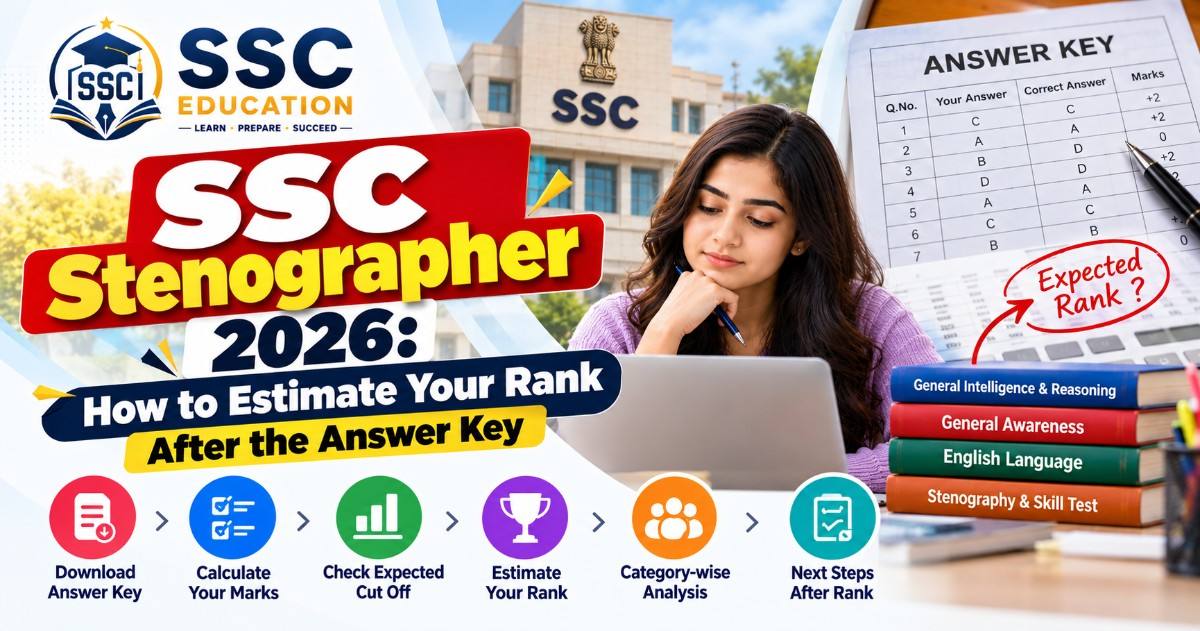
SSC Stenographer 2026: How to Estimate Your Rank After the Answer Key
Rahul Kumar
SSC Exam Expert & Content Editor
Table of Contents
- 1.Step 1: Calculate Your Raw Score Using the Marking Scheme
- 2.Step 2: Adjust for Any Answer Key Changes
- 3.Step 3: Compare Against Previous Years' Trends, Not Just This Year's Buzz
- 4.Step 4: Understand That Stenographer Selection Has More Than One Stage
- 5.Step 5: Keep Your Documents and Preparation Moving in Parallel
- 6.Frequently Asked Questions (FAQs)
After the SSC Stenographer 2026 answer key, learn how to calculate your real score and realistically gauge your rank and cutoff chances — without guesswork.
Once the SSC Stenographer Grade C & D 2026 answer key is out, the next question on every candidate's mind is simple: "Where do I stand?" While no unofficial method can replace SSC's own result, you can build a fairly realistic picture of your likely rank and selection chances by working through your marks methodically. Here's how to do it right.
Step 1: Calculate Your Raw Score Using the Marking Scheme
Before estimating anything, get your exact raw score:
- Match every question in your response sheet against the released answer key, one by one.
- Award marks for each correct answer as per the official marking scheme for Stenographer Grade C & D CBE.
- Deduct marks for every incorrect answer as per the negative marking rule mentioned in the exam notice — do not skip this step, as it changes your score meaningfully.
- Leave unattempted questions at zero; they carry no penalty.
Step 2: Adjust for Any Answer Key Changes
If you plan to raise objections — or if you're checking after the objection window has closed — recalculate your score using only the questions you're confident about, and separately note how many marks are "at stake" from questions you've challenged. This gives you a realistic score range instead of one fixed number.
Step 3: Compare Against Previous Years' Trends, Not Just This Year's Buzz
To judge where your score might land, look at:
- The final cutoff trend for Stenographer Grade C and Grade D over the last 2–3 recruitment cycles for your category (UR/OBC/SC/ST/EWS/PwBD).
- Whether this year's paper felt easier, harder or about the same in difficulty compared to previous years — this shifts cutoffs up or down even when the syllabus stays identical.
- The number of vacancies notified this cycle for your post/category, since more vacancies generally means a comparatively more accessible cutoff.
Avoid comparing your raw score directly to a random number circulating on social media or messaging groups — most "expected cutoff" claims shared informally are guesses, not calculations based on actual data.
Step 4: Understand That Stenographer Selection Has More Than One Stage
Clearing the CBE cutoff is not the final step for SSC Stenographer. Shortlisted candidates must also qualify the Skill Test in Stenography (dictation and transcription), which has its own qualifying speed and accuracy requirements depending on whether you've applied for Grade C or Grade D. A strong CBE score only gets you to this next stage — genuine stenography practice from now on is just as important as your CBE performance.
Step 5: Keep Your Documents and Preparation Moving in Parallel
While you wait for the official result, use the time productively:
- Start or continue regular dictation practice at the speed required for your applied grade.
- Keep your document set (category, PwBD, educational and identity certificates) ready and verified in advance.
- Track the official SSC website regularly for the final answer key and result notification instead of relying on unverified rumours.
Frequently Asked Questions (FAQs)
1. How do I calculate my likely SSC Stenographer 2026 score?
Match your response sheet against the official answer key, add marks for correct answers, and subtract marks for incorrect ones as per the notified negative marking scheme.
2. Should I include challenged questions in my score calculation?
Calculate a safe minimum score assuming challenged questions don't change, and separately track how many marks are at stake if your objections are accepted — this gives a more realistic score range.
3. Is there an official rank predictor from SSC?
No. SSC does not release an official rank predictor tool; only the final result and cutoff marks are officially declared. Any unofficial estimate should be treated as a rough guide only.
4. What matters more — my raw score or the expected cutoff?
Both matter together. Your raw score tells you where you stand individually, while comparing it against realistic historical cutoff trends for your category helps gauge your selection chances.
5. Does a higher number of vacancies always mean a lower cutoff?
Generally, more vacancies relative to the number of applicants can lead to a comparatively more accessible cutoff, but difficulty level and competition also play a significant role each year.
6. Is clearing the CBE enough to get selected as SSC Stenographer?
No. Candidates who qualify the CBE cutoff must also clear the Skill Test in Stenography with the required speed and accuracy before final selection.
7. What is the difference between Grade C and Grade D skill test requirements?
Grade C and Grade D have different dictation speed and transcription time requirements as notified by SSC — always check the latest official notice for the exact speed applicable to your applied grade.
8. Should I trust cutoff numbers shared on social media?
Treat informally shared cutoff numbers with caution. They are usually estimates or guesses rather than figures based on verified data, so rely on the official SSC result for final confirmation.
9. What should I do while waiting for the SSC Stenographer 2026 result?
Continue stenography practice at your required speed, keep your certificates and documents ready, and check the official SSC website regularly for updates.
10. Where will the final SSC Stenographer 2026 result be announced?
The final result will be published on the official SSC website, ssc.gov.in, along with the region-wise cutoff marks for each category.
Rahul Kumar
SSC Exam Expert & Content Editor
Rahul is a senior SSC exam strategist with 8+ years of experience helping aspirants crack CGL, CHSL and MTS exams. He writes in-depth notification breakdowns, exam pattern guides and preparation strategies.