
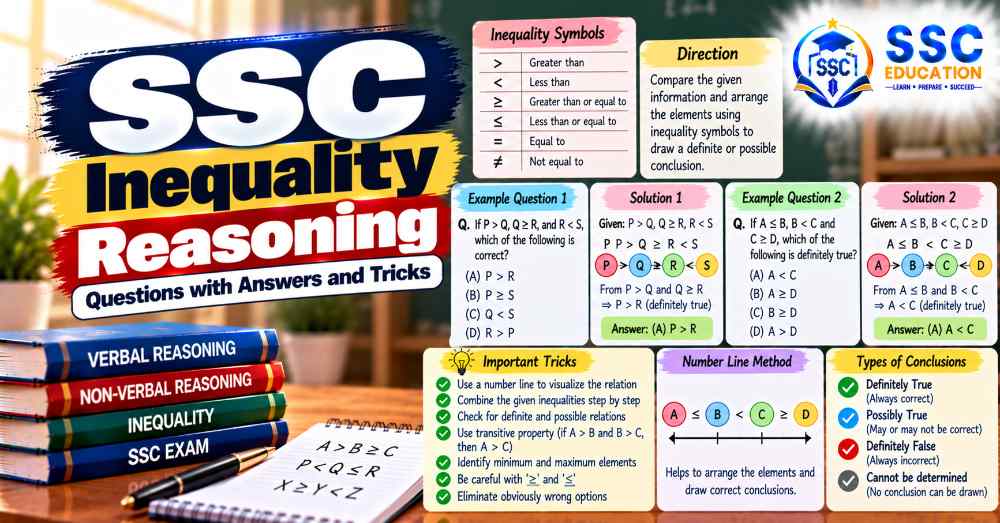
SSC Inequality Reasoning Questions with Answers and Tricks
Rahul Kumar
SSC Exam Expert & Content Editor
Table of Contents
- 1.What Are Inequality Questions?
- 2.Rules and Shortcut Tricks
- 3.Set 1: Direct Inequality (Does the Conclusion Follow?) (Q1–Q7)
- 4.Set 2: Longer Chains (Q8–Q14)
- 5.Set 3: Coded Inequality (Q15–Q21)
- 6.Worked Example
- 7.Common Mistakes in Inequality Questions
- 8.How to Practice These 21 Questions
- 9.Related Topics to Study Next
- 10.Frequently Asked Questions
Practice 21 SSC inequality reasoning questions with answers and tricks. Covers direct and coded inequalities, chain rules and definitely true conclusions for CGL, CHSL, MTS and GD.
Inequality questions give a chain of symbols such as greater than, less than and equal to, and ask which conclusion must be true. They are popular in SSC CGL, CHSL and MTS reasoning papers and in banking exams. With three simple rules, you can solve each question in 20 to 30 seconds. This practice paper gives you 21 questions with answers and short explanations.
What Are Inequality Questions?
An inequality compares two quantities with the symbols > (greater than), < (less than), ≥ (greater than or equal to), ≤ (less than or equal to) and = (equal to). The question asks whether a conclusion between two letters is definitely true.
- Direct type: the relation between the letters is written with symbols.
- Coded type: symbols like @, #, $ and % stand for the real signs, and you first decode them.
Rules and Shortcut Tricks
- Same direction: if the signs all point in one direction (all greater or all less), the end letters are related. A > B ≥ C gives A > C.
- Strict sign wins: if a chain has at least one strict sign (> or <) and the others are ≥ or ≤ in the same direction, the result is strict.
- Opposite direction (A > B < C): no relation between A and C.
- Only equal signs in the chain: the end letters are equal.
- Either-or: if neither X > Y nor X < Y is certain but X = Y or X > Y fits, check both conclusions.
- Always decode the symbols first in coded questions.
Set 1: Direct Inequality (Does the Conclusion Follow?) (Q1–Q7)
Q1. A > B > C. Does A > C follow?
Answer: Yes
Solution: Both signs point the same way.
Q2. P >= Q >= R. Does P >= R follow?
Answer: Yes
Solution: Same direction with non-strict signs.
Q3. X > Y >= Z. Does X > Z follow?
Answer: Yes
Trick: One strict sign gives a strict result.
Q4. M >= N > O. Does M > O follow?
Answer: Yes
Solution: The strict sign makes the result strict.
Q5. A > B < C. Does A > C follow?
Answer: No
Solution: The signs point in opposite directions, so there is no relation.
Q6. P = Q = R. Does P = R follow?
Answer: Yes
Solution: All the letters are equal.
Q7. X > Y and Y = Z. Does X > Z follow?
Answer: Yes
Solution: Y is equal to Z, so X is greater than Z.
Set 2: Longer Chains (Q8–Q14)
Q8. A >= B > C = D. Which is definitely true: A > D or A = D?
Answer: A > D
Solution: A >= B > C gives A > C and C = D.
Q9. P > Q >= R < S. Is P > S definitely true?
Answer: No
Solution: R is less than both P and S but nothing links P and S.
Q10. X < Y <= Z > W. Is Y > W definitely true?
Answer: No
Solution: Y and W are both less than Z, but their order is unknown.
Q11. M = N >= O >= P. Which is definitely true: M >= P or M > P?
Answer: M >= P
Solution: All signs are non-strict, so only M >= P is certain.
Q12. A < B < C > D. Is B > D definitely true?
Answer: No
Solution: B and D are both less than C with no link between them.
Q13. P >= Q >= R = S. Which is definitely true: P >= S or P > S?
Answer: P >= S
Trick: There is no strict sign in the chain.
Q14. X > Y >= Z > W. Is X > W definitely true?
Answer: Yes
Solution: All signs point the same way with strict signs present.
Set 3: Coded Inequality (Q15–Q21)
Q15. Code: P @ Q means P >= Q, P # Q means P < Q, P $ Q means P = Q, P % Q means P > Q and P & Q means P <= Q. Statement: A @ B, B % C. Conclusion: A % C.
Answer: True
Solution: A >= B and B > C gives A > C.
Q16. Using the same code, Statement: P # Q, Q & R. Conclusion: P # R.
Answer: True
Solution: P < Q <= R gives P < R.
Q17. Using the same code, Statement: X $ Y, Y @ Z. Conclusion: X @ Z.
Answer: True
Solution: X = Y >= Z gives X >= Z.
Q18. Using the same code, Statement: M % N, N $ O. Conclusion: M % O.
Answer: True
Solution: M > N = O gives M > O.
Q19. Using the same code, Statement: A & B, B # C. Conclusion: A # C.
Answer: True
Solution: A <= B < C gives A < C.
Q20. Using the same code, Statement: P @ Q, R @ Q. Conclusion: P % R.
Answer: Not definitely true
Solution: P >= Q <= R gives no relation between P and R.
Q21. Using the same code, Statement: A % B, B % C, C % D. Conclusion: A % D.
Answer: True
Solution: A > B > C > D gives A > D.
Worked Example
Take the statement A ≥ B > C = D. Check the conclusion "A > D". The signs ≥ and > point in the same direction, and the equal sign passes the relation from C to D. Because one sign is strict, the result is strict, so A > D is definitely true. Now check "A = D": this is not certain because A could be larger than D, so it does not follow. Always compare the conclusion with the strongest relation that the chain proves.
Common Mistakes in Inequality Questions
- Drawing a conclusion from opposite-direction signs.
- Treating >= as strict greater than.
- Forgetting to decode the symbols in coded questions.
- Ignoring the equal sign in the middle of a chain.
- Marking "A = C" as definitely true when only "A >= C" is true.
- Not checking both parts of an either-or conclusion.
How to Practice These 21 Questions
- Learn the three rules and the meaning of each sign.
- Decode the symbols before reading the conclusions.
- Solve each set in 7 minutes.
- Practise 15 questions every day for a week.
Related Topics to Study Next
Frequently Asked Questions
What is an inequality question in reasoning?
It is a question in which the relation between letters is given by signs, and you decide whether a conclusion definitely follows.
When can two letters be compared?
When all the signs between them point in the same direction.
What happens when the signs point in opposite directions?
No relation can be found between the end letters.
What does A >= B > C give?
It gives A > C because there is a strict sign.
What is a coded inequality?
It is a question where symbols such as @, #, $, % and & stand for real signs, which you must decode first.
What is the meaning of "definitely true"?
It means the conclusion is true in every situation allowed by the statements.
What is an either-or conclusion?
It is a pair of conclusions where one of them must be true, such as P > Q or P = Q.
Is the sign = useful in a chain?
Yes. It lets you pass the relation from one letter to another without changing the direction.
How many inequality questions come in SSC exams?
One question per shift is common in the reasoning section, and banking exams have more.
How can I solve inequality faster?
Rewrite the statement as one chain and check the direction of the signs.
Do I need to remember the codes?
The code is given in the question. You only have to decode it carefully.
How should I prepare inequality for SSC exams?
Learn the rules, practise direct and coded questions and solve previous year reasoning sets.
Rahul Kumar
SSC Exam Expert & Content Editor
Rahul is a senior SSC exam strategist with 8+ years of experience helping aspirants crack CGL, CHSL and MTS exams. He writes in-depth notification breakdowns, exam pattern guides and preparation strategies.