
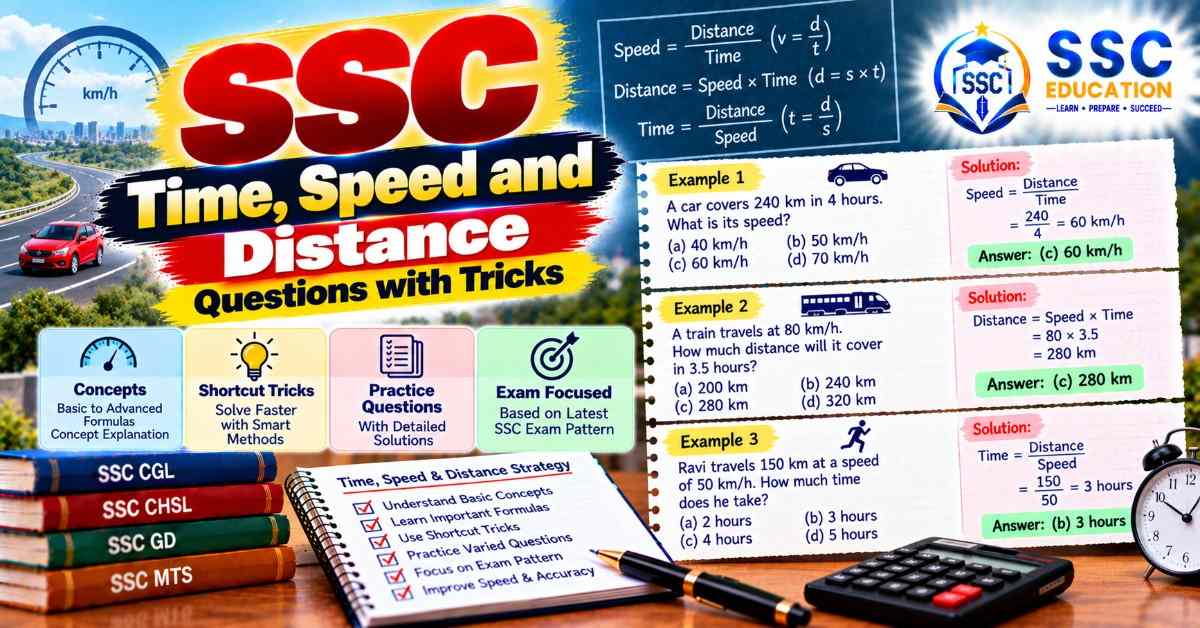
SSC Time, Speed and Distance Questions with Tricks
Rahul Kumar
SSC Exam Expert & Content Editor
Table of Contents
- 1.Practice Paper at a Glance
- 2.What Is Time, Speed and Distance? Basic Concept in Simple Words
- 3.Formulas and Shortcut Tricks for SSC Time, Speed and Distance
- 4.Set 1: Basic Speed, Time and Distance Questions (Q1–Q10)
- 5.Set 2: Relative Speed and Train Questions (Q11–Q20)
- 6.Set 3: Boats, Streams and Mixed Questions (Q21–Q30)
- 7.Common Mistakes in Time, Speed and Distance
- 8.How to Practice These 30 Questions
- 9.Related Topics to Study Next
- 10.Frequently Asked Questions
Practice 30 SSC time, speed and distance questions with answers and solutions. Covers speed conversion, average speed, relative speed, trains and boats and streams for CGL, CHSL, MTS and GD.
Time, Speed and Distance (TSD) is a core Quantitative Aptitude chapter that also supports train problems, boats and streams, races and circular tracks. SSC CGL, CHSL and MTS papers carry two to four questions from this family in almost every shift. This practice paper has 30 questions with answers and short solutions, arranged from basic to exam level so you can learn the shortcuts and build speed together.
Practice Paper at a Glance
| Detail | Information |
|---|---|
| Topic | Time, Speed and Distance |
| Total questions | 30 questions in 3 sets |
| Level | Easy to exam level |
| Useful for | SSC CGL, CHSL, MTS, GD, CPO and other government exams |
| Includes | Answers, step-by-step solutions, shortcut tricks and FAQs |
| Time to attempt | 35 to 40 minutes |
What Is Time, Speed and Distance? Basic Concept in Simple Words
Everything in this chapter is built on one relation: Distance = Speed x Time. If you know any two of them, you can find the third. Speed tells you how much distance is covered in one unit of time.
- Speed = Distance / Time
- Time = Distance / Speed
- Distance = Speed x Time
- When the distance is fixed, speed and time are inversely proportional. When the speed is fixed, distance and time are directly proportional.
Formulas and Shortcut Tricks for SSC Time, Speed and Distance
- km/h to m/s: multiply by 5/18. m/s to km/h: multiply by 18/5. So 36 km/h = 10 m/s and 72 km/h = 20 m/s.
- Average speed for equal distances at speeds x and y = 2xy / (x + y). Do not take a simple average.
- Relative speed: add speeds when two objects move in opposite directions and subtract them when they move in the same direction.
- Train crossing a pole or man: time = length of train / speed. Crossing a platform or bridge: time = (train length + platform length) / speed.
- Two trains crossing each other: time = (sum of lengths) / (relative speed).
- Boats and streams: downstream speed = u + v and upstream speed = u - v (u = boat in still water, v = stream). Still water speed = (downstream + upstream) / 2 and stream speed = (downstream - upstream) / 2.
- If speed changes in the ratio a : b, the time for the same distance changes in the ratio b : a.
- Late or early arrival: for a speed ratio a : b, the usual time and the new time are in the ratio b : a. The difference of the ratio parts equals the time difference given.
Set 1: Basic Speed, Time and Distance Questions (Q1–Q10)
Q1. A car covers 180 km in 3 hours. What is its speed?
Answer: 60 km/h
Solution: Speed = 180 / 3 = 60 km/h.
Q2. Convert 72 km/h into m/s.
Answer: 20 m/s
Trick: 72 x 5/18 = 20 m/s.
Q3. Convert 15 m/s into km/h.
Answer: 54 km/h
Trick: 15 x 18/5 = 54 km/h.
Q4. How much time will a bus take to cover 150 km at 50 km/h?
Answer: 3 hours
Solution: Time = 150 / 50 = 3 hours.
Q5. A man walks at 5 km/h. How far will he walk in 2 hours 24 minutes?
Answer: 12 km
Solution: 2 h 24 min = 2.4 hours. Distance = 5 x 2.4 = 12 km.
Q6. A car covers 240 km in 4 hours. At the same speed, how long will it take to cover 360 km?
Answer: 6 hours
Solution: Speed = 240 / 4 = 60 km/h. Time = 360 / 60 = 6 hours.
Q7. A man goes from A to B at 60 km/h and returns at 40 km/h. What is his average speed for the whole journey?
Answer: 48 km/h
Trick: Average speed = 2 x 60 x 40 / (60 + 40) = 4,800 / 100 = 48 km/h.
Q8. If a person increases his speed by 25%, by what percent does the time taken for the same distance decrease?
Answer: 20%
Solution: Speed ratio = 5 : 4 (new : old), so time ratio = 4 : 5. Time decreases by 1/5 = 20%.
Q9. A person travels at 12 km/h for 40 minutes. What distance does he cover?
Answer: 8 km
Solution: Distance = 12 x (40/60) = 8 km.
Q10. Walking at 4/5 of his usual speed, a man reaches the office 15 minutes late. What is his usual time?
Answer: 60 minutes
Solution: Speed ratio usual : new = 5 : 4, so time ratio usual : new = 4 : 5. The difference of 1 part = 15 minutes, so usual time = 4 x 15 = 60 minutes.
Set 2: Relative Speed and Train Questions (Q11–Q20)
Q11. Two trains run in opposite directions at 54 km/h and 36 km/h. What is their relative speed in m/s?
Answer: 25 m/s
Solution: Relative speed = 54 + 36 = 90 km/h = 90 x 5/18 = 25 m/s.
Q12. A 150 m long train crosses a pole in 10 seconds. What is its speed in km/h?
Answer: 54 km/h
Solution: Speed = 150 / 10 = 15 m/s = 15 x 18/5 = 54 km/h.
Q13. A 200 m long train running at 72 km/h crosses a 300 m long platform. How much time does it take?
Answer: 25 seconds
Solution: Speed = 20 m/s. Distance = 200 + 300 = 500 m. Time = 500 / 20 = 25 s.
Q14. Two trains of length 120 m and 180 m run in opposite directions at 40 km/h and 50 km/h. In how many seconds will they cross each other?
Answer: 12 seconds
Solution: Relative speed = 90 km/h = 25 m/s. Distance = 120 + 180 = 300 m. Time = 300 / 25 = 12 s.
Q15. Two trains of length 110 m and 90 m run in the same direction at 72 km/h and 54 km/h. In how many seconds does the faster train overtake the slower one?
Answer: 40 seconds
Solution: Relative speed = 72 - 54 = 18 km/h = 5 m/s. Distance = 110 + 90 = 200 m. Time = 200 / 5 = 40 s.
Q16. A 220 m long train running at 60 km/h passes a man walking at 6 km/h in the opposite direction. How long does it take to pass him?
Answer: 12 seconds
Solution: Relative speed = 66 km/h = 66 x 5/18 = 55/3 m/s. Time = 220 / (55/3) = 12 s.
Q17. Two cars start from places 300 km apart and move towards each other at 60 km/h and 40 km/h. After how many hours will they meet?
Answer: 3 hours
Solution: Relative speed = 100 km/h. Time = 300 / 100 = 3 hours.
Q18. Car A is 20 km behind car B. A runs at 15 km/h and B at 10 km/h in the same direction. After how many hours will A catch B?
Answer: 4 hours
Solution: Relative speed = 15 - 10 = 5 km/h. Time = 20 / 5 = 4 hours.
Q19. A train crosses a pole in 9 seconds and a 180 m long platform in 18 seconds. What is the length of the train?
Answer: 180 m
Trick: Let length = L. Speed = L/9. (L + 180) / (L/9) = 18, so L + 180 = 2L and L = 180 m.
Q20. A 300 m long train running at 72 km/h takes 30 seconds to cross a bridge. What is the length of the bridge?
Answer: 300 m
Solution: Speed = 20 m/s. Distance in 30 s = 600 m. Bridge = 600 - 300 = 300 m.
Set 3: Boats, Streams and Mixed Questions (Q21–Q30)
Q21. The speed of a boat in still water is 12 km/h and the speed of the stream is 3 km/h. How long will it take to go 45 km downstream?
Answer: 3 hours
Solution: Downstream speed = 12 + 3 = 15 km/h. Time = 45 / 15 = 3 hours.
Q22. A boat goes 30 km upstream in 5 hours and 44 km downstream in 4 hours. What is the speed of the boat in still water?
Answer: 8.5 km/h
Solution: Upstream = 30/5 = 6 km/h. Downstream = 44/4 = 11 km/h. Still water speed = (6 + 11)/2 = 8.5 km/h.
Q23. A man rows at 6 km/h in still water and the river flows at 2 km/h. How much total time will he take to row 16 km up the river and come back?
Answer: 6 hours
Solution: Upstream = 4 km/h so 16/4 = 4 hours. Downstream = 8 km/h so 16/8 = 2 hours. Total = 6 hours.
Q24. The downstream speed of a boat is 20 km/h and the upstream speed is 12 km/h. Find the speed of the stream.
Answer: 4 km/h
Solution: Stream = (20 - 12) / 2 = 4 km/h.
Q25. A man covers a distance in 4 hours at 6 km/h. At what speed must he travel to cover it in 3 hours?
Answer: 8 km/h
Solution: Distance = 6 x 4 = 24 km. Speed = 24 / 3 = 8 km/h.
Q26. Two persons start from the same point and walk in opposite directions at 4 km/h and 6 km/h. What will be the distance between them after 3 hours?
Answer: 30 km
Solution: Relative speed = 4 + 6 = 10 km/h. Distance = 10 x 3 = 30 km.
Q27. A man goes to his office at 30 km/h and returns at 20 km/h. The total time taken is 5 hours. What is the distance between his home and office?
Answer: 60 km
Solution: Let distance = d. d/30 + d/20 = 5, so (2d + 3d)/60 = 5 and d = 60 km.
Q28. A car running at 48 km/h takes 5 hours to cover a distance. At what speed should it run to cover the same distance in 4 hours?
Answer: 60 km/h
Solution: Distance = 48 x 5 = 240 km. Speed = 240 / 4 = 60 km/h.
Q29. A thief runs at 8 km/h. A policeman, 1 km behind him, chases at 10 km/h. How much time will the policeman take to catch the thief?
Answer: 30 minutes
Solution: Relative speed = 2 km/h. Time = 1 / 2 = 0.5 hour = 30 minutes.
Q30. The speeds of two trains are in the ratio 7 : 8. If the first train takes 4 hours to cover a distance, how long will the second take?
Answer: 3.5 hours
Solution: For the same distance, time is inversely proportional to speed. Time ratio = 8 : 7. Second train time = 4 x 7/8 = 3.5 hours.
Common Mistakes in Time, Speed and Distance
- Using a simple average for average speed. For equal distances, use 2xy / (x + y).
- Forgetting to convert km/h to m/s when the length is in metres and time is in seconds.
- Adding speeds when objects move in the same direction, or subtracting when they move in opposite directions.
- Ignoring the length of the train while crossing a platform or another train.
- Mixing upstream and downstream speeds in boat problems.
- Not converting minutes into hours before multiplying with speed in km/h.
How to Practice These 30 Questions
- Memorise the 5/18 and 18/5 conversion and the common pairs (36 = 10, 54 = 15, 72 = 20 and 90 = 25).
- Solve Set 1 first to be confident with the basic relation, then attempt trains and boats.
- Draw a small diagram for every train and relative speed question.
- Time yourself: Set 1 in 8 minutes, Set 2 in 15 minutes and Set 3 in 15 minutes.
- Redo the questions you got wrong after one day and again after one week.
Related Topics to Study Next
Frequently Asked Questions
What is the formula for time, speed and distance?
Distance = Speed x Time. From this, Speed = Distance / Time and Time = Distance / Speed. These three forms solve most basic questions in this chapter.
How do you convert km/h into m/s?
Multiply the speed in km/h by 5/18 to get m/s. For example, 72 km/h = 72 x 5/18 = 20 m/s. To convert m/s into km/h, multiply by 18/5.
What is the formula for average speed?
Average speed = Total distance / Total time. When two equal distances are covered at speeds x and y, the average speed is 2xy / (x + y).
What is relative speed?
Relative speed is the speed of one object as seen from another. It is the sum of speeds when objects move in opposite directions and the difference when they move in the same direction.
How do you solve train problems in SSC exams?
Convert the speed to m/s, add the lengths when a train crosses another train, a platform or a bridge, and divide the total distance by the speed or relative speed.
What is the formula for boats and streams?
Downstream speed = boat speed + stream speed and upstream speed = boat speed - stream speed. Still water speed = (downstream + upstream) / 2 and stream speed = (downstream - upstream) / 2.
How many time, speed and distance questions come in SSC CGL?
Usually two to four questions per shift come from this family, which includes trains, boats and streams, races and relative speed.
What is the relation between speed and time?
For a fixed distance, speed and time are inversely proportional. If speed becomes double, the time taken becomes half.
How do I solve questions where a person is late by some minutes?
Write the speed ratio, reverse it to get the time ratio, and equate the difference between the ratio parts with the given late or early time. This gives the usual time directly.
How should I prepare time, speed and distance for SSC exams?
Learn the conversions and formulas, solve one set daily in a fixed time, practise trains and boats separately and then attempt previous year SSC papers to check your speed.
Rahul Kumar
SSC Exam Expert & Content Editor
Rahul is a senior SSC exam strategist with 8+ years of experience helping aspirants crack CGL, CHSL and MTS exams. He writes in-depth notification breakdowns, exam pattern guides and preparation strategies.