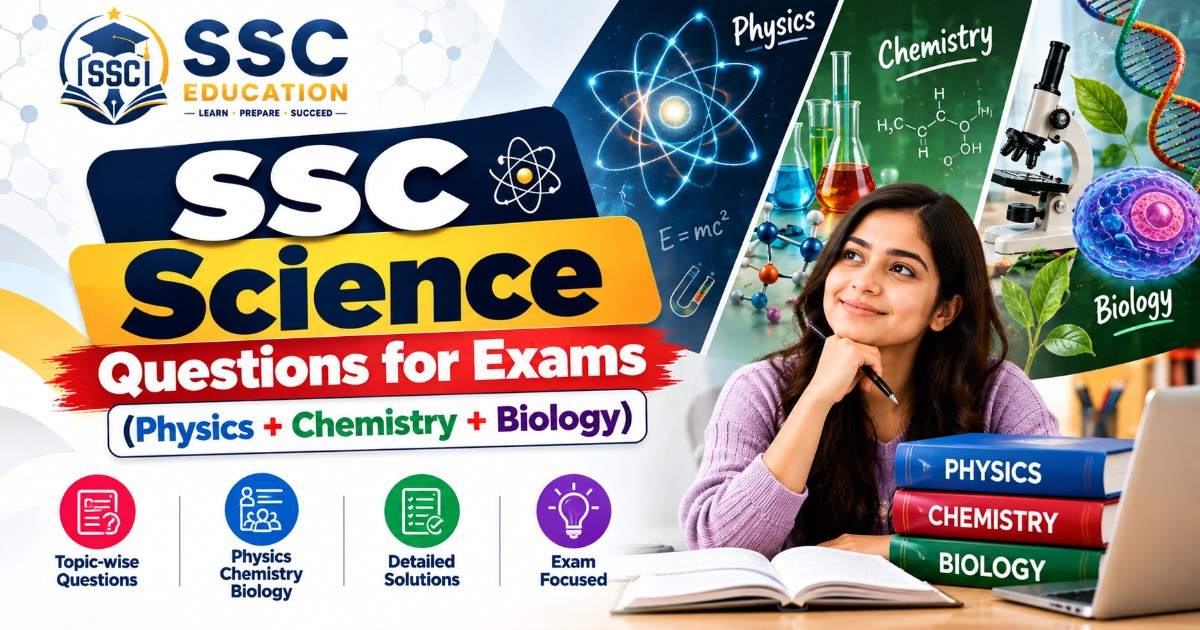
SSC Science Questions for Exams (Physics + Chemistry + Biology)
Rahul Kumar
SSC Exam Expert & Content Editor
Table of Contents
Sixty general science questions, twenty each from Physics, Chemistry and Biology, with four options and a short explanation for each answer.
General Science in SSC exams is based on the NCERT science books of classes 6 to 10. That is good news, because the concepts are simple and the same ones are repeated in different forms. If you understand the ideas instead of just memorising facts, you can answer even the questions you have never seen before.
This set has 60 questions, with 20 each from Physics, Chemistry and Biology. Every question has four options, the correct answer and a short explanation of the idea behind it.
How to use it: Attempt each subject in about 15 minutes. After that, read the explanations for every question, including the ones you got right, since the explanation often gives you a second fact for free.
Where to Focus in Each Subject
- Physics: Units, motion, light (reflection and refraction), sound, electricity and simple circuits.
- Chemistry: Acids, bases and salts, chemical and physical changes, metals and non-metals, and everyday materials such as cement, glass and soap.
- Biology: Human body systems, plants, nutrition, diseases and vitamins, and environment.
Physics (Q1–Q20)
Q1. Which of the following is a vector quantity?
(a) Speed (b) Velocity (c) Distance (d) Mass
Answer: (b) Velocity
Explanation: A vector has both magnitude and direction. Speed, distance and mass have only magnitude.
Q2. What is the SI unit of momentum?
(a) kg·m/s² (b) N·m (c) kg·m/s (d) kg/m³
Answer: (c) kg·m/s
Explanation: Momentum = mass × velocity.
Q3. The working of a rocket is based on which law?
(a) Newton's first law (b) Law of gravitation (c) Ohm's law (d) Newton's third law of motion
Answer: (d) Newton's third law of motion
Explanation: The hot gases are pushed backwards and the rocket is pushed forward by the equal and opposite reaction.
Q4. A car travels 60 km in 2 hours. What is its average speed?
(a) 30 km/h (b) 60 km/h (c) 120 km/h (d) 20 km/h
Answer: (a) 30 km/h
Explanation: Average speed = total distance ÷ total time = 60 ÷ 2.
Q5. When a ball is thrown vertically upwards, what is its velocity at the highest point?
(a) Maximum (b) Zero (c) Equal to the starting velocity (d) Infinite
Answer: (b) Zero
Explanation: The ball momentarily stops before falling back.
Q6. How much work is done when the force acts at right angles to the displacement?
(a) Maximum (b) Half of the force (c) Zero (d) Equal to force × displacement
Answer: (c) Zero
Explanation: Work = F × d × cos θ, and cos 90° = 0.
Q7. One kilowatt-hour is equal to how many joules?
(a) 3.6 × 10³ J (b) 1 × 10⁶ J (c) 36 × 10⁶ J (d) 3.6 × 10⁶ J
Answer: (d) 3.6 × 10⁶ J
Explanation: 1 kW = 1,000 J/s, and 1 hour = 3,600 seconds.
Q8. Sound cannot travel through:
(a) Vacuum (b) Water (c) Steel (d) Air
Answer: (a) Vacuum
Explanation: Sound needs a material medium to travel.
Q9. For an echo to be heard clearly, the reflecting surface should be at least how far from the source (in air)?
(a) About 5 m (b) About 17 m (c) About 34 m (d) About 100 m
Answer: (b) About 17 m
Explanation: Sound must return after at least 0.1 s. Distance = 340 × 0.1 ÷ 2 = 17 m.
Q10. Which colour of visible light has the longest wavelength?
(a) Violet (b) Green (c) Red (d) Blue
Answer: (c) Red
Explanation: Red has the longest wavelength and violet has the shortest.
Q11. A pencil appears bent when placed in a glass of water. This is due to:
(a) Reflection of light (b) Dispersion of light (c) Diffraction of light (d) Refraction of light
Answer: (d) Refraction of light
Explanation: Light bends when it goes from water to air.
Q12. A person suffering from myopia cannot see clearly:
(a) Distant objects (b) Near objects (c) Colours (d) Objects in the dark
Answer: (a) Distant objects
Explanation: Myopia is corrected using a concave lens.
Q13. What is the focal length of a plane mirror?
(a) Zero (b) Infinity (c) One metre (d) Equal to its radius
Answer: (b) Infinity
Explanation: A plane mirror does not converge or diverge light.
Q14. In which unit is the power of a lens measured?
(a) Metre (b) Watt (c) Dioptre (d) Lumen
Answer: (c) Dioptre
Explanation: Power = 1 ÷ focal length in metres.
Q15. Which of these is a poor conductor of electricity?
(a) Copper (b) Silver (c) Aluminium (d) Rubber
Answer: (d) Rubber
Explanation: Rubber is an insulator.
Q16. Two resistors of 2 Ω and 3 Ω are connected in series. What is the total resistance?
(a) 5 Ω (b) 1.2 Ω (c) 6 Ω (d) 2.5 Ω
Answer: (a) 5 Ω
Explanation: In series, resistances add up: 2 + 3 = 5 Ω.
Q17. Two resistors of 6 Ω and 3 Ω are connected in parallel. What is the total resistance?
(a) 9 Ω (b) 2 Ω (c) 4.5 Ω (d) 18 Ω
Answer: (b) 2 Ω
Explanation: Total = (6 × 3) ÷ (6 + 3) = 18 ÷ 9 = 2 Ω.
Q18. What is the power of an appliance running on 220 V and taking 5 A of current?
(a) 44 W (b) 225 W (c) 1,100 W (d) 1,000 W
Answer: (c) 1,100 W
Explanation: Power = V × I = 220 × 5 = 1,100 W.
Q19. Water is used as a coolant in engines mainly because it has:
(a) A low boiling point (b) A high density (c) A low freezing point (d) A high specific heat capacity
Answer: (d) A high specific heat capacity
Explanation: It can absorb a lot of heat without a large rise in temperature.
Q20. Which colour does the sky appear at sunrise and sunset, and why?
(a) Reddish, due to scattering of shorter wavelengths (b) Blue, due to reflection (c) Green, due to refraction (d) White, due to dispersion
Answer: (a) Reddish, due to scattering of shorter wavelengths
Explanation: Sunlight travels a longer path, and the blue light is scattered away, leaving the red.
Chemistry (Q21–Q40)
Q21. The atomic number of an element is equal to the number of:
(a) Neutrons (b) Protons (c) Electrons plus neutrons (d) Nucleons
Answer: (b) Protons
Explanation: The number of protons defines the element.
Q22. Isotopes of an element have the same:
(a) Mass number (b) Number of neutrons (c) Atomic number (d) Physical properties
Answer: (c) Atomic number
Explanation: They differ in the number of neutrons.
Q23. What is the valency of oxygen?
(a) 1 (b) 3 (c) 4 (d) 2
Answer: (d) 2
Explanation: Oxygen needs two more electrons to complete its outer shell.
Q24. What kind of bond is present in sodium chloride?
(a) Ionic bond (b) Covalent bond (c) Metallic bond (d) Hydrogen bond
Answer: (a) Ionic bond
Explanation: Sodium gives an electron to chlorine.
Q25. A covalent bond is formed by:
(a) Transfer of electrons (b) Sharing of electrons (c) Attraction between ions (d) Loss of protons
Answer: (b) Sharing of electrons
Explanation: Both atoms share pairs of electrons.
Q26. Which type of substance turns red litmus paper blue?
(a) Acid (b) Salt (c) Base (d) Neutral substance
Answer: (c) Base
Explanation: Bases turn red litmus blue.
Q27. What is formed when an acid reacts with a base?
(a) Salt and hydrogen (b) Acid and water (c) Only water (d) Salt and water
Answer: (d) Salt and water
Explanation: This reaction is called neutralisation.
Q28. Coating iron with zinc to prevent rusting is called:
(a) Galvanisation (b) Electrolysis (c) Distillation (d) Vulcanisation
Answer: (a) Galvanisation
Explanation: Zinc protects the iron underneath.
Q29. Stainless steel is an alloy of iron with which metals?
(a) Copper and zinc (b) Chromium and nickel (c) Tin and lead (d) Aluminium and magnesium
Answer: (b) Chromium and nickel
Explanation: Chromium prevents rusting.
Q30. The main raw material for cement is:
(a) Sand (b) Coal (c) Limestone (d) Gypsum only
Answer: (c) Limestone
Explanation: Limestone and clay are heated to make cement clinker.
Q31. Glass is mainly made from:
(a) Limestone (b) Clay (c) Marble (d) Silica (sand)
Answer: (d) Silica (sand)
Explanation: Sand is melted with soda and lime.
Q32. Which of the following is a greenhouse gas?
(a) Carbon dioxide (b) Nitrogen (c) Argon (d) Helium
Answer: (a) Carbon dioxide
Explanation: Carbon dioxide traps heat in the atmosphere.
Q33. Bakelite, polythene and nylon are examples of:
(a) Alloys (b) Polymers (c) Minerals (d) Fertilisers
Answer: (b) Polymers
Explanation: A polymer is made up of a large number of repeating units.
Q34. Soap is a salt of:
(a) Hydrochloric acid (b) Nitric acid (c) Fatty acids (d) Carbonic acid
Answer: (c) Fatty acids
Explanation: It is made from fats or oils with an alkali.
Q35. Hard water contains dissolved salts of:
(a) Sodium and potassium (b) Iron and zinc (c) Copper and lead (d) Calcium and magnesium
Answer: (d) Calcium and magnesium
Explanation: It does not lather easily with soap.
Q36. Distillation is used to separate:
(a) Liquids with different boiling points (b) Solids from liquids (c) Two solids (d) Gases from solids
Answer: (a) Liquids with different boiling points
Explanation: The liquid with the lower boiling point evaporates first.
Q37. Which technique is used to separate the different colours in ink?
(a) Filtration (b) Chromatography (c) Sublimation (d) Evaporation
Answer: (b) Chromatography
Explanation: The colours move at different speeds on the paper.
Q38. Which of these is a physical change?
(a) Burning of paper (b) Rusting of iron (c) Melting of ice (d) Curdling of milk
Answer: (c) Melting of ice
Explanation: No new substance is formed when ice melts.
Q39. Which of these is a chemical change?
(a) Melting of wax (b) Freezing of water (c) Dissolving sugar (d) Rusting of iron
Answer: (d) Rusting of iron
Explanation: Rust is a new substance, iron oxide.
Q40. Which of these is a fossil fuel?
(a) Coal (b) Wood (c) Biogas (d) Ethanol
Answer: (a) Coal
Explanation: Coal, petroleum and natural gas are fossil fuels.
Biology (Q41–Q60)
Q41. In which part of the plant does photosynthesis mainly take place?
(a) Roots (b) Leaves (c) Stem (d) Flowers
Answer: (b) Leaves
Explanation: Leaves contain chloroplasts with chlorophyll.
Q42. Loss of water vapour from the leaves of a plant is called:
(a) Respiration (b) Germination (c) Transpiration (d) Fertilisation
Answer: (c) Transpiration
Explanation: It happens through tiny pores called stomata.
Q43. Which tissue carries water from the roots to the leaves?
(a) Phloem (b) Cambium (c) Epidermis (d) Xylem
Answer: (d) Xylem
Explanation: Phloem carries food from the leaves to other parts.
Q44. Pollination is the transfer of pollen from:
(a) Anther to stigma (b) Stigma to ovary (c) Root to leaf (d) Ovule to anther
Answer: (a) Anther to stigma
Explanation: It can be done by wind, insects or water.
Q45. Which is NOT needed for seed germination?
(a) Water (b) Sunlight (c) Oxygen (d) Suitable temperature
Answer: (b) Sunlight
Explanation: Many seeds germinate in the dark.
Q46. Which is the liquid part of the blood?
(a) Serum only (b) Platelets (c) Plasma (d) Haemoglobin
Answer: (c) Plasma
Explanation: It makes up about 55 per cent of the blood.
Q47. The right side of the heart pumps blood to:
(a) The brain (b) The whole body (c) The kidneys (d) The lungs
Answer: (d) The lungs
Explanation: It sends deoxygenated blood to the lungs to pick up oxygen.
Q48. Which organ removes urea from the blood?
(a) Kidney (b) Liver (c) Lungs (d) Heart
Answer: (a) Kidney
Explanation: The kidney filters the blood and produces urine.
Q49. The brain and spinal cord together form the:
(a) Peripheral nervous system (b) Central nervous system (c) Endocrine system (d) Autonomic system
Answer: (b) Central nervous system
Explanation: The nerves outside them form the peripheral nervous system.
Q50. Vaccination helps the body by:
(a) Curing a disease at once (b) Providing energy (c) Building immunity against a disease (d) Killing all bacteria in the body
Answer: (c) Building immunity against a disease
Explanation: It trains the immune system to recognise a germ.
Q51. Which nutrient is the main source of energy for the body?
(a) Proteins (b) Vitamins (c) Minerals (d) Carbohydrates
Answer: (d) Carbohydrates
Explanation: Proteins are mainly for growth and repair.
Q52. In a food chain, green plants are called:
(a) Producers (b) Consumers (c) Decomposers (d) Predators
Answer: (a) Producers
Explanation: They make their own food by photosynthesis.
Q53. Which organisms break down dead plants and animals in an ecosystem?
(a) Producers (b) Decomposers (bacteria and fungi) (c) Herbivores (d) Carnivores
Answer: (b) Decomposers (bacteria and fungi)
Explanation: They return nutrients to the soil.
Q54. Which of these is a biodiversity hotspot in India?
(a) Thar Desert (b) Deccan Plateau (c) Western Ghats (d) Indo-Gangetic Plain
Answer: (c) Western Ghats
Explanation: Others include the Himalayas, Indo-Burma and the Nicobar islands.
Q55. Which chemicals are mainly responsible for depletion of the ozone layer?
(a) Carbon dioxide (b) Methane (c) Sulphur dioxide (d) Chlorofluorocarbons (CFCs)
Answer: (d) Chlorofluorocarbons (CFCs)
Explanation: CFCs were used in refrigerators and aerosols.
Q56. Which organisation publishes the Red List of threatened species?
(a) IUCN (b) WHO (c) UNEP (d) FAO
Answer: (a) IUCN
Explanation: IUCN stands for International Union for Conservation of Nature.
Q57. In which year was Project Tiger launched in India?
(a) 1963 (b) 1973 (c) 1983 (d) 1993
Answer: (b) 1973
Explanation: It was started to protect the tiger and its habitat.
Q58. Which vitamin is needed for good eyesight?
(a) Vitamin C (b) Vitamin D (c) Vitamin A (d) Vitamin K
Answer: (c) Vitamin A
Explanation: Its deficiency can cause night blindness.
Q59. Which part of the flower develops into a fruit?
(a) Petal (b) Sepal (c) Anther (d) Ovary
Answer: (d) Ovary
Explanation: The ovules inside it become seeds.
Q60. Which type of blood vessel carries blood away from the heart?
(a) Arteries (b) Veins (c) Capillaries (d) Lymph vessels
Answer: (a) Arteries
Explanation: Veins carry blood back to the heart.
How to Score Better in Science
- Read the NCERT science chapters once, and underline the definitions, units and examples.
- Make a one-page list of scientific units, discoveries and inventions and revise it every week.
- For each disease, learn three things: the cause (bacteria, virus or deficiency), the affected organ and the prevention.
- Attempt this set again after a week. If you score above 50 out of 60, your science base is in good shape.
Rahul Kumar
SSC Exam Expert & Content Editor
Rahul is a senior SSC exam strategist with 8+ years of experience helping aspirants crack CGL, CHSL and MTS exams. He writes in-depth notification breakdowns, exam pattern guides and preparation strategies.