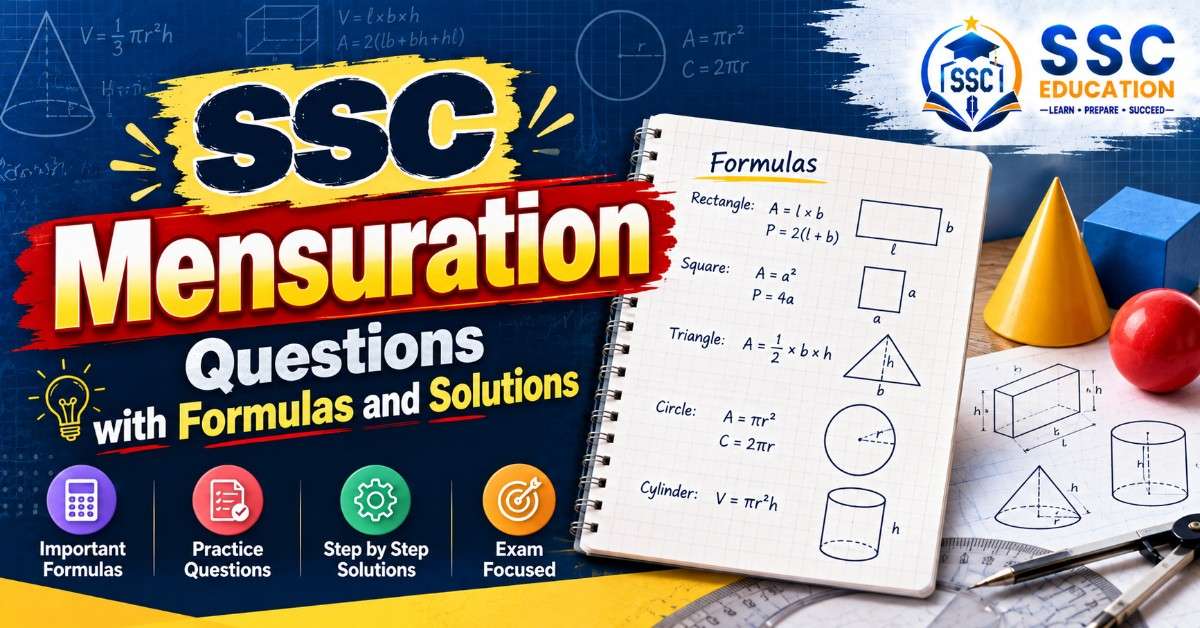
SSC Mensuration Questions with Formulas and Solutions
Rahul Kumar
SSC Exam Expert & Content Editor
Table of Contents
- 1.Practice Paper at a Glance
- 2.What Is Mensuration? Basic Concept in Simple Words
- 3.Mensuration Formulas and Shortcut Tricks for SSC
- 4.Set 1: Area and Perimeter of 2D Shapes (Q1–Q10)
- 5.Set 2: Surface Area and Volume of 3D Shapes (Q11–Q20)
- 6.Set 3: Percentage Change, Recasting and Mixed Questions (Q21–Q30)
- 7.Common Mistakes in Mensuration
- 8.How to Practice These 30 Questions
- 9.Related Topics to Study Next
- 10.Frequently Asked Questions
Practice 30 SSC mensuration questions with formulas, answers and solutions. Covers 2D shapes, cuboid, cube, cylinder, cone, sphere and percentage change in area and volume for CGL, CHSL, MTS and GD.
Mensuration is the chapter on the area, perimeter, surface area and volume of shapes. It carries three to five questions in the SSC CGL Tier 1 paper and many more in Tier 2, so it is a chapter you cannot skip. The questions are formula-based, so once your formula sheet is ready, you can solve most of them in under a minute. This practice paper gives you 30 mensuration questions with answers and short solutions. Use pi = 22/7 wherever the question does not state otherwise.
Practice Paper at a Glance
| Detail | Information |
|---|---|
| Topic | Mensuration |
| Total questions | 30 questions in 3 sets |
| Level | Easy to exam level |
| Useful for | SSC CGL, CHSL, MTS, GD, CPO and other government exams |
| Includes | Answers, step-by-step solutions, shortcut tricks and FAQs |
| Time to attempt | 35 to 40 minutes |
What Is Mensuration? Basic Concept in Simple Words
Mensuration is the branch of mathematics that measures shapes.
- 2D shapes (square, rectangle, triangle, circle, trapezium) have perimeter (boundary length) and area (space inside).
- 3D shapes (cube, cuboid, cylinder, cone, sphere) have curved or lateral surface area (CSA/LSA), total surface area (TSA) and volume.
- Units: area is in square units and volume is in cubic units. 1 cubic metre = 1,000 litres.
Mensuration Formulas and Shortcut Tricks for SSC
| Shape | Area / Perimeter |
|---|---|
| Rectangle | Area = l x b, Perimeter = 2(l + b), Diagonal = square root of (l^2 + b^2) |
| Square | Area = a^2 = d^2/2, Perimeter = 4a |
| Triangle | Area = 1/2 x base x height; Heron: square root of s(s-a)(s-b)(s-c); Equilateral: (root 3 / 4) a^2 |
| Circle | Area = pi r^2, Circumference = 2 pi r |
| Trapezium | Area = 1/2 x (sum of parallel sides) x height |
| Rhombus | Area = 1/2 x d1 x d2, side = 1/2 x square root of (d1^2 + d2^2) |
| Solid | Surface Area / Volume |
|---|---|
| Cuboid | TSA = 2(lb + bh + hl), Volume = l x b x h, Diagonal = square root of (l^2 + b^2 + h^2) |
| Cube | TSA = 6a^2, LSA = 4a^2, Volume = a^3, Diagonal = a root 3 |
| Cylinder | CSA = 2 pi r h, TSA = 2 pi r (r + h), Volume = pi r^2 h |
| Cone | CSA = pi r l, TSA = pi r (r + l), Volume = 1/3 pi r^2 h, l^2 = r^2 + h^2 |
| Sphere | Surface area = 4 pi r^2, Volume = 4/3 pi r^3 |
| Hemisphere | CSA = 2 pi r^2, TSA = 3 pi r^2, Volume = 2/3 pi r^3 |
- Percentage change: if length changes by x percent and breadth by y percent, area changes by (x + y + xy/100) percent.
- Melting and recasting: volume stays the same. Equate the volumes of the old and new solids.
- Scale rule: if every length is multiplied by k, area becomes k^2 times and volume becomes k^3 times.
Set 1: Area and Perimeter of 2D Shapes (Q1–Q10)
Q1. Find the area of a rectangle of length 15 cm and breadth 8 cm.
Answer: 120 sq cm
Solution: Area = 15 x 8 = 120 sq cm.
Q2. The diagonal of a square is 10 cm. Find its area.
Answer: 50 sq cm
Trick: Area = d^2 / 2 = 100 / 2 = 50 sq cm.
Q3. Find the area of a triangle with base 14 cm and height 9 cm.
Answer: 63 sq cm
Solution: Area = 1/2 x 14 x 9 = 63 sq cm.
Q4. Find the area of a triangle with sides 13 cm, 14 cm and 15 cm.
Answer: 84 sq cm
Trick: s = 21. Area = square root of (21 x 8 x 7 x 6) = square root of 7,056 = 84 sq cm.
Q5. Find the area of a circle of radius 7 cm.
Answer: 154 sq cm
Solution: Area = 22/7 x 7 x 7 = 154 sq cm.
Q6. The circumference of a circle is 88 cm. Find its radius.
Answer: 14 cm
Solution: 2 x 22/7 x r = 88, so r = 14 cm.
Q7. Find the area of a trapezium with parallel sides 12 cm and 18 cm and height 10 cm.
Answer: 150 sq cm
Solution: Area = 1/2 x (12 + 18) x 10 = 150 sq cm.
Q8. The diagonals of a rhombus are 16 cm and 12 cm. Find its perimeter.
Answer: 40 cm
Trick: Side = square root of (8^2 + 6^2) = 10 cm. Perimeter = 4 x 10 = 40 cm.
Q9. Find the area of an equilateral triangle of side 10 cm.
Answer: 25 root 3 sq cm (about 43.3 sq cm)
Solution: Area = (root 3 / 4) x 100 = 25 root 3 sq cm.
Q10. Find the area of a semicircle of radius 14 cm.
Answer: 308 sq cm
Solution: Area = 1/2 x 22/7 x 14 x 14 = 308 sq cm.
Set 2: Surface Area and Volume of 3D Shapes (Q11–Q20)
Q11. Find the total surface area of a cuboid of dimensions 10 cm, 8 cm and 5 cm.
Answer: 340 sq cm
Solution: TSA = 2(10 x 8 + 8 x 5 + 5 x 10) = 2(80 + 40 + 50) = 340 sq cm.
Q12. The total surface area of a cube is 150 sq cm. Find its volume.
Answer: 125 cubic cm
Trick: 6a^2 = 150, so a = 5. Volume = 5^3 = 125 cubic cm.
Q13. Find the volume of a cylinder with radius 7 cm and height 10 cm.
Answer: 1,540 cubic cm
Solution: Volume = 22/7 x 7 x 7 x 10 = 1,540 cubic cm.
Q14. Find the curved surface area of a cylinder with radius 7 cm and height 10 cm.
Answer: 440 sq cm
Solution: CSA = 2 x 22/7 x 7 x 10 = 440 sq cm.
Q15. Find the volume of a cone of radius 7 cm and height 6 cm.
Answer: 308 cubic cm
Solution: Volume = 1/3 x 22/7 x 49 x 6 = 308 cubic cm.
Q16. Find the curved surface area of a cone of radius 7 cm and slant height 25 cm.
Answer: 550 sq cm
Solution: CSA = pi r l = 22/7 x 7 x 25 = 550 sq cm.
Q17. Find the volume of a sphere of radius 21 cm.
Answer: 38,808 cubic cm
Solution: Volume = 4/3 x 22/7 x 21^3 = 4/3 x 22/7 x 9,261 = 38,808 cubic cm.
Q18. Find the surface area of a sphere of radius 7 cm.
Answer: 616 sq cm
Solution: Surface area = 4 x 22/7 x 49 = 616 sq cm.
Q19. Find the total surface area of a solid hemisphere of radius 14 cm.
Answer: 1,848 sq cm
Trick: TSA = 3 pi r^2 = 3 x 22/7 x 196 = 1,848 sq cm.
Q20. A cube of side 9 cm is melted and recast into small cubes of side 3 cm. How many small cubes are formed?
Answer: 27
Trick: Number = (9^3) / (3^3) = 729 / 27 = 27.
Set 3: Percentage Change, Recasting and Mixed Questions (Q21–Q30)
Q21. The length of a rectangle is increased by 20% and its breadth is decreased by 10%. Find the percentage change in area.
Answer: 8% increase
Trick: Net change = 20 - 10 + (20 x -10)/100 = 10 - 2 = 8% increase.
Q22. If each side of a square is increased by 10%, find the percentage increase in its area.
Answer: 21%
Trick: Net change = 10 + 10 + 100/100 = 21%.
Q23. If the radius of a circle is doubled, by what percent does its area increase?
Answer: 300%
Solution: Area becomes 4 times, so the increase = 300%.
Q24. A rectangular field is 60 m long and 40 m wide. A path 2 m wide runs inside along its boundary. Find the area of the path.
Answer: 384 sq m
Solution: Inner rectangle = 56 x 36 = 2,016. Path = 2,400 - 2,016 = 384 sq m.
Q25. A tank is 5 m long, 4 m wide and 3 m deep. How many litres of water can it hold?
Answer: 60,000 litres
Solution: Volume = 5 x 4 x 3 = 60 cubic m = 60,000 litres.
Q26. The height of a cylinder is doubled and its radius is halved. By what percent does its volume change?
Answer: 50% decrease
Trick: New volume = pi (r/2)^2 (2h) = 1/2 of the original, so it decreases by 50%.
Q27. A metal sphere of radius 6 cm is melted and recast into a cone of height 24 cm. Find the radius of the cone.
Answer: 6 cm
Solution: Sphere volume = 4/3 pi x 216 = 288 pi. Cone volume = 1/3 pi r^2 x 24 = 8 pi r^2. So r^2 = 36 and r = 6 cm.
Q28. Find the length of the diagonal of a cuboid with dimensions 3 cm, 4 cm and 12 cm.
Answer: 13 cm
Trick: Diagonal = square root of (9 + 16 + 144) = square root of 169 = 13 cm.
Q29. The perimeter of a rectangle is 36 cm and its length is 10 cm. Find its area.
Answer: 80 sq cm
Solution: l + b = 18, so b = 8 cm. Area = 10 x 8 = 80 sq cm.
Q30. Find the cost of fencing a circular field of radius 35 m at Rs 10 per metre.
Answer: Rs 2,200
Solution: Circumference = 2 x 22/7 x 35 = 220 m. Cost = 220 x 10 = Rs 2,200.
Common Mistakes in Mensuration
- Using the wrong formula for CSA and TSA (curved surface area does not include the base).
- Using the radius instead of the diameter or the other way around.
- Forgetting to convert units (cm to m, cubic m to litres).
- Using height instead of slant height in the cone surface area formula.
- Not squaring or cubing the scale factor in area and volume questions.
- Using pi = 3.14 when the numbers are designed for 22/7.
How to Practice These 30 Questions
- Prepare a formula sheet of 2D and 3D shapes and revise it daily for a week.
- Use Set 1 to warm up and Set 2 to practise 3D formulas.
- Attempt Set 3 and use shortcut methods for percentage change and melting questions.
- Practise calculations with 22/7 so that you can do them mentally.
- Revisit your mistakes and repeat the paper after seven days.
Related Topics to Study Next
Frequently Asked Questions
What is mensuration in SSC maths?
Mensuration deals with the measurement of length, area, surface area and volume of 2D and 3D shapes. It is a formula-based chapter that appears in both Tier 1 and Tier 2 of SSC CGL.
How many mensuration questions come in SSC CGL?
Tier 1 usually has three to five questions on mensuration (2D and 3D), and Tier 2 has more, so it is one of the most important chapters.
What is the difference between CSA and TSA?
Curved (or lateral) surface area excludes the top and bottom surfaces, while total surface area includes all surfaces. For a cylinder, TSA = CSA + 2 x area of the base.
What is the formula for the volume of a cone?
Volume of a cone = 1/3 x pi x r^2 x h. It is one third of the volume of a cylinder with the same base and height.
What is the formula for the volume and surface area of a sphere?
Volume = 4/3 pi r^3 and surface area = 4 pi r^2. For a hemisphere, the CSA is 2 pi r^2, the TSA is 3 pi r^2 and the volume is 2/3 pi r^3.
How do you solve melting and recasting questions?
The volume of the material does not change. Equate the volume of the original solid with the total volume of the new solids and solve for the unknown.
How do I find percentage change in area?
If the dimensions change by x percent and y percent, the area changes by x + y + xy/100 percent. Use negative values for decreases.
How many litres are there in one cubic metre?
1 cubic metre = 1,000 litres and 1 cubic centimetre = 1 millilitre. These conversions are common in tank and water questions.
Should I use 22/7 or 3.14 for pi?
Use 22/7 when the radius or diameter is a multiple of 7 and 3.14 only when the question says so. In SSC exams, 22/7 is used in most questions.
How should I prepare mensuration for SSC exams?
Memorise the formulas, practise 2D and 3D questions separately, solve one timed set daily and revise the scale and percentage change shortcuts before the exam.
Rahul Kumar
SSC Exam Expert & Content Editor
Rahul is a senior SSC exam strategist with 8+ years of experience helping aspirants crack CGL, CHSL and MTS exams. He writes in-depth notification breakdowns, exam pattern guides and preparation strategies.