
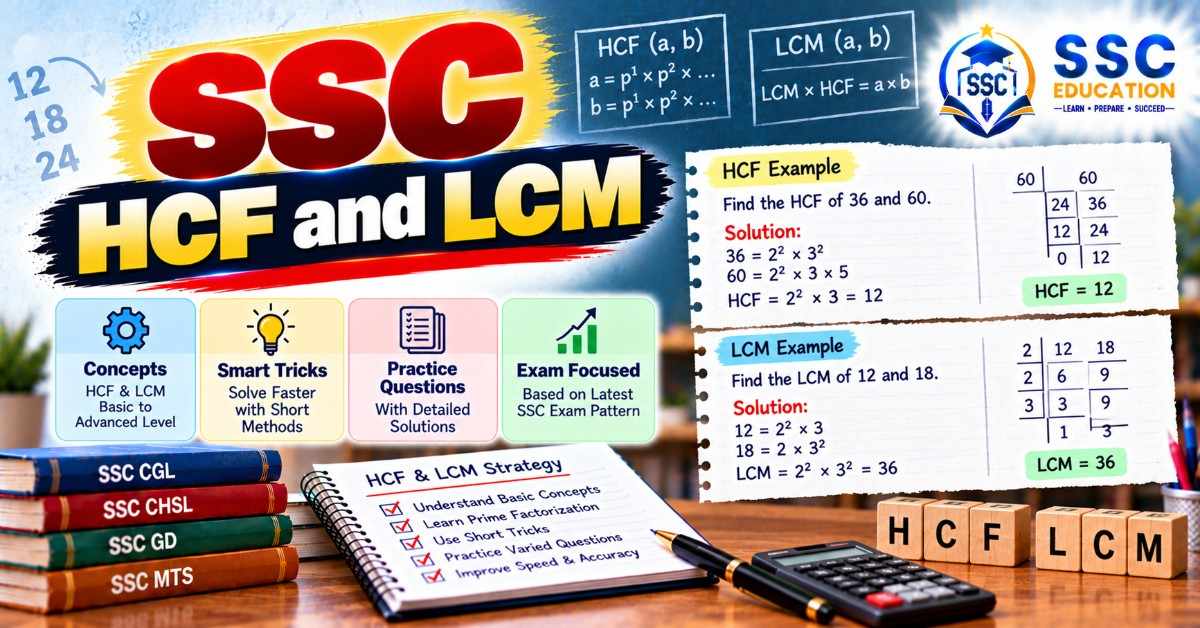
SSC HCF and LCM Questions with Answers and Tricks
Rahul Kumar
SSC Exam Expert & Content Editor
Table of Contents
- 1.Practice Paper at a Glance
- 2.What Are HCF and LCM? Basic Concept in Simple Words
- 3.Formulas and Shortcut Tricks for SSC HCF and LCM
- 4.Set 1: Basic HCF and LCM Questions (Q1–Q10)
- 5.Set 2: Remainder, Bell and Tile Questions (Q11–Q20)
- 6.Set 3: HCF and LCM of Fractions, Ratios and Mixed Questions (Q21–Q30)
- 7.Common Mistakes in HCF and LCM
- 8.How to Practice These 30 Questions
- 9.Related Topics to Study Next
- 10.Frequently Asked Questions
Practice 30 SSC HCF and LCM questions with answers, formulas and solutions. Covers remainder problems, bells, tiles, fractions and co-prime numbers for CGL, CHSL, MTS and GD.
HCF and LCM questions are a regular part of SSC CGL, CHSL, MTS and GD papers, and most of them follow a handful of patterns: remainder problems, tile and rope questions, bell problems and fraction HCF-LCM. Once you know these patterns, each question takes less than 30 seconds. This practice paper gives you 30 HCF and LCM questions with answers and short solutions, from basic to exam level.
Practice Paper at a Glance
| Detail | Information |
|---|---|
| Topic | HCF and LCM |
| Total questions | 30 questions in 3 sets |
| Level | Easy to exam level |
| Useful for | SSC CGL, CHSL, MTS, GD, CPO and other government exams |
| Includes | Answers, step-by-step solutions, shortcut tricks and FAQs |
| Time to attempt | 35 to 40 minutes |
What Are HCF and LCM? Basic Concept in Simple Words
HCF (Highest Common Factor) or GCD is the greatest number that divides two or more numbers exactly. LCM (Least Common Multiple) is the smallest number that is exactly divisible by all the given numbers.
- HCF is used when you want to divide, cut or split into equal parts (largest tile, longest rope piece).
- LCM is used when events repeat together (bells ringing, traffic lights) or when you need the smallest common multiple.
- The HCF of co-prime numbers is 1 and their LCM is their product.
Formulas and Shortcut Tricks for SSC HCF and LCM
- HCF x LCM = Product of the two numbers (only for two numbers).
- Prime factor method: HCF takes the lowest power of each common prime; LCM takes the highest power of each prime.
- Fractions: HCF = HCF of numerators / LCM of denominators. LCM = LCM of numerators / HCF of denominators.
- Largest number that divides a, b, c leaving remainders r1, r2, r3 = HCF of (a - r1), (b - r2) and (c - r3).
- Smallest number which leaves the same remainder r when divided by a, b, c = LCM(a, b, c) + r.
- Smallest number which leaves a remainder that is always k less than the divisor = LCM - k.
- Numbers in the ratio a : b with HCF h are ah and bh, and their LCM is abh.
- Largest n-digit number divisible by x: divide the largest n-digit number by x and subtract the remainder. For the smallest n-digit number, add (x - remainder).
- Euclid's method: HCF(a, b) = HCF(b, a mod b). Keep dividing till the remainder is zero.
Set 1: Basic HCF and LCM Questions (Q1–Q10)
Q1. Find the HCF of 12 and 18.
Answer: 6
Solution: Factors of 12: 1, 2, 3, 4, 6, 12. Factors of 18: 1, 2, 3, 6, 9, 18. Common greatest factor is 6.
Q2. Find the LCM of 12 and 18.
Answer: 36
Trick: HCF = 6. LCM = (12 x 18) / 6 = 36.
Q3. Find the HCF of 36, 48 and 60.
Answer: 12
Solution: 36 = 2^2 x 3^2, 48 = 2^4 x 3 and 60 = 2^2 x 3 x 5. Lowest powers: 2^2 x 3 = 12.
Q4. Find the LCM of 4, 6 and 8.
Answer: 24
Solution: Highest powers: 2^3 x 3 = 24.
Q5. The HCF of two numbers is 8 and their LCM is 96. If one number is 24, find the other.
Answer: 32
Trick: Other number = (HCF x LCM) / 24 = (8 x 96) / 24 = 32.
Q6. The product of two numbers is 2,400 and their HCF is 20. Find their LCM.
Answer: 120
Trick: LCM = Product / HCF = 2,400 / 20 = 120.
Q7. Find the HCF of 2^3 x 3^2 and 2^2 x 3^3 x 5.
Answer: 36
Solution: Lowest powers of common primes: 2^2 x 3^2 = 36.
Q8. Find the LCM of 15 and 20.
Answer: 60
Solution: 15 = 3 x 5 and 20 = 2^2 x 5. LCM = 2^2 x 3 x 5 = 60.
Q9. Find the LCM of 3, 5 and 7.
Answer: 105
Solution: They are co-prime, so LCM = 3 x 5 x 7 = 105.
Q10. Find the HCF of 84 and 126.
Answer: 42
Trick: 126 = 84 x 1 + 42 and 84 = 42 x 2. So HCF = 42.
Set 2: Remainder, Bell and Tile Questions (Q11–Q20)
Q11. Find the greatest number that divides 78 and 104 exactly.
Answer: 26
Solution: HCF of 78 and 104: 104 - 78 = 26 and 78 = 26 x 3. So HCF = 26.
Q12. Find the greatest number which divides 41 and 59 leaving a remainder 5 in each case.
Answer: 18
Trick: Required number = HCF of (41 - 5) and (59 - 5) = HCF of 36 and 54 = 18.
Q13. Find the greatest number which divides 57, 134 and 213 leaving remainders 1, 2 and 3 respectively.
Answer: 2
Solution: HCF of (57 - 1), (134 - 2) and (213 - 3) = HCF of 56, 132 and 210. HCF(56, 132) = 4 and HCF(4, 210) = 2.
Q14. Find the smallest number divisible by 6, 8 and 12.
Answer: 24
Solution: LCM of 6, 8 and 12 = 24.
Q15. Find the smallest number which leaves a remainder 3 when divided by 6, 8 and 12.
Answer: 27
Trick: LCM = 24. Required number = 24 + 3 = 27.
Q16. Find the smallest number which when divided by 6, 8 and 12 leaves remainders 5, 7 and 11 respectively.
Answer: 23
Trick: In each case divisor - remainder = 1. So the number = LCM - 1 = 24 - 1 = 23.
Q17. Find the smallest 4-digit number divisible by 12, 15 and 20.
Answer: 1,020
Solution: LCM = 60. 1,000 / 60 gives remainder 40. Add (60 - 40) = 20 to get 1,020.
Q18. Find the largest 3-digit number divisible by 6, 8 and 12.
Answer: 984
Solution: LCM = 24. 999 / 24 gives remainder 15. Subtract: 999 - 15 = 984.
Q19. Three bells ring at intervals of 6, 8 and 12 minutes. They ring together at 9:00 AM. At what time will they next ring together?
Answer: 9:24 AM
Solution: LCM of 6, 8 and 12 = 24 minutes, so the next common ring is at 9:24 AM.
Q20. A room is 6 m 40 cm long and 4 m 80 cm wide. Find the side of the largest square tile that exactly covers the floor, and the number of tiles.
Answer: 160 cm and 12 tiles
Solution: 640 cm and 480 cm. HCF = 160 cm. Number of tiles = (640/160) x (480/160) = 4 x 3 = 12.
Set 3: HCF and LCM of Fractions, Ratios and Mixed Questions (Q21–Q30)
Q21. Find the HCF of 2/3, 4/9 and 8/15.
Answer: 2/45
Trick: HCF = HCF of numerators / LCM of denominators = HCF(2, 4, 8) / LCM(3, 9, 15) = 2 / 45.
Q22. Find the LCM of 2/3, 4/9 and 8/15.
Answer: 8/3
Trick: LCM = LCM of numerators / HCF of denominators = LCM(2, 4, 8) / HCF(3, 9, 15) = 8 / 3.
Q23. Two numbers are in the ratio 3 : 4 and their LCM is 240. Find their HCF.
Answer: 20
Solution: Numbers are 3h and 4h with LCM 12h = 240, so h = 20 (the HCF).
Q24. The sum of two numbers is 84 and their HCF is 12. How many such pairs of numbers are possible?
Answer: 3 pairs
Solution: Numbers are 12a and 12b with a + b = 7 and a, b co-prime. Pairs (1, 6), (2, 5) and (3, 4) work, so 3 pairs.
Q25. The product of two co-prime numbers is 391. Find their LCM.
Answer: 391
Solution: For co-prime numbers LCM = product = 391.
Q26. Find the smallest number which leaves a remainder 5 when divided by 8, 12 and 16 and is also exactly divisible by 7.
Answer: 245
Solution: LCM = 48. Numbers of the form 48k + 5. For k = 5 we get 245 = 7 x 35, which is divisible by 7.
Q27. Find the least number which when divided by 12, 16 and 18 leaves a remainder 4 in each case.
Answer: 148
Solution: LCM = 144. Required number = 144 + 4 = 148.
Q28. Find the largest 3-digit number which leaves a remainder 7 when divided by 15, 20 and 25.
Answer: 907
Solution: LCM = 300. Numbers are 300k + 7. For k = 3 we get 907 and for k = 4 we get 1,207. So the largest 3-digit number is 907.
Q29. Find the HCF of 108 and 144 using Euclid's method.
Answer: 36
Trick: 144 = 108 x 1 + 36 and 108 = 36 x 3. So the HCF = 36.
Q30. Three ropes of lengths 36 m, 48 m and 60 m are cut into pieces of equal maximum length. What is the length of each piece and how many pieces are there in all?
Answer: 12 m and 12 pieces
Solution: HCF = 12 m. Pieces = 3 + 4 + 5 = 12.
Common Mistakes in HCF and LCM
- Using HCF x LCM = product of numbers for three numbers (it works only for two numbers).
- Using LCM for questions that need HCF, such as cutting ropes or tiles.
- Forgetting to subtract the remainder before finding the HCF in remainder problems.
- Adding the remainder in the wrong direction when divisor - remainder is constant.
- Taking highest powers in HCF or lowest powers in LCM.
- Not simplifying the fraction before applying the HCF or LCM formula for fractions.
How to Practice These 30 Questions
- Memorise the six formulas and remember when to use HCF and when to use LCM.
- Solve Set 1 in 6 minutes and make sure you understand the prime factor method.
- Attempt Set 2 and identify the type of each question before solving.
- Use Set 3 to practise fraction questions and mixed problems.
- Revise wrong answers after a day and attempt the full paper again after a week.
Related Topics to Study Next
- Number System Questions
- Ratio and Proportion Questions
- Time and Work Questions
- SSC Previous Year Papers
Frequently Asked Questions
What is the difference between HCF and LCM?
HCF is the greatest number that divides all the given numbers, while LCM is the smallest number that is divisible by all of them. HCF is always less than or equal to the smallest number and LCM is always greater than or equal to the largest number.
What is the relation between HCF and LCM?
For two numbers, HCF x LCM = product of the two numbers. This formula is used when three of the four quantities (two numbers, HCF, LCM) are known.
How do you find the HCF and LCM of fractions?
HCF of fractions = HCF of numerators / LCM of denominators. LCM of fractions = LCM of numerators / HCF of denominators, with each fraction in its simplest form.
How do you solve remainder questions using HCF?
If the greatest number divides a, b and c leaving remainders r1, r2 and r3, subtract each remainder from its number and find the HCF of the results.
How do you find the smallest number that leaves the same remainder?
Find the LCM of the divisors and add the remainder. If the divisor minus remainder is the same for every divisor (for example 1), subtract that value from the LCM instead.
When should I use HCF and when LCM in word problems?
Use HCF for splitting or cutting into the largest equal parts (tiles, ropes, groups). Use LCM when events repeat together after a certain time (bells, lights, races).
What are co-prime numbers?
Co-prime numbers are numbers whose only common factor is 1, for example 8 and 15. Their HCF is 1 and their LCM is their product.
How many HCF and LCM questions come in SSC exams?
Usually one or two questions per shift come from HCF and LCM, and the concept is also used in number system, time and work and ratio questions.
What is Euclid's algorithm for HCF?
Divide the larger number by the smaller number, then divide the divisor by the remainder and repeat until the remainder is zero. The last divisor is the HCF.
How should I prepare HCF and LCM for SSC exams?
Practise the six main patterns, memorise the formulas, solve one set daily and then try mixed questions from previous year papers.
Rahul Kumar
SSC Exam Expert & Content Editor
Rahul is a senior SSC exam strategist with 8+ years of experience helping aspirants crack CGL, CHSL and MTS exams. He writes in-depth notification breakdowns, exam pattern guides and preparation strategies.