
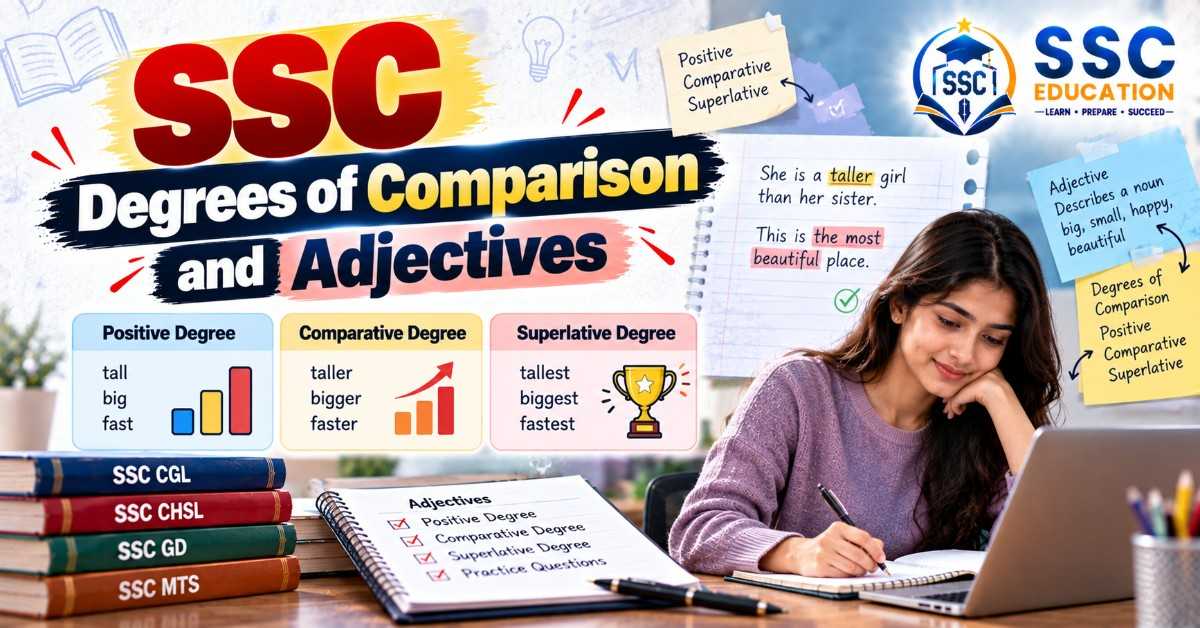
SSC Degrees of Comparison and Adjectives Questions with Answers
Rahul Kumar
SSC Exam Expert & Content Editor
Table of Contents
- 1.The Three Degrees of an Adjective
- 2.Rules and Shortcut Tricks
- 3.Set 1: Forms of Adjectives (Q1–Q7)
- 4.Set 2: Transformation of Degrees (Q8–Q14)
- 5.Set 3: Error Correction (Q15–Q21)
- 6.Rules for Forming Degrees of Comparison
- 7.Changing One Degree into Another
- 8.Common Mistakes in Degrees of Comparison
- 9.How to Practice These 21 Questions
- 10.Related Topics to Study Next
- 11.Frequently Asked Questions
Practice 21 SSC degrees of comparison and adjective questions with answers and rules. Covers positive, comparative and superlative forms, irregular adjectives, transformation and common errors.
Degrees of comparison deal with the three forms of an adjective: positive, comparative and superlative. SSC asks this topic in sentence transformation, fill in the blanks and error spotting questions. The rules are simple, but common errors such as "more better" and "any other" often cost marks. This practice paper gives you the rules and 21 questions with answers and short explanations.
The Three Degrees of an Adjective
| Degree | Use | Example |
|---|---|---|
| Positive | Describes one person or thing | Ravi is tall. |
| Comparative | Compares two | Ravi is taller than Shyam. |
| Superlative | Compares more than two | Ravi is the tallest boy in the class. |
Most short adjectives add -er and -est (tall, taller, tallest), and long adjectives use more and most (beautiful, more beautiful, most beautiful).
Rules and Shortcut Tricks
- Irregular forms: good, better, best; bad, worse, worst; much or many, more, most; little, less, least; far, farther or further, farthest or furthest; old, older or elder, oldest or eldest.
- Use than with the comparative and the with the superlative.
- Never use two comparatives together: "more better" and "more taller" are wrong.
- "Any other" is used when the person is in the same group: "He is taller than any other boy" (not "any boy").
- Of the two takes the comparative: "Of the two sisters, Rita is the taller".
- Absolute adjectives such as unique, perfect and complete have no degrees.
- Transformation: "No other boy is as tall as Ravi" = "Ravi is taller than any other boy" = "Ravi is the tallest boy".
Set 1: Forms of Adjectives (Q1–Q7)
Q1. Write the comparative degree of "good".
Answer: better
Solution: Good, better, best.
Q2. Write the superlative degree of "bad".
Answer: worst
Solution: Bad, worse, worst.
Q3. Write the comparative degree of "much".
Answer: more
Solution: Much, more, most.
Q4. Write the superlative degree of "little".
Answer: least
Solution: Little, less, least.
Q5. Fill in the blank: She is the ___ (clever) girl in the class.
Answer: cleverest
Solution: The superlative takes the.
Q6. Fill in the blank: Of the two sisters, Rita is the ___ (tall).
Answer: taller
Trick: Of the two takes the comparative.
Q7. Fill in the blank: This book is ___ (good) than that one.
Answer: better
Solution: Comparative with than.
Set 2: Transformation of Degrees (Q8–Q14)
Q8. Change into the comparative: No other boy is as tall as Ravi.
Answer: Ravi is taller than any other boy.
Solution: Positive to comparative.
Q9. Change into the superlative: Ravi is taller than any other boy.
Answer: Ravi is the tallest boy.
Solution: Comparative to superlative.
Q10. Change into the positive: Ravi is the tallest boy.
Answer: No other boy is as tall as Ravi.
Solution: Superlative to positive.
Q11. Change into the superlative: Gold is more precious than any other metal.
Answer: Gold is the most precious metal.
Solution: Comparative to superlative.
Q12. Change into the positive: He is wiser than I.
Answer: I am not as wise as he.
Solution: Comparative to positive.
Q13. Change into the comparative: Very few boys are as clever as Ram.
Answer: Ram is cleverer than most other boys.
Solution: Positive to comparative.
Q14. Change into the comparative: Iron is one of the most useful metals.
Answer: Iron is more useful than most other metals.
Solution: Superlative to comparative.
Set 3: Error Correction (Q15–Q21)
Q15. Correct the error: She is more intelligent than any other girls.
Answer: She is more intelligent than any other girl.
Solution: Any other takes a singular noun.
Q16. Correct the error: This is the most unique idea.
Answer: This is a unique idea.
Solution: Unique has no degrees.
Q17. Correct the error: He is senior than me.
Answer: He is senior to me.
Solution: Senior takes to.
Q18. Correct the error: Of the two, this is the best.
Answer: Of the two, this is the better.
Solution: Of the two takes the comparative.
Q19. Correct the error: Gold is costlier than any metal.
Answer: Gold is costlier than any other metal.
Solution: Add other for the same group.
Q20. Correct the error: The Nile is longer than any river in the world.
Answer: The Nile is longer than any other river in the world.
Solution: Add other.
Q21. Correct the error: He is the more intelligent of all the students.
Answer: He is the most intelligent of all the students.
Solution: Superlative is needed for more than two.
Rules for Forming Degrees of Comparison
- Add -er and -est to most short adjectives: tall, taller, tallest.
- Use more and most with long adjectives of three or more syllables: beautiful, more beautiful, most beautiful.
- Double the last consonant in words like big, bigger, biggest, and change y to i in words like happy, happier, happiest.
- Irregular forms: good, better, best; bad, worse, worst; far, farther or further, farthest or furthest; little, less, least; much or many, more, most.
Never use a double comparative such as "more better" or "most easiest". Use than with the comparative degree and the with the superlative degree. Words such as senior, junior, superior, inferior and prefer take to instead of than, for example "He is senior to me".
Changing One Degree into Another
SSC often asks you to change the degree without changing the meaning. The sentence "Ravi is the tallest boy in the class" can be written in the comparative as "Ravi is taller than any other boy in the class" and in the positive as "No other boy in the class is as tall as Ravi". Practise these three-way changes, because the pattern never changes: superlative becomes "taller than any other" and positive becomes "No other ... as ... as".
Common Mistakes in Degrees of Comparison
- Using more with an -er word.
- Forgetting "other" in comparisons within the same group.
- Using the comparative for more than two persons.
- Using the as...as form wrongly in transformation.
- Giving degrees to absolute adjectives like unique and perfect.
- Using "than" with the superlative.
How to Practice These 21 Questions
- Learn the irregular adjectives.
- Practise transformation of one sentence into three forms.
- Underline "than", "the" and "any other" while solving.
- Revise mistakes after a day.
Related Topics to Study Next
- Error Detection Questions
- Fill in the Blanks Questions
- Subject-Verb Agreement Questions
- SSC English Practice Set
Frequently Asked Questions
What are degrees of comparison?
They are the three forms of an adjective: positive, comparative and superlative.
When do we use the comparative degree?
When two things or persons are compared, usually with than.
When do we use the superlative degree?
When one is compared with more than two, usually with the.
What are the irregular adjectives?
Good, better, best; bad, worse, worst; much, more, most; little, less, least; far, farther or further, farthest or furthest.
Why is more better wrong?
Better is already a comparative, so more is not needed.
What does "any other" mean?
It is used when the person or thing belongs to the same group, as in taller than any other boy.
What is the difference between elder and older?
Elder is used for family members, and older is used generally with than.
What is an absolute adjective?
An adjective such as unique, perfect or complete that cannot have degrees.
How do I change the degree of a sentence?
Use the three forms: no other ... as ... as, ... -er than any other, and the -est.
How many such questions come in SSC exams?
Two to three questions in transformation and error spotting.
What is the comparative of beautiful?
More beautiful.
How should I prepare degrees of comparison for SSC exams?
Learn the rules and practise transformation daily.
Rahul Kumar
SSC Exam Expert & Content Editor
Rahul is a senior SSC exam strategist with 8+ years of experience helping aspirants crack CGL, CHSL and MTS exams. He writes in-depth notification breakdowns, exam pattern guides and preparation strategies.