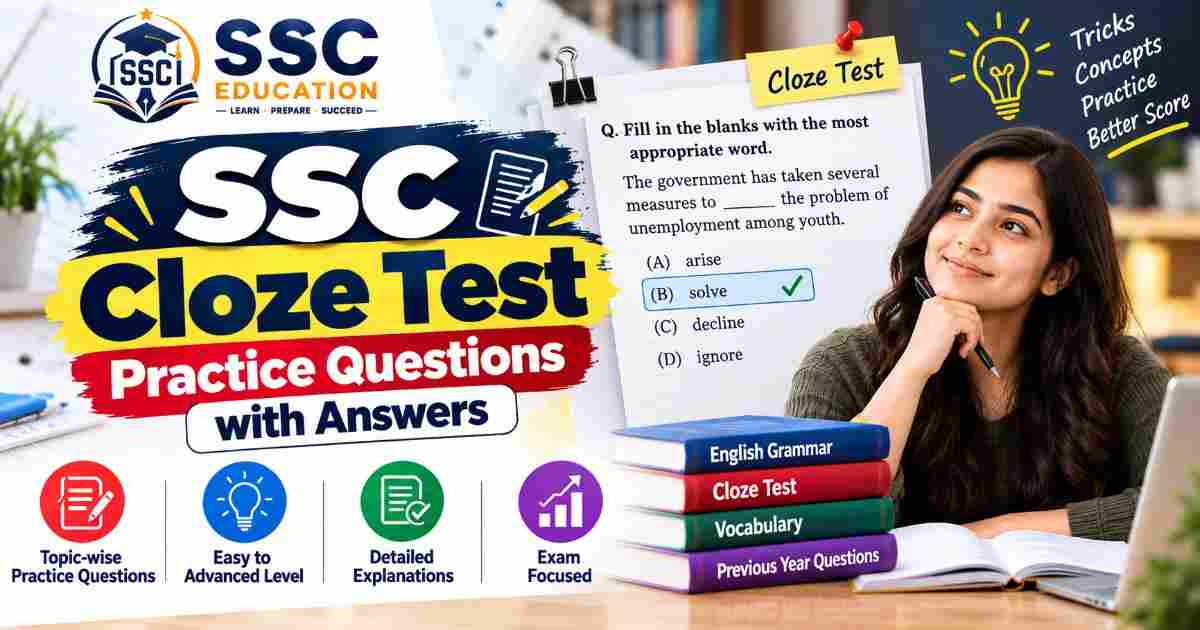
SSC Cloze Test Practice Questions with Answers
Rahul Kumar
SSC Exam Expert & Content Editor
Table of Contents
Six short passages with thirty cloze test questions, each with the answer and a one-line reason, plus simple steps for solving cloze tests.
In a cloze test, you get a short passage with some words missing. For each blank, you choose the word that fits best from four options. The passage is usually simple, but the options can be confusing because more than one word may look right at first glance.
This set has 6 passages with 5 blanks each, 30 questions in all. The passages are short and easy to read, and every answer comes with a one-line reason. Try each passage in about 5 minutes.
How to Solve a Cloze Test
- Read the whole passage first. Do not jump to the blanks. The main idea of the passage tells you whether the tone is positive or negative.
- Look at the words just before and after the blank. Often the grammar itself removes two options.
- Watch for signal words. "But", "however" and "although" show a change in direction. "Because" and "so" show a cause and effect.
- Put the answer back in. Read the sentence again with your chosen word. If it sounds odd, try the next best option.
- Do not spend too long on one blank. Make your best guess and move on.
Passage 1: The Habit of Reading
Reading is one of the most (1)____ habits a student can develop. It not only improves vocabulary but also (2)____ the mind to think clearly. Students who read daily are often better (3)____ to express their ideas. However, in the age of smartphones, many young people have (4)____ books in favour of videos. Teachers and parents should (5)____ children to spend at least thirty minutes with a book every day.
Q1. Blank (1): (a) useless (b) valuable (c) dangerous (d) ordinary
Q2. Blank (2): (a) trains (b) blocks (c) tires (d) confuses
Q3. Blank (3): (a) able (b) afraid (c) unwilling (d) slow
Q4. Blank (4): (a) preferred (b) abandoned (c) discovered (d) written
Q5. Blank (5): (a) discourage (b) forbid (c) encourage (d) warn
Passage 2: Saving Water
Water is (1)____ for all living beings, yet we often waste it without a second thought. In many parts of India, people have to (2)____ long distances to fetch a few buckets of drinking water. The problem is becoming more serious because the level of underground water is (3)____ every year. Simple steps like fixing leaking taps and (4)____ rainwater can make a big difference. If we do not (5)____ now, future generations may face a severe shortage.
Q6. Blank (1): (a) essential (b) optional (c) harmful (d) unusual
Q7. Blank (2): (a) walk (b) sleep (c) ignore (d) borrow
Q8. Blank (3): (a) rising (b) falling (c) freezing (d) improving
Q9. Blank (4): (a) wasting (b) polluting (c) harvesting (d) selling
Q10. Blank (5): (a) act (b) argue (c) wait (d) forget
Passage 3: Ravi's Journey
Ravi lived in a small village where the nearest school was five kilometres away. Every morning he had to (1)____ early to reach on time. His family was poor, but his parents were (2)____ that he should study. With hard work and (3)____, Ravi cleared the entrance exam and won a scholarship. Today he is a doctor and serves the same village that once (4)____ him. His story (5)____ us that success is possible for anyone who never gives up.
Q11. Blank (1): (a) wake up (b) give up (c) take off (d) set down
Q12. Blank (2): (a) doubtful (b) determined (c) careless (d) unaware
Q13. Blank (3): (a) laziness (b) dedication (c) luck (d) fear
Q14. Blank (4): (a) forgot (b) raised (c) feared (d) blamed
Q15. Blank (5): (a) teaches (b) hides (c) forgets (d) asks
Passage 4: Technology and Our Lives
Technology has (1)____ our lives in many ways. We can now talk to a friend living in another country within seconds. Online classes have made education (2)____ to students in remote areas. But there is a darker side too. Spending too many hours on screens can (3)____ our eyesight and sleep. Experts (4)____ that young people should use technology wisely and take regular breaks. The key is (5)____, not complete avoidance.
Q16. Blank (1): (a) transformed (b) ended (c) delayed (d) weakened
Q17. Blank (2): (a) expensive (b) accessible (c) impossible (d) unnecessary
Q18. Blank (3): (a) improve (b) damage (c) protect (d) sharpen
Q19. Blank (4): (a) advise (b) deny (c) forget (d) hide
Q20. Blank (5): (a) excess (b) balance (c) delay (d) silence
Passage 5: Value of Time
Time is the most (1)____ resource we have, because once it is gone, it can never be brought back. Successful people (2)____ their day carefully and give importance to the most urgent tasks. Students, especially, should make a timetable and (3)____ it strictly. Wasting time on unnecessary activities can (4)____ even the brightest student behind others. Remember, a small effort made every day is (5)____ than a big effort made once in a while.
Q21. Blank (1): (a) precious (b) common (c) harmless (d) cheap
Q22. Blank (2): (a) waste (b) plan (c) avoid (d) fear
Q23. Blank (3): (a) follow (b) tear (c) hide (d) forget
Q24. Blank (4): (a) push (b) leave (c) bring (d) carry
Q25. Blank (5): (a) better (b) worse (c) lesser (d) harder
Passage 6: Trees Around Us
Trees are called the lungs of the earth because they (1)____ oxygen and take in carbon dioxide. They also (2)____ the soil from being washed away during heavy rain. In cities, however, trees are being cut down (3)____ to make space for buildings and roads. This has led to a (4)____ in air quality and a rise in temperature. Every citizen should take the (5)____ of planting at least one tree every year.
Q26. Blank (1): (a) release (b) destroy (c) block (d) waste
Q27. Blank (2): (a) protect (b) invite (c) poison (d) spoil
Q28. Blank (3): (a) rapidly (b) gently (c) rarely (d) secretly
Q29. Blank (4): (a) rise (b) decline (c) growth (d) increase
Q30. Blank (5): (a) responsibility (b) advantage (c) permission (d) revenge
Answers and Explanations
Passage 1: The Habit of Reading
Q1. (b) valuable
"Valuable habits" fits the positive tone of the sentence.
Q2. (a) trains
Reading "trains" the mind to think clearly. The other words have a negative meaning.
Q3. (a) able
"Better able to express" is the natural phrase.
Q4. (b) abandoned
"Abandoned books in favour of videos" means they left books for videos.
Q5. (c) encourage
The writer wants teachers to "encourage" reading.
Passage 2: Saving Water
Q6. (a) essential
Water is "essential" (absolutely necessary) for life.
Q7. (a) walk
People "walk" long distances to fetch water.
Q8. (b) falling
The problem is serious because the water level is "falling".
Q9. (c) harvesting
"Harvesting rainwater" is a well-known way to save water.
Q10. (a) act
The warning is that we must "act" now.
Passage 3: Ravi's Journey
Q11. (a) wake up
"Wake up early" fits the sense of reaching school on time.
Q12. (b) determined
His parents were "determined" (firm) that he should study.
Q13. (b) dedication
"Hard work and dedication" is the natural pairing.
Q14. (b) raised
The village "raised" him, that is, he grew up there.
Q15. (a) teaches
The story "teaches" us a lesson.
Passage 4: Technology and Our Lives
Q16. (a) transformed
Technology has "transformed" (changed) our lives.
Q17. (b) accessible
Online classes make education "accessible" (reachable).
Q18. (b) damage
After "But there is a darker side", the verb must be negative: "damage".
Q19. (a) advise
Experts "advise" that people use technology wisely.
Q20. (b) balance
The key is "balance", not complete avoidance.
Passage 5: Value of Time
Q21. (a) precious
Time cannot come back, so it is "precious".
Q22. (b) plan
Successful people "plan" their day.
Q23. (a) follow
A timetable is meant to be "followed".
Q24. (b) leave
"Leave behind" means to make someone fall behind.
Q25. (a) better
A daily effort is "better" than an occasional one.
Passage 6: Trees Around Us
Q26. (a) release
Trees "release" oxygen into the air.
Q27. (a) protect
Roots "protect" the soil from being washed away.
Q28. (a) rapidly
"Rapidly" describes how quickly trees are being cut in cities.
Q29. (b) decline
Air quality gets worse, so we need "decline". The others suggest improvement.
Q30. (a) responsibility
A citizen "takes the responsibility" of planting a tree.
Tips to Score Well in Cloze Tests
A strong vocabulary helps, but you do not need to know every word. If you know that a passage is positive, you can quickly remove all the negative options. Read a short English article every day, and pay attention to words that go together, such as "take responsibility", "harvest rainwater" and "make a difference". These pairs appear again and again in the exam.
Once you finish, check your score: 24 or more out of 30 means you are exam-ready. If you scored less, read the explanations again and re-attempt the set after a few days.
Rahul Kumar
SSC Exam Expert & Content Editor
Rahul is a senior SSC exam strategist with 8+ years of experience helping aspirants crack CGL, CHSL and MTS exams. He writes in-depth notification breakdowns, exam pattern guides and preparation strategies.