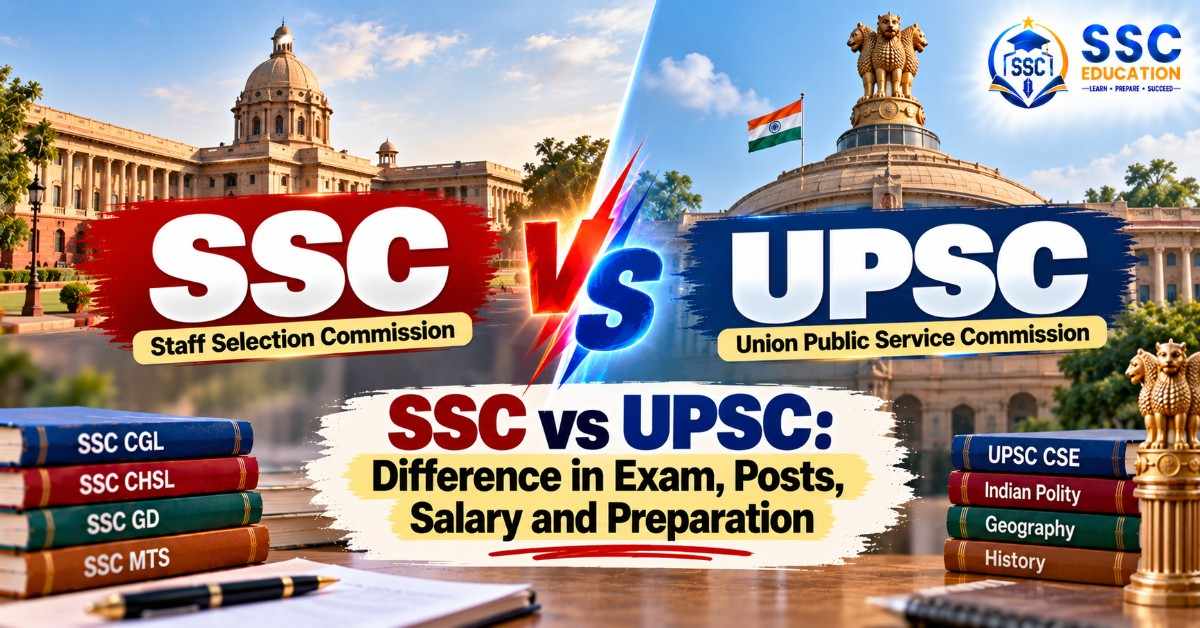
SSC vs UPSC: Difference in Exam, Posts, Salary and Preparation
SSC Education Team
Senior Educator
Table of Contents
- 1.SSC vs UPSC: Quick Comparison
- 2.Difference in the Exam Level
- 3.Salary and Perks
- 4.Preparation Strategy: How the Two Differ
- 5.Which One Should You Choose?
- 6.What Is the Real Difference in the Nature of Work?
- 7.Preparation Cost, Time and Risk
- 8.How SSC Preparation Helps in UPSC
- 9.Eligibility and Attempts: A Closer Look
- 10.Real-Life Planning Examples
- 11.Ways to Combine the Preparation Smartly
- 12.Frequently Asked Questions (FAQs)
SSC vs UPSC compared: exam stages, posts, group level, age limit, attempts, salary, preparation time and difficulty, to help you choose between SSC CGL and the UPSC Civil Services Examination.
SSC and UPSC are two of the biggest recruitment bodies for central government jobs in India, but they work at very different levels. UPSC recruits Group A officers such as IAS and IPS, while SSC recruits mainly Group B and Group C staff for ministries and departments. This guide explains the difference between the two in a simple way.
SSC vs UPSC: Quick Comparison
| Point | SSC (CGL) | UPSC (Civil Services) |
|---|---|---|
| Full name | Staff Selection Commission | Union Public Service Commission |
| Top posts | ASO, Income Tax Inspector, Assistant Enforcement Officer, Auditor | IAS, IPS, IFS and other All India and Central Services (Group A) |
| Post group | Mostly Group B and C | Group A (and some Group B) |
| Qualification | Graduation | Graduation |
| Age limit (General) | 18 to 32 years (post-wise) | 21 to 32 years |
| Number of attempts | No limit within the age limit | 6 attempts for General category (with relaxations for others) |
| Exam stages | Tier 1 and Tier 2 (and others as per post) | Prelims, Mains and Interview (Personality Test) |
| Syllabus | Maths, reasoning, English, GA | Very broad: history, polity, geography, economy, environment, ethics, optional subject |
| Preparation time | 6 to 12 months | 1 to 3 years |
| Success rate | Low | Very low |
Difference in the Exam Level
- SSC CGL tests speed and accuracy in objective questions. The syllabus is limited and well-defined.
- UPSC CSE tests deep understanding, analytical writing and personality. The syllabus is very broad and the Mains exam needs descriptive answers.
- SSC is closer to a school-level syllabus and UPSC is closer to a graduate-level and above syllabus.
Salary and Perks
- SSC posts range from Pay Level 4 to Level 8, with the Group B posts at Level 7 or 8.
- UPSC Group A services start at Pay Level 10 and rise to the top grades in the government.
- UPSC officers also get greater authority, official accommodation, vehicle and prestige along with broader responsibilities.
- SSC posts give stable jobs with steady growth and a much lower pressure than UPSC services.
Preparation Strategy: How the Two Differ
- SSC: practise maths and reasoning daily, learn grammar and vocabulary, revise static GK and current affairs, and take many mock tests.
- UPSC: read NCERT and standard books, make notes, practise answer writing, read newspapers daily and prepare an optional subject.
- You can prepare for SSC while studying for UPSC, because the Prelims has aptitude-style questions and general studies overlap with SSC GA.
Which One Should You Choose?
- If you want a high-level administrative or police role and can give 2 to 3 years of focused preparation, choose UPSC.
- If you want a stable central government job within a shorter time, choose SSC.
- If you are unsure, prepare for SSC first. The skills you build also help in UPSC Prelims.
- Use SSC as a safety net while you try UPSC, but do not mix the two strategies completely: prepare in phases.
What Is the Real Difference in the Nature of Work?
An SSC officer usually works as a part of an organisation: assisting senior officers, handling files, accounts or tax work, or doing field duties in departments like income tax and customs. The role is defined by rules and procedures, and the authority is limited to the post. A UPSC officer, especially in services such as IAS and IPS, works at the policy and administration level, with powers to take decisions, lead teams and manage districts or departments. UPSC jobs come with more responsibility, more public attention and also more pressure. SSC jobs are more stable and predictable, and their influence is limited to the department.
- SSC: supportive and middle-level roles with clearly defined duties.
- UPSC: leadership roles with higher authority and responsibility.
- Work-life balance: generally better in SSC desk jobs than in most UPSC field services.
Preparation Cost, Time and Risk
The UPSC journey is long and expensive. Most candidates need 2 to 3 years, often with coaching, test series and travel to a coaching city. The success rate is very low, so the risk is high. SSC preparation can be done in 6 to 12 months, mostly through self-study, and the cost is much lower. However, SSC has high competition in terms of the number of applicants, so you still need strong preparation. If you want a safe path, SSC is the better option. If you want to aim high and are ready to take the risk, UPSC is the exam for you. Many candidates choose both by preparing the basic subjects for UPSC and clearing SSC as a backup.
How SSC Preparation Helps in UPSC
- General awareness, polity, history and geography overlap with the UPSC Prelims.
- Reasoning and quantitative aptitude help in CSAT, which is a qualifying paper.
- The habit of mock tests and time management helps in Prelims.
- English comprehension practice helps in reading long passages in the UPSC exam.
Eligibility and Attempts: A Closer Look
Both exams need a graduation degree, but the age limit and the attempts are very different. UPSC has a minimum age of 21 years and a maximum of 32 years for General candidates, with relaxations for OBC, SC, ST and other categories, and a fixed number of attempts. SSC CGL has no fixed number of attempts, only an age limit by post. This difference changes your strategy: in UPSC, you must plan each attempt very carefully because the number is limited, while in SSC, you can improve your preparation in multiple attempts. Candidates who are at the start of their graduation should plan to build general knowledge early, because it helps in both exams.
- UPSC attempts are limited, so you should start only when you are ready to give a serious effort.
- SSC attempts are not limited, so you can use the exam to build experience.
- Both exams allow candidates from any stream with a graduation degree.
Real-Life Planning Examples
| Student profile | Suggested path |
|---|---|
| Final year student with limited savings | Start with SSC CGL while building basics for UPSC |
| Graduate with family support and strong writing skills | Prepare for UPSC with SSC as backup |
| Working professional with 3 hours daily | SSC CGL with a 8 to 10 month plan |
| Student who wants a government job quickly | SSC CGL, CHSL or other SSC exams |
Ways to Combine the Preparation Smartly
- Study NCERT books for history, geography and polity once and use them for both exams.
- Make one set of notes for static GK and use it for SSC and UPSC Prelims.
- Keep SSC maths and reasoning practice for 1 hour every day; it also helps in CSAT.
- Use the SSC exam as a practice for time-bound exams, and use UPSC Mains practice for writing skills.
Frequently Asked Questions (FAQs)
1. What is the main difference between SSC and UPSC?
SSC recruits for mainly Group B and C posts in the central government, while UPSC recruits for Group A services such as IAS and IPS.
2. Is SSC CGL easier than UPSC?
Yes. SSC CGL has a limited and objective syllabus, while UPSC has a very broad syllabus and a descriptive Mains exam with an interview.
3. Can I prepare for SSC and UPSC together?
Yes, partly. General awareness and some aptitude topics overlap, but UPSC needs much more depth and writing practice.
4. Which has a better salary, SSC or UPSC?
UPSC Group A services start at a higher pay level and have a higher growth ceiling than SSC posts.
5. Is SSC a good backup for UPSC?
Yes. Many candidates take SSC exams as a backup while preparing for UPSC.
6. What is the age limit of UPSC and SSC CGL?
UPSC CSE: 21 to 32 years for the General category. SSC CGL: depends on the post, generally 18 to 32 years.
7. How many attempts are allowed in UPSC and SSC?
UPSC has a limit of 6 attempts for General category candidates. SSC does not have an attempt limit within the age limit.
8. Is there an interview in SSC CGL?
Most CGL posts do not have an interview as part of the main process. Check the notification for exceptions.
9. How long does it take to prepare for UPSC?
Most candidates need 1 to 3 years of consistent study for the UPSC Civil Services examination.
10. Where can I start with SSC preparation?
Start with the exam pattern and syllabus, then use free notes, practice papers and previous year papers on SSC Education.
SSC Education Team
A dedicated member of the SSC Education team, committed to helping aspirants crack SSC exams with well-researched study material and exam strategy.