SSC Stenographer Grade C vs Grade D: Key Differences Explained
Rahul Kumar
SSC Exam Expert & Content Editor
Table of Contents
- 1.SSC Stenographer Grade C vs Grade D: Quick Comparison
- 2.Educational Qualification: Same for Both Grades
- 3.Shorthand Speed: The Key Skill Differentiator
- 4.Age Limit Differences
- 5.Salary Comparison in Detail
- 6.Job Profile and Posting Differences
- 7.Career Growth: Grade C vs Grade D
- 8.Which Grade Should You Choose?
- 9.Can You Apply for Both Grades in the Same Cycle?
- 10.Exam Pattern: Is It Different for Grade C and Grade D?
- 11.How to Prepare for the Higher Grade C Shorthand Speed
- 12.Frequently Asked Questions
- 13.Key Takeaways
- 14.Conclusion
- 15.Promotion Path Comparison: Grade C vs Grade D
- 16.Real Talk: Which Grade Do Most Candidates Prefer?
- 17.How Vacancy Numbers Typically Compare
- 18.Impact of Grade on Long-Term Financial Planning
- 19.Test-Taking Differences at the Skill Test Stage
- 20.Final Thought
- 21.What If You Fail to Meet the Grade C Shorthand Speed?
- 22.Physical and Mental Demands: Any Difference?
- 23.Regional and Language Considerations
- 24.Key Resources for Stenography Practice
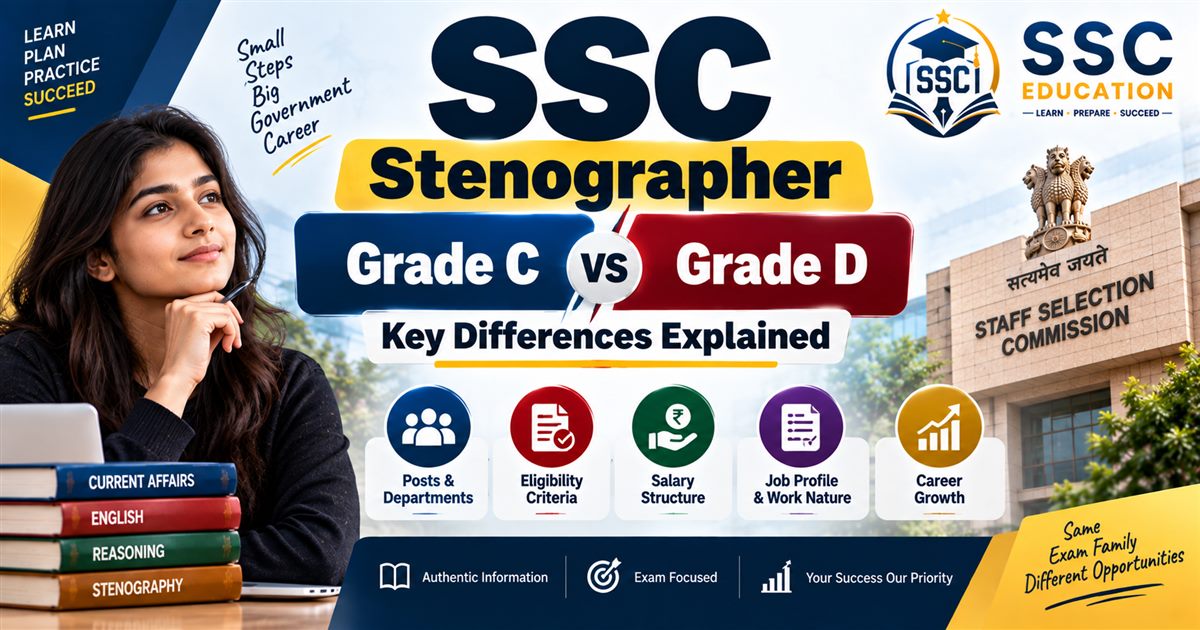
SSC Stenographer Grade C vs Grade D compared: salary, shorthand speed, age limit, career growth and which grade you should prepare for.
Quick answer: SSC Stenographer Grade C is the higher-paying, faster-growth option (Pay Level 7, ~₹51,000 in-hand, 100 wpm shorthand requirement), while Grade D offers a more stable, routine role (Pay Level 4, ~₹36,000 in-hand, 80 wpm requirement). Here's a complete comparison to help you understand which suits your goals better.
SSC Stenographer Grade C vs Grade D: Quick Comparison
| Parameter | Grade C | Grade D |
|---|---|---|
| Pay Level | Level 7 | Level 4 |
| Pay Scale | ₹44,900 – ₹1,42,400 | ₹25,500 – ₹81,100 |
| Approx. In-Hand Salary | ~₹51,000/month | ~₹36,000/month |
| Shorthand Speed Required | 100 words per minute | 80 words per minute |
| Age Limit | 18–30 years | 18–27 years |
| Typical Posting | Central government ministries/offices | Subordinate offices |
| Career Growth | Faster | Slower but stable |
Educational Qualification: Same for Both Grades
Both Grade C and Grade D require candidates to have passed Class 12 (10+2) from a recognised board. The educational bar is identical — the real differentiators are shorthand speed, age limit, pay level, and typical posting responsibilities.
Shorthand Speed: The Key Skill Differentiator
This is the most significant practical difference between the two grades. Grade C requires a shorthand dictation speed of 100 words per minute, while Grade D requires 80 words per minute. Both require transcription within a specified time limit, but Grade C's higher speed requirement demands significantly more practice and is often the deciding factor for candidates choosing which grade to prepare for.
Age Limit Differences
Grade C has a wider age window (18–30 years) compared to Grade D (18–27 years), calculated as on 1 August of the recruitment year. This means slightly older candidates who've missed the Grade D age cutoff may still be eligible for Grade C, making it accessible to a broader age range of aspirants.
Salary Comparison in Detail
Grade C's Pay Level 7 (₹44,900–₹1,42,400) translates to an approximate in-hand salary of ₹51,000 per month, factoring in DA, HRA and standard deductions. Grade D's Pay Level 4 (₹25,500–₹81,100) results in an approximate in-hand salary of ₹36,000 per month. This roughly ₹15,000 monthly difference compounds significantly over a career through annual increments and periodic DA revisions.
Job Profile and Posting Differences
Grade C Stenographers are typically posted in central government ministries and offices, working closely with senior officers on higher-stakes correspondence, meeting minutes, and administrative documentation — roles that carry more visibility and responsibility. Grade D Stenographers are generally posted in subordinate offices with more routine stenography and clerical support duties, offering a more predictable, lower-pressure work environment.
Career Growth: Grade C vs Grade D
Grade C offers faster promotional avenues given its higher starting pay level and closer proximity to central ministry hierarchies, with potential progression toward senior administrative and stenography supervisory roles. Grade D offers steadier but slower growth, with promotions typically taking longer to materialise, though the work-life balance is often considered more predictable and less demanding than Grade C postings.
Which Grade Should You Choose?
Choose Grade C If:
- You can practice and achieve 100 wpm shorthand speed with dedicated preparation
- You want higher starting pay and faster career growth
- You're comfortable with potentially higher-pressure central ministry postings
- You're within the 18–30 age bracket and want the wider eligibility window
Choose Grade D If:
- 80 wpm is a more realistic target for your current shorthand skill level
- You prioritise a stable, predictable work environment over faster growth
- You're comfortable with somewhat lower starting pay in exchange for potentially better work-life balance
Can You Apply for Both Grades in the Same Cycle?
Yes, SSC Stenographer recruitment typically allows candidates to indicate preference for both Grade C and Grade D in the same application, based on meeting the respective age and shorthand speed criteria. Many candidates prepare for the higher 100 wpm standard, which automatically qualifies them for both grades, giving them flexibility in final post allocation based on merit and preference order.
Exam Pattern: Is It Different for Grade C and Grade D?
The written exam (Computer Based Test covering General Intelligence & Reasoning, General Awareness, and English Language & Comprehension) is common for both grades. The key differentiation comes at the skill test stage, where Grade C and Grade D candidates are tested on their respective shorthand speed requirements (100 wpm vs 80 wpm) and given separate transcription time limits.
How to Prepare for the Higher Grade C Shorthand Speed
- Start with accuracy at a comfortable speed before pushing for higher words-per-minute targets — speed without accuracy leads to failed transcription tests
- Practice daily with varied dictation content (news, formal letters, speeches) to build versatility rather than memorising fixed practice passages
- Gradually increase speed in small increments (5 wpm every few weeks) rather than attempting to jump straight to 100 wpm
- Practice transcription under timed conditions regularly, since transcription speed and accuracy matter as much as dictation-taking speed itself
Frequently Asked Questions
Q1. What is the main difference between SSC Stenographer Grade C and Grade D?
Grade C requires a higher shorthand speed (100 wpm vs 80 wpm), offers higher pay (Pay Level 7 vs Level 4), and has a wider age limit (18–30 vs 18–27).
Q2. Which pays more, Grade C or Grade D?
Grade C pays more, with an approximate in-hand salary of ₹51,000 compared to Grade D's approximately ₹36,000 per month.
Q3. Is the educational qualification different for the two grades?
No, both require a minimum of Class 12 (10+2) pass from a recognised board.
Q4. Can I apply for both Grade C and Grade D together?
Yes, most candidates indicate preference for both grades in the same application, subject to meeting each grade's specific age and shorthand speed eligibility.
Q5. Is Grade D easier to clear than Grade C?
The written exam is identical; Grade D's lower shorthand speed requirement (80 wpm vs 100 wpm) makes its skill test comparatively easier to clear for candidates with moderate stenography skills.
Key Takeaways
- Grade C offers higher pay (~₹51,000 in-hand), faster growth, and requires 100 wpm shorthand speed
- Grade D offers more stability (~₹36,000 in-hand) and requires a comparatively achievable 80 wpm speed
- Educational qualification (12th pass) is identical for both grades
- Age limits differ: 18–30 for Grade C, 18–27 for Grade D
- Most candidates can apply for both grades in the same cycle, subject to eligibility
Conclusion
Choosing between SSC Stenographer Grade C and Grade D ultimately comes down to your current shorthand speed, age eligibility, and career priorities — higher pay and faster growth with Grade C's demanding 100 wpm requirement, or a more stable, achievable path with Grade D's 80 wpm standard. Since both grades share the same written exam and educational requirements, preparing for the higher Grade C speed standard while keeping Grade D as a fallback option is often the smartest strategy for maximising your options.
Promotion Path Comparison: Grade C vs Grade D
| Grade | Typical Promotion Path |
|---|---|
| Grade C | Senior Stenographer → Private Secretary → Senior Private Secretary, with potential further administrative growth |
| Grade D | Senior Stenographer (Grade D level) → gradual movement toward Grade C-equivalent responsibilities over a longer service period |
Grade C's promotion ladder generally moves faster and reaches higher administrative responsibility sooner, reflecting its higher starting pay level and closer integration with central ministry hierarchies from day one.
Real Talk: Which Grade Do Most Candidates Prefer?
Most well-prepared candidates aim for Grade C given its clear salary and growth advantages, treating Grade D as a backup option in case their shorthand speed doesn't reach the 100 wpm threshold by exam time. This is a sensible strategy since the written exam preparation is identical for both grades — the shorthand speed is the only major differentiator requiring grade-specific practice targets.
How Vacancy Numbers Typically Compare
Vacancy distribution between Grade C and Grade D varies by recruitment cycle based on departmental requirements, but Grade D often has a larger vacancy pool in a given year since more departments require Grade D-level support staff compared to the more specialised central ministry Grade C postings. Candidates should check the specific year's notification for the exact vacancy split, since this can influence your realistic chances at each grade level.
Impact of Grade on Long-Term Financial Planning
The salary gap between Grade C and Grade D (~₹15,000 per month) compounds substantially over a 30-year career when accounting for annual increments and periodic DA revisions on a higher base. Candidates who can realistically achieve the 100 wpm Grade C standard should generally prioritise this path for its stronger long-term financial trajectory, provided the higher-pressure central ministry environment aligns with their working style preferences.
Test-Taking Differences at the Skill Test Stage
Beyond the raw speed difference, Grade C's skill test often involves more complex dictation content (reflecting the more senior correspondence Grade C stenographers handle in practice), while Grade D's content, though still professional in nature, tends to be marginally more straightforward. This makes sense given the different operational contexts each grade typically serves within government offices.
Final Thought
Both SSC Stenographer Grade C and Grade D lead to secure, respected central government careers with a shared educational foundation and largely overlapping written exam preparation. Your shorthand speed capability, more than any other single factor, should guide which grade you prioritise — and given the flexibility to apply for both, there's little downside to preparing for Grade C's higher standard while Grade D remains available as a realistic fallback.
What If You Fail to Meet the Grade C Shorthand Speed?
If you qualify the written exam but fall short of 100 wpm at the skill test stage, you're generally still considered for Grade D provided you meet its 80 wpm standard and Grade D age eligibility. This built-in flexibility means preparing primarily for Grade C rarely backfires — even a shortfall in speed often still results in Grade D consideration, making the higher-target preparation strategy relatively low-risk.
Physical and Mental Demands: Any Difference?
Neither grade involves physical fitness tests like PST/PET (unlike SSC GD or CPO), since stenography is a desk-based, skill-focused role. The main demand in both grades is sustained mental focus and manual dexterity for accurate, fast shorthand transcription, with Grade C's higher speed and more senior correspondence content requiring marginally greater sustained concentration during actual duty.
Regional and Language Considerations
SSC Stenographer recruitment is typically conducted in English and Hindi shorthand streams, and candidates should choose their preferred language stream carefully based on which they can achieve higher accuracy and speed in, since switching languages after building speed in one system requires substantial re-training rather than a quick adjustment.
Key Resources for Stenography Practice
- Standard shorthand theory books matching your chosen system (Pitman or similar, as applicable)
- Daily dictation practice audio/passages at gradually increasing speeds
- A reliable typing/transcription practice tool to build transcription speed alongside shorthand-taking speed
- Previous year skill test passages, where available, to understand the actual content complexity expected
Rahul Kumar
SSC Exam Expert & Content Editor
Rahul is a senior SSC exam strategist with 8+ years of experience helping aspirants crack CGL, CHSL and MTS exams. He writes in-depth notification breakdowns, exam pattern guides and preparation strategies.