What is SSC Selection Post? Complete Guide to Phases, Eligibility, Posts & Salary
Rahul Kumar
SSC Exam Expert & Content Editor
Table of Contents
- 1.SSC Selection Post: Quick Overview
- 2.What Exactly Is SSC Selection Post?
- 3.Why Is It Called "Phase-wise"?
- 4.SSC Selection Post Eligibility Criteria
- 5.Types of Posts Under SSC Selection Post
- 6.SSC Selection Post Exam Pattern
- 7.SSC Selection Post Salary Structure
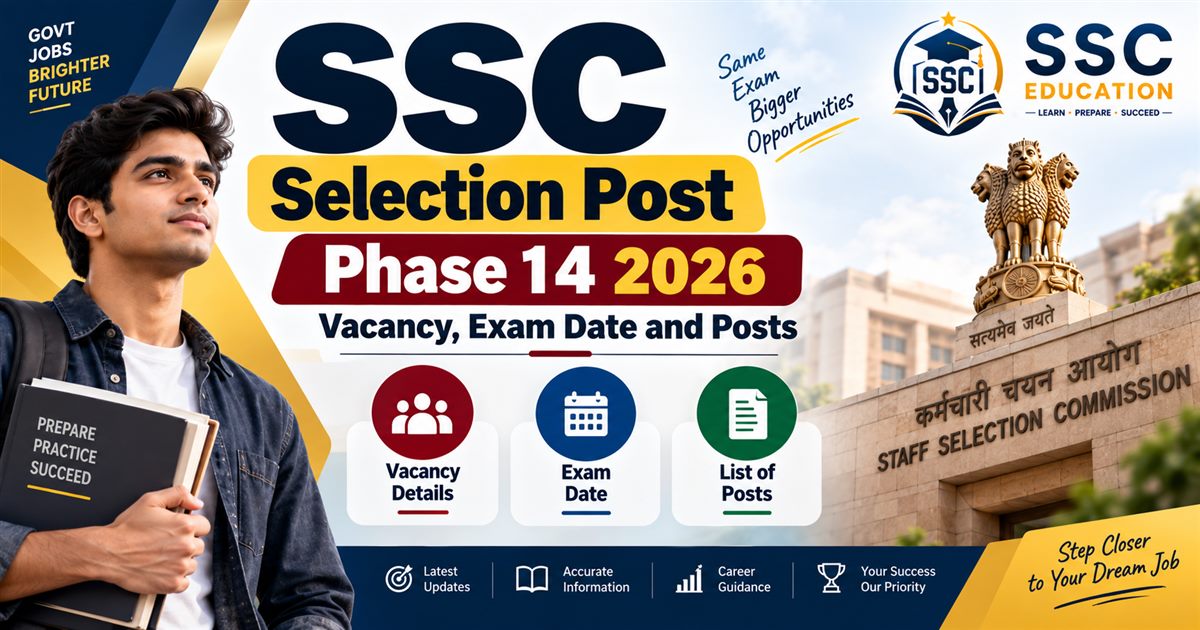
- 8.SSC Selection Post Phase 14: Current Cycle Snapshot
- 9.How SSC Selection Post Differs From Other SSC Exams
- 10.How to Apply for SSC Selection Post
- 11.Why Consider SSC Selection Post?
- 12.Frequently Asked Questions (FAQs)
- 13.Conclusion
- 14.Related Articles
SSC Selection Post is a unique exam covering Matric, 12th, and Graduate level posts across all SSC regions. Learn about phases, eligibility, posts, and salary.
If you've been researching SSC exams, you may have come across "SSC Selection Post" and wondered how it's different from more well-known exams like CGL or CHSL. Unlike those, Selection Post isn't built around one fixed set of posts — it's a flexible, multi-phase recruitment exam that fills a huge variety of Group 'B' and 'C' vacancies across different ministries, departments, and organisations, for candidates from Matriculation, Higher Secondary, and Graduate educational backgrounds all at once. Here's a complete, easy-to-understand guide to what SSC Selection Post actually is and how it works.
SSC Selection Post: Quick Overview
| Exam Name | SSC Selection Post (Phase-wise Examination) |
| Conducting Body | Staff Selection Commission (SSC) |
| Educational Levels Covered | Matriculation (10th), Higher Secondary (12th), Graduation and above |
| Current Phase | Phase 14 (2026) |
| Phase 14 Vacancies | 2,919 posts (revised from an initial 3,003) |
| Age Limit | Generally 18-30 years (varies by specific post) |
| Salary Range | Pay Level 1 to Level 7/8 (₹18,000 to ₹47,600+ basic pay) |
| Official Website | ssc.gov.in |
What Exactly Is SSC Selection Post?
SSC Selection Post is a distinct recruitment exam conducted by the Staff Selection Commission to fill Group 'B' (Non-Gazetted) and Group 'C' vacancies in various ministries, departments, and government organisations that don't have their own dedicated recruitment exam (unlike CGL for graduate-level posts or CHSL for 12th-level posts). Instead of being tied to one qualification level, Selection Post pools together vacancies across Matriculation, Higher Secondary, and Graduate levels in a single notification, spread across more than 380 different post types and all SSC regions in a typical cycle. This is what makes it unique — the same exam notification can include everything from clerical roles to technical assistant positions to translator posts, depending on what vacancies various departments have reported that year.
Why Is It Called "Phase-wise"?
SSC Selection Post is conducted in numbered phases (Phase 1, Phase 2, and so on), with each phase representing a fresh recruitment cycle covering a new set of reported vacancies. The current cycle, for instance, is referred to as "Phase 14," meaning it's the fourteenth such cycle conducted by SSC. Each phase functions as a self-contained exam with its own notification, application window, exam dates, and results — so "Phase 14" and "Phase 13" are essentially separate recruitment drives rather than stages of the same process.
SSC Selection Post Eligibility Criteria
Educational Qualification
Since Selection Post spans multiple education levels, eligibility varies by the specific post you're applying for:
- Matriculation level: Candidates who have passed Class 10 from a recognised board.
- Higher Secondary level: Candidates who have passed Class 12 (10+2) from a recognised board.
- Graduation level: Candidates holding a Bachelor's Degree, with some technical posts requiring specific diplomas or degrees (e.g., engineering, statistics).
Age Limit
The general age requirement across most Selection Post vacancies is 18 to 30 years, though this can vary depending on the specific post and the recruiting department's own norms. Standard SSC age relaxation applies for reserved categories — 3 years for OBC, 5 years for SC/ST, and further relaxation for PwBD and Ex-Servicemen candidates as per government rules.
Types of Posts Under SSC Selection Post
Because Selection Post covers vacancies from many different departments, the range of posts is unusually broad. Common examples include:
- Technical Assistant (various departments)
- Senior/Junior Translator
- Accountant / Junior Accountant
- Stenographer
- Multi-Tasking Staff (in specific organisations not covered by the regular MTS exam)
- Field Assistant, Investigator, and various clerical/support roles
The exact list of posts changes with every phase, since it depends entirely on which vacancies different ministries and departments report to SSC for that particular cycle.
SSC Selection Post Exam Pattern
The exam is conducted as a Computer-Based Test, generally covering:
- General Intelligence and Reasoning
- General Awareness
- Quantitative Aptitude
- English Language
The exact difficulty level and question distribution can vary slightly depending on whether you're applying for a Matriculation, Higher Secondary, or Graduate-level post, since SSC sets separate difficulty benchmarks appropriate to each educational level. Some specific technical posts may also require an additional skill test or document verification stage relevant to that role.
SSC Selection Post Salary Structure
Since posts under Selection Post span such a wide range of departments and qualification levels, the salary structure is correspondingly broad — anywhere from Pay Level 1 to Level 7 or 8, depending on the specific post:
| Qualification Level | Typical Pay Level | Approximate Basic Pay |
|---|---|---|
| Matriculation | Level 1-2 | ₹18,000 – ₹19,900 |
| Higher Secondary | Level 2-4 | ₹19,900 – ₹25,500 |
| Graduation | Level 4-8 | ₹25,500 – ₹47,600+ |
On top of basic pay, selected candidates receive Dearness Allowance, House Rent Allowance, Transport Allowance, and other standard central government benefits, with in-hand salaries generally ranging from around ₹25,000 for entry-level Matriculation posts up to ₹60,000 or more for higher-level Graduate posts, depending on the city of posting and applicable DA rate.
SSC Selection Post Phase 14: Current Cycle Snapshot
The ongoing Phase 14 cycle was initially announced with 3,003 vacancies, later revised to 2,919 posts spread across more than 380 different post types and all SSC regions. This kind of revision — where the vacancy count changes slightly after the initial notification — isn't unusual for Selection Post, since it depends on real-time updates from participating departments about their exact staffing needs.
How SSC Selection Post Differs From Other SSC Exams
| Aspect | SSC Selection Post | SSC CGL / CHSL |
|---|---|---|
| Qualification Levels | Matric, 12th, and Graduate — all in one notification | Fixed to one level (Graduate for CGL, 12th for CHSL) |
| Posts Covered | 380+ varied posts across many departments | A defined, fixed set of posts |
| Frequency | Conducted in numbered phases as vacancies arise | Conducted annually on a fixed cycle |
| Vacancy Source | Ad-hoc vacancies reported by various departments | Planned annual recruitment for specific cadres |
How to Apply for SSC Selection Post
- Visit the official SSC website: ssc.gov.in.
- Complete One Time Registration (OTR) if you haven't already.
- Log in and open the SSC Selection Post application form for the current phase.
- Select your preferred posts carefully, since eligibility and pay levels vary significantly across the listed options.
- Upload your photograph, signature, and required documents in the specified format.
- Pay the applicable application fee online.
- Review and submit your form, saving the confirmation page for your records.
Why Consider SSC Selection Post?
SSC Selection Post is particularly valuable for candidates who may not qualify for or prefer other fixed-cadre SSC exams, since it opens the door to a very wide variety of government departments and post types in a single application cycle. It's also a good option if you want to apply based purely on your current qualification level (Matric, 12th, or Graduate) without needing to compete specifically against candidates targeting one narrow set of posts, since the pool of opportunities is far more diverse than in CGL or CHSL.
Frequently Asked Questions (FAQs)
1. What is SSC Selection Post in simple terms?
It's a flexible SSC exam that fills a wide variety of Group B and C vacancies across different departments, for candidates with Matriculation, 12th, or Graduate qualifications, conducted in numbered phases.
2. What is the current phase of SSC Selection Post?
The ongoing cycle is Phase 14, with 2,919 vacancies across 380+ post types.
3. What is the eligibility for SSC Selection Post?
Eligibility depends on the specific post — ranging from Matriculation (10th) to Higher Secondary (12th) to Graduation, generally with an age limit of 18-30 years.
4. What is the salary range under SSC Selection Post?
Salary ranges from Pay Level 1 (around ₹18,000 basic pay) to Pay Level 7/8 (₹44,900-₹47,600+ basic pay), depending on the specific post and qualification level.
5. How is Selection Post different from CGL or CHSL?
Unlike CGL (Graduate-level) or CHSL (12th-level), Selection Post combines vacancies across all three qualification levels in one notification, covering a much wider and more varied range of posts.
6. How often is SSC Selection Post conducted?
It's conducted in numbered phases as vacancies are reported by various departments, rather than on one fixed annual schedule like CGL or CHSL.
Conclusion
SSC Selection Post is one of the most flexible and wide-reaching recruitment exams conducted by the Staff Selection Commission, offering opportunities across Matriculation, Higher Secondary, and Graduate qualification levels in a single cycle. If you're looking for government job opportunities beyond the fixed cadres of CGL or CHSL, keeping an eye on the latest Selection Post phase notification on ssc.gov.in is well worth it, given the sheer variety of posts and departments it covers.
Disclaimer: Details mentioned here are based on general SSC norms and the current Phase 14 cycle available at the time of writing, and may be updated by the Commission. Please verify all details from the official SSC notification and ssc.gov.in.
Related Articles
Rahul Kumar
SSC Exam Expert & Content Editor
Rahul is a senior SSC exam strategist with 8+ years of experience helping aspirants crack CGL, CHSL and MTS exams. He writes in-depth notification breakdowns, exam pattern guides and preparation strategies.