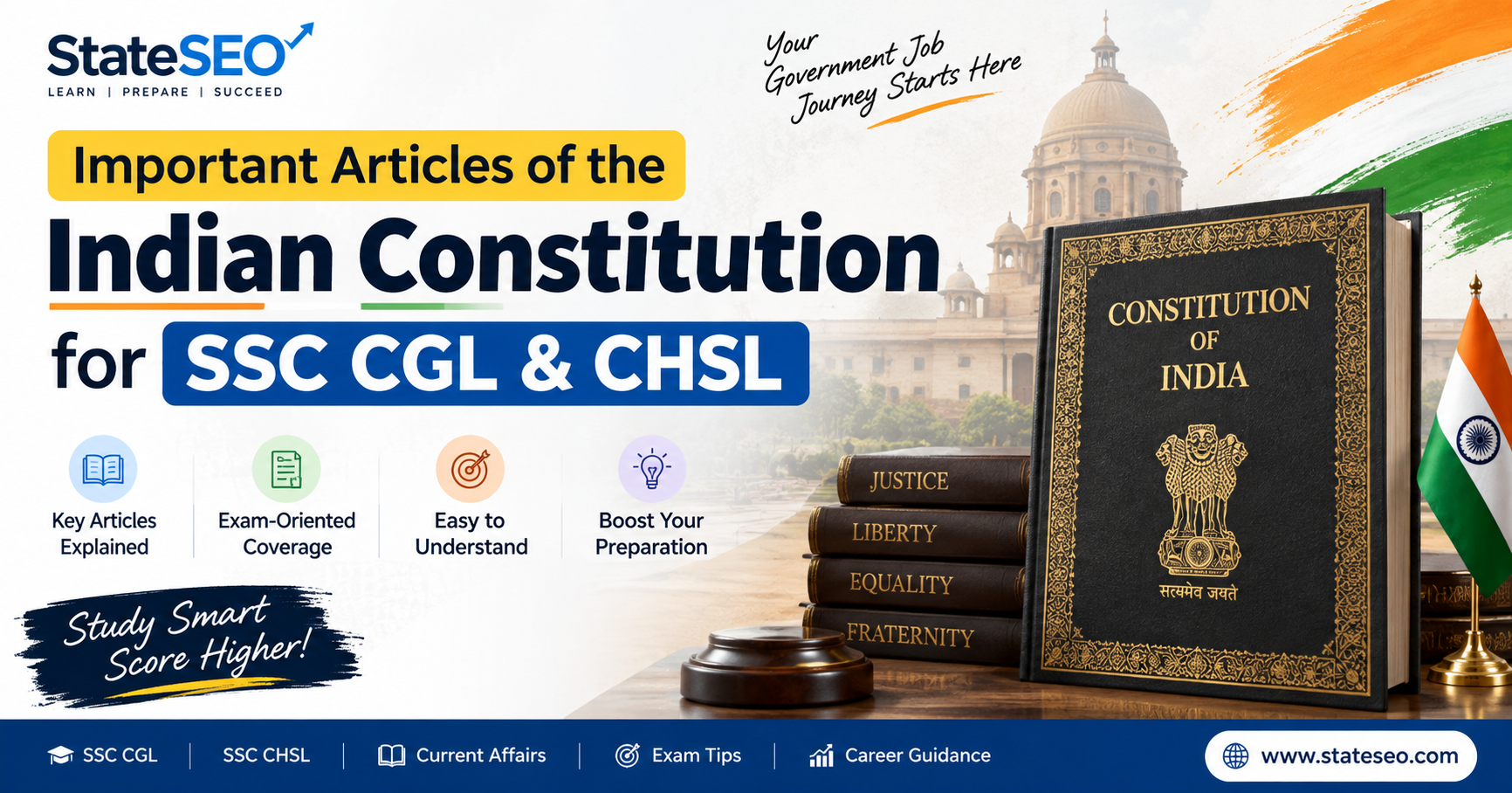
Important Articles of the Indian Constitution for SSC CGL & CHSL
Rahul Kumar
SSC Exam Expert & Content Editor
Table of Contents
- 1.Quick Answer: Which Constitution Articles Matter Most for SSC?
- 2.Important Articles of the Indian Constitution – Full List
- 3.The 12 Schedules of the Indian Constitution
- 4.Quick Revision Tips for Constitution Articles
- 5.Which Articles of the Indian Constitution are most important for SSC CGL and CHSL?
- 6.How many Fundamental Rights are there in the Indian Constitution?
- 7.How many Schedules does the Indian Constitution have?
- 8.Can I download this Constitution Articles list as a PDF?
- 9.Is Article 370 still relevant for SSC exams?
- 10.What is the best way to memorise Constitution Articles quickly?
- 11.Related Articles
A revision-ready list of important Indian Constitution Articles and all 12 Schedules for SSC CGL and CHSL, with quick memorisation tips.
Questions on the Indian Constitution are almost guaranteed in the General Awareness section of SSC CGL and SSC CHSL. Most of these questions are direct and factual — they ask which Article deals with a particular right, power or institution. That makes this topic highly scoring if you revise the right list of Articles instead of trying to read the entire Constitution.
This page lists the Articles, Parts and Schedules of the Indian Constitution that are most frequently tested in SSC exams, organised in an easy revision-table format. You can bookmark this page or use your browser’s “Print → Save as PDF” option to keep an offline copy for revision.
Quick Answer: Which Constitution Articles Matter Most for SSC?
The Articles SSC tests most often relate to Fundamental Rights (Articles 14–32), the Election Commission (Article 324), the President and Governor (Articles 52–75, 153–167), Emergency provisions (Articles 352, 356, 360), the Supreme Court and High Courts (Articles 124, 214, 226), Panchayati Raj (Articles 243 series), and the process of Constitutional Amendment (Article 368). Alongside these, the 12 Schedules and the sources of major constitutional features are frequently asked as direct one-line questions.
Important Articles of the Indian Constitution – Full List
| Article | Subject |
|---|---|
| Article 1 | Name and territory of the Union |
| Article 14 | Equality before law |
| Article 15 | Prohibition of discrimination on grounds of religion, race, caste, sex or place of birth |
| Article 16 | Equality of opportunity in public employment |
| Article 17 | Abolition of untouchability |
| Article 18 | Abolition of titles |
| Article 19 | Protection of six fundamental freedoms (speech, assembly, association, movement, residence, profession) |
| Article 20 | Protection in respect of conviction for offences |
| Article 21 | Protection of life and personal liberty |
| Article 21A | Right to Education |
| Article 22 | Protection against arrest and detention in certain cases |
| Article 23 | Prohibition of traffic in human beings and forced labour |
| Article 24 | Prohibition of employment of children in factories |
| Article 25 | Freedom of conscience and free profession, practice and propagation of religion |
| Article 29 | Protection of interests of minorities |
| Article 30 | Right of minorities to establish and administer educational institutions |
| Article 32 | Right to Constitutional Remedies |
| Articles 36–51 | Directive Principles of State Policy (DPSP) |
| Article 51A | Fundamental Duties |
| Article 52 | The President of India |
| Article 61 | Procedure for impeachment of the President |
| Article 72 | Pardoning power of the President |
| Article 74 | Council of Ministers to aid and advise the President |
| Article 76 | Attorney General for India |
| Article 79 | Constitution of Parliament |
| Article 80 | Composition of the Rajya Sabha |
| Article 81 | Composition of the Lok Sabha |
| Article 110 | Definition of a Money Bill |
| Article 123 | Power of the President to promulgate ordinances |
| Article 124 | Establishment of the Supreme Court of India |
| Article 148 | Comptroller and Auditor General of India (CAG) |
| Article 153 | Governors of States |
| Article 163 | Council of Ministers to aid and advise the Governor |
| Article 165 | Advocate General for a State |
| Article 214 | High Courts for States |
| Article 226 | Power of High Courts to issue certain writs |
| Article 243 | Constitution of Panchayats |
| Article 245 | Extent of laws made by Parliament and State Legislatures |
| Article 262 | Adjudication of disputes relating to inter-State river waters |
| Article 263 | Establishment of an Inter-State Council |
| Article 280 | Constitution of a Finance Commission |
| Article 300A | Right to Property (a legal right, not a Fundamental Right) |
| Article 315 | Public Service Commissions for the Union and States |
| Article 324 | Establishment of the Election Commission of India |
| Article 326 | Elections to the Lok Sabha and State Assemblies based on adult suffrage |
| Article 343 | Official language of the Union (Hindi in Devanagari script) |
| Article 352 | National Emergency |
| Article 356 | President’s Rule in a State (State Emergency) |
| Article 360 | Financial Emergency |
| Article 368 | Power of Parliament to amend the Constitution |
| Article 370 | Historical special status provision for Jammu & Kashmir (abrogated in 2019) |
The 12 Schedules of the Indian Constitution
| Schedule | Deals With |
|---|---|
| 1st Schedule | Names of States and Union Territories |
| 2nd Schedule | Salaries and allowances of the President, Governors, Speaker, judges and other officials |
| 3rd Schedule | Forms of oaths and affirmations |
| 4th Schedule | Allocation of seats in the Rajya Sabha |
| 5th Schedule | Administration of Scheduled Areas and Scheduled Tribes |
| 6th Schedule | Administration of tribal areas in Assam, Meghalaya, Tripura and Mizoram |
| 7th Schedule | Union List, State List and Concurrent List |
| 8th Schedule | The 22 officially recognised languages |
| 9th Schedule | Laws protected from judicial review |
| 10th Schedule | Anti-defection law |
| 11th Schedule | Powers, authority and responsibilities of Panchayats |
| 12th Schedule | Powers, authority and responsibilities of Municipalities |
Quick Revision Tips for Constitution Articles
- Group Articles by theme — Fundamental Rights, DPSP, President/Governor, Judiciary, Emergency provisions, Local Government — instead of memorising numbers randomly.
- Learn the Fundamental Rights (Articles 14–32) first, since this block is asked most frequently.
- Remember the three Emergency Articles together: 352 (National), 356 (State/President’s Rule), 360 (Financial).
- Revise the 12 Schedules as a separate short list, since SSC often asks a schedule number directly.
- Practise a few previous year GK questions on Polity to see exactly how SSC frames Article-based questions.
Frequently Asked Questions About Indian Constitution Articles for SSC
Which Articles of the Indian Constitution are most important for SSC CGL and CHSL?
Articles 14 to 32 (Fundamental Rights), Article 324 (Election Commission), Article 368 (Amendment procedure), Articles 352, 356 and 360 (Emergency provisions), and Article 124 (Supreme Court) are among the most frequently asked in SSC exams.
How many Fundamental Rights are there in the Indian Constitution?
There are 6 Fundamental Rights: Right to Equality, Right to Freedom, Right against Exploitation, Right to Freedom of Religion, Cultural and Educational Rights, and Right to Constitutional Remedies.
How many Schedules does the Indian Constitution have?
The Indian Constitution currently has 12 Schedules, covering topics ranging from the names of States and Union Territories to the Union, State and Concurrent Lists and the anti-defection law.
Can I download this Constitution Articles list as a PDF?
This page is designed as a print-friendly revision sheet. You can use your browser’s Print option and choose “Save as PDF” to keep an offline copy for quick revision before your exam.
Is Article 370 still relevant for SSC exams?
Yes, in a historical sense. Article 370, which gave special status to Jammu & Kashmir, was abrogated in August 2019. SSC exams may still ask about its original purpose and the fact of its abrogation as a static and current-affairs crossover question.
What is the best way to memorise Constitution Articles quickly?
Memorise Articles in thematic groups rather than as a single long list, revise using a table like the one on this page, and test yourself regularly by covering the subject column and recalling it from the Article number alone.
Related Articles
Rahul Kumar
SSC Exam Expert & Content Editor
Rahul is a senior SSC exam strategist with 8+ years of experience helping aspirants crack CGL, CHSL and MTS exams. He writes in-depth notification breakdowns, exam pattern guides and preparation strategies.