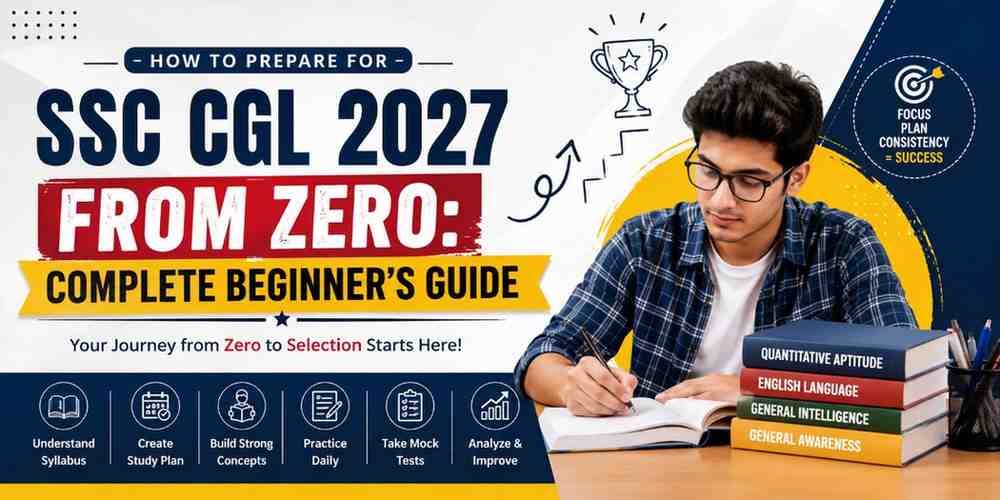
How to Prepare for SSC CGL 2027 from Zero: Complete Beginner’s Guide
Rahul Kumar
SSC Exam Expert & Content Editor
Table of Contents
- 1.Quick Answer: How to Prepare for SSC CGL 2027 from Zero?
- 2.Why Should You Know Tier-II From the Beginning?
- 3.Quantitative Aptitude
- 4.Reasoning
- 5.English
- 6.General Awareness
- 7.Recommended Maths Sequence
- 8.Grammar
- 9.Vocabulary
- 10.Practice
- 11.Static GK
- 12.Current Affairs
- 13.Phase 1: Foundation
- 14.1. Starting Without the Syllabus
- 15.2. Collecting Too Many Resources
- 16.3. Watching Lectures All Day
- 17.4. Ignoring PYQs
- 18.5. Avoiding Weak Subjects
- 19.6. Leaving GK Until the End
- 20.7. Ignoring English
- 21.8. Taking Mock Tests Without Analysis
- 22.9. Changing Teachers and Books Constantly
- 23.10. Studying Without Revision
- 24.Can I prepare for SSC CGL 2027 from zero?
- 25.When should I start preparing for SSC CGL 2027?
- 26.How many hours should I study for SSC CGL 2027?
- 27.Which subject should I study first for SSC CGL?
- 28.Is SSC CGL Maths difficult for beginners?
- 29.Should I solve SSC CGL previous year papers?
- 30.When should I start mock tests?
- 31.Can I clear SSC CGL without coaching?
- 32.How should I prepare General Awareness for SSC CGL 2027?
- 33.Is Tier-II important for SSC CGL?
- 34.What is the best strategy for SSC CGL beginners?
- 35.Related Articles
Preparing for SSC CGL 2027 from zero can seem difficult if you have never prepared for a competitive examination before. This guide explains the syllabus, strategy, and daily timetable for beginners.
Preparing for SSC CGL 2027 from zero can seem difficult, especially if you have never prepared for a competitive examination before. Many beginners are confused about where to start, which subjects to study first, how many hours to study, which books to use, when to start mock tests and how to complete the syllabus.
The good news is that you do not need to be an expert to begin your SSC CGL preparation.
You need a clear strategy, the right study material, regular practice, previous year questions, mock tests and consistent revision.
If you are planning to appear for SSC CGL 2027, starting early gives you an important advantage. You can build your fundamentals properly instead of trying to complete the entire syllabus in a hurry.
This guide explains how to prepare for SSC CGL 2027 from zero, including the syllabus, subject-wise strategy, daily timetable, study plan, previous year questions, mock-test strategy, revision techniques and common mistakes beginners should avoid.
Important: SSC has not yet released the official SSC CGL 2027 notification. Therefore, official 2027 dates, vacancies and any changes in the examination scheme should be checked on the SSC website when the notification is released. The preparation strategy below is based on the latest official SSC CGL examination scheme and syllabus available at the time of writing.
Quick Answer: How to Prepare for SSC CGL 2027 from Zero?
If you are a complete beginner, follow this preparation sequence:
1. Understand the SSC CGL examination.
2. Download and study the official syllabus.
3. Take one diagnostic mock test.
4. Identify your strong and weak subjects.
5. Build basic concepts in Maths, Reasoning and English.
6. Study General Awareness consistently.
7. Start solving SSC previous year questions topic-wise.
8. Create short revision notes.
9. Begin sectional tests after building your basics.
10. Gradually move to full-length mock tests.
11. Analyse every mistake.
12. Revise repeatedly before the examination.
The biggest mistake beginners make is trying to study everything simultaneously.
Instead, follow:
Learn → Practise → Solve PYQs → Analyse → Revise → Test
This simple cycle should remain at the centre of your SSC CGL 2027 preparation.
What Is SSC CGL?
The Staff Selection Commission Combined Graduate Level (SSC CGL) Examination is conducted by the Staff Selection Commission for recruitment to various Group B and Group C posts in government ministries, departments and organisations.
The examination is highly competitive, so preparation should not be limited to simply completing the syllabus. You also need to develop speed, accuracy, question-selection ability and exam temperament.
SSC’s official examination information and syllabus should always be treated as the final authority for the applicable year.
SSC CGL 2027: What Should You Know Right Now?
At the time of writing, the SSC CGL 2027 official notification has not been released.
Therefore, do not rely on websites claiming confirmed 2027:
· Vacancy numbers
· Application dates
· Exam dates
· Cut-offs
· Changes in exam pattern
· Eligibility changes
until SSC officially publishes them.
The SSC examination calendar is the appropriate place to monitor upcoming examination schedules, while the official CGL notification will provide the final details applicable to the 2027 examination.
What can you prepare now?
You can start preparing for the core subjects:
· Quantitative Aptitude
· Reasoning
· English
· General Awareness
· Current Affairs
· Computer Knowledge
· Previous Year Questions
· Mock Tests
Even if SSC changes a minor part of the examination pattern, strong fundamentals will continue to help.
SSC CGL Exam Pattern: Understand It Before Preparing
The latest official SSC CGL scheme available shows a two-tier computer-based examination structure consisting of Tier-I and Tier-II. Tier-I includes four sections:
· General Intelligence and Reasoning
· General Awareness
· Quantitative Aptitude
· English Comprehension
The official scheme specifies 25 questions per section, for 100 questions and 200 marks in total, with a one-hour duration under the stated scheme and 0.50 negative marking for each wrong answer.
|
Tier-I Subject |
Questions |
Marks |
|
General Intelligence & Reasoning |
25 |
50 |
|
General Awareness |
25 |
50 |
|
Quantitative Aptitude |
25 |
50 |
|
English Comprehension |
25 |
50 |
|
Total |
100 |
200 |
Note: The exact SSC CGL 2027 examination scheme should be confirmed from the 2027 notification when released.
Why Should You Know Tier-II From the Beginning?
A common beginner mistake is to prepare only for Tier-I.
The latest official SSC scheme shows that Tier-II Paper-I covers:
· Mathematical Abilities
· Reasoning and General Intelligence
· English Language and Comprehension
· General Awareness
· Computer Knowledge
· Data Entry Speed Test
Paper-II is applicable to candidates for specific statistical posts.
Therefore, your long-term preparation should be designed with both Tier-I and Tier-II requirements in mind.
Step 1: Start With the SSC CGL 2027 Syllabus
Before buying books or watching hundreds of lectures, download the official syllabus.
The SSC syllabus gives you a roadmap of what you actually need to prepare. SSC maintains an official syllabus section where candidates can check examination-specific syllabus information.
Your main Tier-I preparation areas are:
Quantitative Aptitude
Important areas include:
· Number System
· Percentage
· Ratio and Proportion
· Average
· Profit and Loss
· Discount
· Interest
· Time and Work
· Time and Distance
· Algebra
· Geometry
· Mensuration
· Trigonometry
· Data Interpretation
Reasoning
Important areas include:
· Analogy
· Classification
· Series
· Coding-Decoding
· Venn Diagrams
· Blood Relations
· Direction Sense
· Non-Verbal Reasoning
· Figural Classification
· Problem Solving
· Mathematical Operations
· Embedded Figures
English
Focus on:
· Grammar
· Vocabulary
· Synonyms
· Antonyms
· One Word Substitution
· Idioms and Phrases
· Error Detection
· Fill in the Blanks
· Sentence Improvement
· Active and Passive Voice
· Direct and Indirect Speech
· Cloze Test
· Reading Comprehension
General Awareness
Prepare areas such as:
· History
· Geography
· Polity
· Economics
· General Science
· Culture
· Static GK
· Current Affairs
· Important government schemes
· Awards
· Sports
· Important national and international events
The exact syllabus for SSC CGL 2027 should be checked against the official notification once released.
Step 2: Take a Mock Test Before Serious Preparation
If you are starting from zero, take one SSC CGL mock test at the beginning.
Your score does not matter at this stage.
The purpose is to understand your current level.
Check:
· How much Maths do you know?
· How good is your English?
· Can you solve Reasoning questions?
· How much GK do you remember?
· How quickly do you solve questions?
· How many questions do you get wrong?
· Which subjects consume most of your time?
For example, if your first mock score is low, do not become discouraged.
That score is simply your starting point.
Your objective is to make the score improve month after month.
Step 3: Build Your Basics From Zero
If your fundamentals are weak, do not immediately jump into difficult questions.
Start from basic concepts.
For example, in Maths:
Percentage → Ratio → Average → Profit & Loss → Interest → Time & Work
In English:
Basic Grammar → Vocabulary → Sentence Correction → Comprehension
In Reasoning:
Basic Patterns → Topic Practice → PYQs → Timed Questions
The correct sequence is:
Concept → Examples → Basic Questions → SSC PYQs → Timed Practice
Do not confuse watching a lecture with learning a topic.
A topic is not complete until you can solve questions from it.
Step 4: Make Previous Year Questions a Core Part of Preparation
SSC CGL previous year questions are extremely important.
Do not wait until you complete the entire syllabus.
Suppose you complete Percentage in Maths.
Immediately solve SSC questions related to Percentage.
Then identify:
· Repeated concepts
· Common question patterns
· Difficult question types
· Calculation-heavy questions
· Your mistakes
Do the same for English and Reasoning.
PYQs help you move from theoretical preparation to actual exam-oriented preparation.
SSC CGL 2027 Maths Preparation Strategy
For beginners, Maths can initially feel difficult.
The solution is not to avoid Maths.
The solution is to build your fundamentals gradually.
Recommended Maths Sequence
Start with:
1. Number System
2. Simplification
3. Percentage
4. Ratio and Proportion
5. Average
6. Profit and Loss
7. Discount
8. Simple Interest
9. Compound Interest
10. Time and Work
11. Time, Speed and Distance
12. Mixture and Alligation
13. Algebra
14. Geometry
15. Mensuration
16. Trigonometry
17. Data Interpretation
Do not try to memorise shortcuts before understanding the basic method.
First learn the concept.
Then solve questions.
Then learn faster approaches.
Maths Practice Formula
Concept + PYQs + Timed Practice + Revision
This approach is much more useful than simply watching multiple Maths lectures.
SSC CGL 2027 Reasoning Preparation Strategy
Reasoning improves significantly through practice.
Start with relatively straightforward topics and gradually increase difficulty.
Focus on:
· Analogy
· Classification
· Number Series
· Alphabet Series
· Coding-Decoding
· Blood Relations
· Direction Sense
· Venn Diagram
· Syllogism
· Mathematical Operations
· Non-Verbal Reasoning
· Figure-Based Questions
Once you understand a topic, solve SSC PYQs.
The objective is to reach a stage where you can recognise the question pattern quickly.
SSC CGL 2027 English Preparation Strategy
English should be studied every day.
Divide your preparation into three areas.
Grammar
Focus on:
· Parts of Speech
· Tenses
· Articles
· Prepositions
· Pronouns
· Subject-Verb Agreement
· Conjunctions
· Active and Passive Voice
· Direct and Indirect Speech
Vocabulary
Prepare:
· Synonyms
· Antonyms
· One Word Substitution
· Idioms and Phrases
· Important vocabulary from PYQs
Practice
Solve:
· Error Detection
· Fill in the Blanks
· Sentence Improvement
· Cloze Tests
· Reading Comprehension
· Vocabulary Questions
Instead of trying to memorise hundreds of words in one day, learn a manageable number every day and revise them regularly.
SSC CGL 2027 General Awareness Preparation Strategy
General Awareness should be prepared consistently.
Do not leave the entire subject for the last few weeks.
Divide it into two broad areas.
Static GK
Study:
· History
· Geography
· Polity
· Economics
· General Science
· Culture
· Important facts
Current Affairs
Follow important current events related to:
· Government schemes
· Awards
· Appointments
· Sports
· National events
· International events
· Important organisations
· Important reports
· Science and technology
Make short notes.
For example:
Award → Winner → Category → Year
Scheme → Ministry → Objective
Appointment → Person → Organization
This format makes revision much easier.
How Many Hours Should You Study for SSC CGL 2027?
There is no fixed number of hours that guarantees selection.
The right study duration depends on:
· Your current level
· Available time
· College/job
· Strengths and weaknesses
· Preparation timeline
For a beginner, 4–6 focused hours per day can be a practical target if you can maintain it consistently.
Studying for 6 focused hours is better than sitting with books for 10 hours while being distracted.
Your preparation should include:
Learning + Practice + PYQs + Revision + Tests
SSC CGL 2027 Daily Timetable for Beginners
If you can study approximately six hours per day, try this structure:
|
Activity |
Time |
|
Maths |
90 minutes |
|
English |
60 minutes |
|
Reasoning |
60 minutes |
|
General Awareness |
60 minutes |
|
PYQs/Practice |
60 minutes |
|
Revision |
30 minutes |
|
Total |
6 hours |
You can adjust this according to your strengths.
For example, if Maths is your weakest subject, give it additional time.
If English is already strong, use that time for another weaker subject.
SSC CGL 2027 Study Plan for Beginners
If you are starting early, divide your preparation into phases.
Phase 1: Foundation
Duration: 6–8 Weeks
Focus on:
· Basic Maths
· Basic Reasoning
· English grammar
· Vocabulary
· Static GK
· Current affairs
· Topic-wise PYQs
Do not worry about getting extremely high mock scores.
Your goal is to build a strong foundation.
Phase 2: Syllabus Completion
Duration: 8–12 Weeks
Now increase the difficulty.
Focus on:
· Remaining topics
· Topic-wise PYQs
· Mixed practice
· Sectional tests
· Revision
· Weak areas
Maintain a notebook for mistakes.
Phase 3: Intensive Practice
Once you have completed most of the syllabus, increase:
· Sectional tests
· Full-length mocks
· Previous year papers
· Timed practice
· Revision
· Error analysis
At this stage, your goal should be improving speed and accuracy.
Phase 4: Final Revision
When the examination approaches, reduce unnecessary resource collection.
Focus on:
· Formulas
· Important concepts
· Vocabulary
· GK notes
· Current affairs
· PYQs
· Mock tests
· Mistake notebook
Do not continuously change your preparation strategy.
6-Month SSC CGL 2027 Preparation Plan
If you have approximately six months, use a compressed strategy.
Month 1
· Build fundamentals
· Start Maths
· Start English
· Start Reasoning
· Begin GK
· Start PYQs
Month 2
· Continue core topics
· Increase question practice
· Start sectional tests
Month 3
· Complete major syllabus areas
· Increase PYQ practice
· Start regular mocks
Month 4
· Complete remaining topics
· Focus on weak areas
· Increase mock frequency
Month 5
· Full-length tests
· PYQ revision
· Error analysis
· Formula and vocabulary revision
Month 6
· Intensive revision
· Full mocks
· Previous year papers
· Weak-topic revision
· Exam strategy
12-Month SSC CGL 2027 Preparation Plan
If you are starting approximately one year before the examination, you have a significant advantage.
Months 1–3: Foundation
Build strong concepts in:
· Maths
· Reasoning
· English
· GK
Months 4–6: Syllabus + PYQs
Complete the major syllabus and solve topic-wise PYQs.
Months 7–9: Practice
Increase:
· Sectional tests
· Mixed questions
· Full mocks
· Revision
Months 10–12: Exam Mode
Focus on:
· Mock tests
· Previous year papers
· Speed
· Accuracy
· Mistake correction
· Revision
This longer approach is particularly useful for beginners because you have enough time to revisit difficult topics.
How to Use Mock Tests for SSC CGL 2027
Taking a mock test is only half the job.
Analysis is where improvement happens.
After every test, classify your mistakes.
Type 1: Conceptual Mistake
You did not understand the topic.
Action: Revise the concept.
Type 2: Calculation Mistake
You knew the method but made an arithmetic error.
Action: Practise calculations.
Type 3: Silly Mistake
You knew the answer but marked the wrong option.
Action: Slow down slightly and improve attention.
Type 4: Time Management Problem
You spent too long on one question.
Action: Practise timed questions and learn when to move on.
Type 5: Guessing Error
You attempted questions without sufficient confidence.
Action: Improve question selection and accuracy.
Maintain a Mistake Notebook containing these errors.
Revise it regularly.
How Many Mock Tests Should You Take?
There is no fixed number of mock tests required for selection.
Instead of asking:
“How many mocks should I take?”
ask:
“Am I improving after every mock?”
A candidate who takes 50 tests without analyzing them may improve less than someone who takes fewer tests but carefully studies every mistake.
Your mock-test cycle should be:
Mock → Analyze → Identify Weakness → Practice → Revise → Mock Again
Best Books and Study Material for SSC CGL 2027
Do not make the mistake of collecting too many books.
For each subject, try to keep:
· One reliable concept resource
· One PYQ book/resource
· One mock-test source
· One revision notebook
Your resources should cover:
Math's
Concepts + PYQs + practice questions
Reasoning
Concepts + PYQs + practice sets
English
Grammar + vocabulary + PYQs + comprehension
General Awareness
Static GK + current affairs + revision notes
The best resource is the one you actually complete, practice and revise.
Can I Prepare for SSC CGL 2027 Without Coaching?
Yes.
Coaching is not compulsory for SSC CGL preparation.
You can prepare through:
· Self-study
· Online lectures
· Books
· Previous year papers
· Mock tests
· Study notes
· Current affairs resources
However, coaching can be useful if you struggle to understand concepts independently or have difficulty maintaining a structured study routine.
The important thing is not whether you study through coaching or self-study.
The important thing is whether your preparation includes:
Concepts + Practice + PYQs + Tests + Revision
Can a Weak Student Clear SSC CGL?
Yes.
Your current level does not permanently determine your result.
A beginner may initially struggle with:
· Maths
· English
· Speed
· GK
· Accuracy
But these skills can improve through systematic practice.
Instead of asking:
“Am I good enough for SSC CGL?”
ask:
“Am I improving every month?”
Track your:
· Mock score
· Accuracy
· Attempts
· Time taken
· Subject-wise performance
· Repeated mistakes
Improvement is a better indicator than your first mock score.
Common Mistakes to Avoid During SSC CGL 2027 Preparation
1. Starting Without the Syllabus
You may spend weeks studying topics that are less important while ignoring important areas.
2. Collecting Too Many Resources
More books do not automatically mean better preparation.
3. Watching Lectures All Day
Learning without solving questions is incomplete preparation.
4. Ignoring PYQs
Previous year questions should be an important part of your strategy.
5. Avoiding Weak Subjects
Do not study only the subjects you enjoy.
6. Leaving GK Until the End
General Awareness requires repeated revision.
7. Ignoring English
English can become a strong scoring area with consistent practice.
8. Taking Mock Tests Without Analysis
Your score tells you where you are.
Your analysis tells you how to improve.
9. Changing Teachers and Books Constantly
Give your resources enough time before deciding to change them.
10. Studying Without Revision
Information that is not revised is easy to forget.
How to Improve Speed and Accuracy for SSC CGL
SSC CGL preparation is not only about knowing the answers.
You also need to answer efficiently.
Use this progression:
Stage 1
Focus on accuracy.
Stage 2
Improve question-solving speed.
Stage 3
Practise under time pressure.
Stage 4
Learn question selection.
Stage 5
Take full-length mocks.
Do not sacrifice accuracy simply to increase attempts.
Because the official scheme includes negative marking, careless attempts can reduce your score.
What Should You Do Every Day for SSC CGL 2027?
A simple daily routine can include:
Maths: Learn one concept + solve questions
Reasoning: Practise one or two topics
English: Grammar + vocabulary + questions
General Awareness: Learn and revise
PYQs: Solve previous SSC questions
Revision: Review formulas, vocabulary and mistakes
This routine may look simple, but doing it consistently for months can produce significant improvement.
SSC CGL 2027 Preparation Strategy for Working Students
If you are working or studying in college, you do not necessarily need to study 8–10 hours every day.
Use your available time efficiently.
Morning
30–60 minutes:
· Vocabulary
· Current affairs
· GK revision
Evening
2–3 hours:
· Maths
· Reasoning
· English
Weekend
Use longer sessions for:
· Full mock tests
· PYQs
· Revision
· Weak topics
Consistency is more important than following an unrealistic timetable.
What If You Have Only 3 Months for SSC CGL 2027?
Do not panic.
Use a priority-based strategy.
First Priority
Previous year questions.
Second Priority
Important and frequently practised topics.
Third Priority
Mock tests.
Fourth Priority
Revision.
Fifth Priority
Weak areas.
Avoid spending too much time making perfect notes or watching lengthy lectures for every topic.
Your goal should be maximum useful practice in limited time.
What Should You Do One Month Before SSC CGL?
During the final month, avoid major changes in your preparation.
Focus on:
· Full-length mocks
· Previous year papers
· Formula revision
· Vocabulary revision
· GK revision
· Current affairs
· Mistake notebook
· Weak topics
· Time management
Do not start collecting new books at the last moment.
Final 10 Rules for SSC CGL 2027 Preparation
If you are preparing from zero, remember these ten rules:
1. Start with the official syllabus.
2. Build fundamentals before shortcuts.
3. Study Maths, Reasoning, English and GK consistently.
4. Solve previous year questions regularly.
5. Do not ignore Tier-II preparation.
6. Take mock tests and analyse them.
7. Maintain a mistake notebook.
8. Revise repeatedly.
9. Use limited and reliable resources.
10. Stay consistent for the long term.
Final Takeaway: How to Prepare for SSC CGL 2027 from Zero
If you are starting SSC CGL 2027 preparation from zero, you do not need to know everything on Day 1.
Your preparation should develop gradually.
Start by understanding the syllabus and examination structure. Build your fundamentals in Maths, Reasoning and English. Study General Awareness regularly. Start solving previous year questions as soon as you complete individual topics.
Once your basics become stronger, introduce sectional tests and then full-length mock tests.
Most importantly, do not judge your preparation only by your mock-test score. Analyse your mistakes, identify weak topics, practise them and take another test.
The ideal preparation cycle is:
Understand → Learn → Practise → Solve PYQs → Test → Analyse → Revise → Repeat
If you start early and follow this process consistently, you can build a strong foundation for SSC CGL 2027 without depending on last-minute preparation.
Since SSC CGL 2027 dates, vacancies and the final examination scheme will be announced officially later, always verify those details from the Staff Selection Commission before making decisions about applications or examination planning. SSC’s official examination calendar and CGL pages are the best sources for future updates.
Frequently Asked Questions About SSC CGL 2027 Preparation
Can I prepare for SSC CGL 2027 from zero?
Yes. Beginners can start with the official syllabus, build basic concepts, practise previous year questions and gradually move towards mock tests and revision.
When should I start preparing for SSC CGL 2027?
Starting as early as possible gives you more time to build fundamentals, practise PYQs and revise. Since the official 2027 notification is not yet available, candidates can begin with the core syllabus and update their strategy when SSC releases the notification.
How many hours should I study for SSC CGL 2027?
There is no fixed number of hours required for selection. A beginner can start with around 4–6 focused hours daily and adjust the schedule according to their preparation level and available time.
Which subject should I study first for SSC CGL?
You do not need to finish one subject completely before starting another. A balanced routine covering Maths, Reasoning, English and General Awareness is generally more practical.
Is SSC CGL Maths difficult for beginners?
Maths may feel difficult if your fundamentals are weak. Start with basic arithmetic concepts and gradually move to SSC-level questions and previous year questions.
Should I solve SSC CGL previous year papers?
Yes. PYQs should be an important part of SSC CGL preparation. They help you understand question patterns, difficulty levels and the concepts tested by SSC.
When should I start mock tests?
Take one mock test at the beginning to assess your current level. After building your fundamentals, start sectional tests and gradually introduce regular full-length mocks.
Can I clear SSC CGL without coaching?
Yes. Coaching is not compulsory. Candidates can prepare through self-study using reliable books, online resources, PYQs, mock tests and a structured study plan.
How should I prepare General Awareness for SSC CGL 2027?
Prepare Static GK and current affairs consistently. Make short notes and revise them regularly rather than trying to complete the entire General Awareness section at the last moment.
Is Tier-II important for SSC CGL?
Yes. The latest official SSC scheme includes Tier-II as a major stage, with Paper-I covering Mathematical Abilities, Reasoning, English, General Awareness, Computer Knowledge and Data Entry Speed Test. Candidates should therefore plan their preparation with Tier-II requirements in mind.
What is the best strategy for SSC CGL beginners?
The best approach is to follow a continuous cycle of concept learning, question practice, previous year questions, mock tests, mistake analysis and revision.
Related Articles
Rahul Kumar
SSC Exam Expert & Content Editor
Rahul is a senior SSC exam strategist with 8+ years of experience helping aspirants crack CGL, CHSL and MTS exams. He writes in-depth notification breakdowns, exam pattern guides and preparation strategies.