
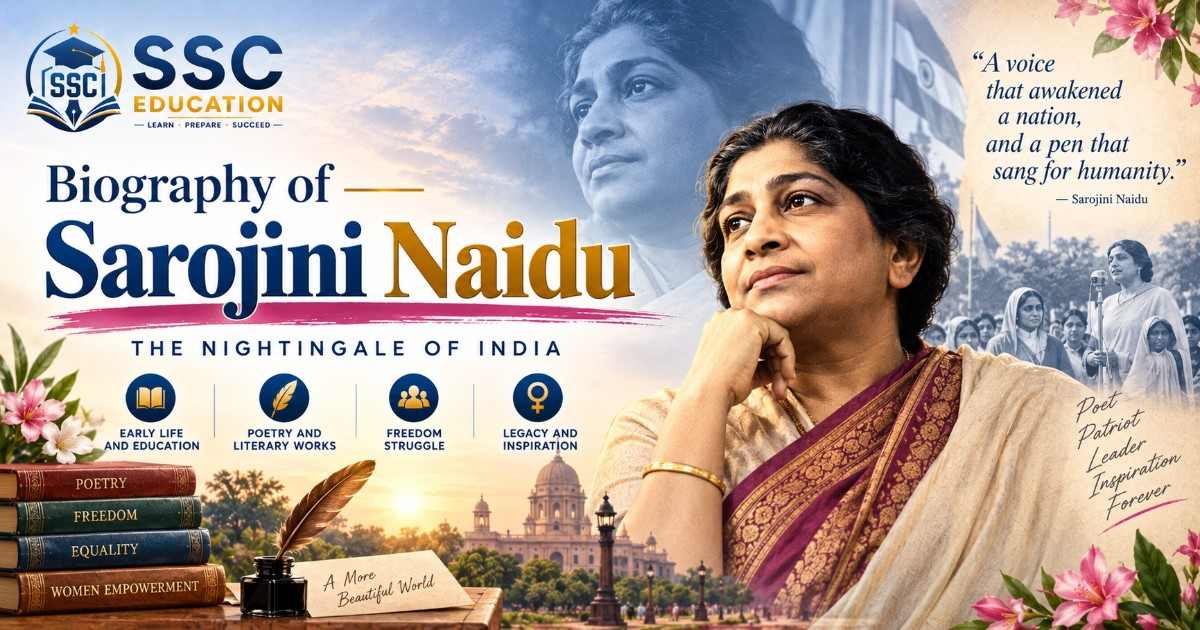
Biography of Sarojini Naidu
Rahul Kumar
SSC Exam Expert & Content Editor
Table of Contents
- 1.Introduction
- 2.Quick Facts: Sarojini Naidu
- 3.Early Life and Family
- 4.Education and Early Recognition
- 5.Marriage to Govindarajulu Naidu
- 6.Sarojini Naidu as a Poet
- 7.Entry into the Freedom Movement
- 8.Fighting for Women's Rights
- 9.Return of the Kaisar-i-Hind Medal
- 10.First Indian Woman President of the Congress (1925)
- 11.The Salt Satyagraha and the Dharasana Raid (1930)
- 12.Round Table Conference and Later Struggles
- 13.First Woman Governor of Independent India
- 14.Death
- 15.Themes and Style of Her Poetry
- 16.Sarojini Naidu and Hindu–Muslim Unity
- 17.Her Speeches and Writings on Women's Emancipation
- 18.Life as Governor of the United Provinces
- 19.Famous Quotes and Ideas
- 20.The Kanpur Congress of 1925: A Closer Look
- 21.Sarojini Naidu Among the Women Leaders of Her Time
- 22.Sarojini Naidu in Memory and Education
- 23.Books and Sources for Further Reading
- 24.Personality and Oratory
- 25.Sarojini Naidu and Mahatma Gandhi
- 26.Legacy and Honours
- 27.Lesser-Known Facts about Sarojini Naidu
- 28.Timeline of Sarojini Naidu's Life
- 29.Why Sarojini Naidu Is Important for SSC and Other Competitive Exams
- 30.Related Reading
- 31.Conclusion
- 32.Frequently Asked Questions
Complete biography of Sarojini Naidu, the Nightingale of India: early life, poetry, Congress presidency, Dharasana salt raid, first woman Governor, timeline and 24 FAQs for SSC exams.
Introduction
Sarojini Naidu (13 February 1879 – 2 March 1949) was a poet, orator, freedom fighter and administrator whom Mahatma Gandhi affectionately called the Nightingale of India (Bharat Kokila). She was the first Indian woman to become President of the Indian National Congress, in 1925, and the first woman to serve as a Governor in independent India, when she took charge of the United Provinces in 1947. Her birth anniversary, 13 February, is observed every year as National Women's Day.
Sarojini Naidu's life brought together two worlds that are often kept apart. She wrote lyrical English poetry that won admirers such as Edmund Gosse and Rabindranath Tagore, and she also led salt satyagrahis, went to jail, negotiated with viceroys and spoke to crowds from Bombay to Boston. In this biography, we trace her life from a scholarly household in Hyderabad to Government House in Lucknow, explain her contributions to literature, women's rights and the national movement, and give a revision guide with FAQs that are useful for SSC and other competitive examinations.
Quick Facts: Sarojini Naidu
| Nationality | Indian |
|---|---|
| Best Known For | Poet and freedom fighter known as the "Nightingale of India"; first Indian woman President of the Indian National Congress |
| Born | 13 February 1879, Hyderabad (then the princely state of Hyderabad) |
| Died | 2 March 1949, Lucknow, Uttar Pradesh (aged 70) |
| Father | Aghorenath Chattopadhyay, scientist and principal of the Nizam College |
| Mother | Barada Sundari Devi, a Bengali poet |
| Husband | Dr. Govindarajulu Naidu (married 1898) |
| Education | Studied at King's College, London and Girton College, Cambridge |
| Known As | Nightingale of India, Bharat Kokila, Bulbul-e-Hind |
| Famous Poetry Books | The Golden Threshold (1905), The Bird of Time (1912), The Broken Wing (1917) |
| Political Milestones | Congress President (1925), Dharasana salt raid (1930), Quit India imprisonment (1942) |
| Later Career | First Governor of the United Provinces (1947–1949) |
Early Life and Family
Sarojini was born in Hyderabad on 13 February 1879, the eldest of eight children of Aghorenath Chattopadhyay and Barada Sundari Devi. Her father, a Bengali Brahmin, had studied science at the University of Edinburgh, earning a doctorate, and had come to Hyderabad to found the Nizam College, where he served as principal. He was a champion of modern education, a chemist, and a man of wide interests who filled the house with books and visitors. Her mother, Barada Sundari, wrote poetry in Bengali and often sang her own songs to the children.
The household was unusual for its time. It held Urdu, Telugu, Bengali, Persian and English conversation at the same table, and it welcomed poets, scientists and reformers. Her brothers and sisters became well known in their own right: Virendranath Chattopadhyay was a revolutionary who worked among Indian nationalists abroad; Harindranath was a poet, dramatist and actor; Suhasini became a communist leader; and Sunalini and Mrinalini were among the early women who appeared on the silent screen. Growing up among such siblings, Sarojini learned that ideas were meant to be argued over and acted on.
Her father hoped that she would become a mathematician or a scientist, but Sarojini had other interests. One day, while struggling with an algebra problem, she began to write a poem instead. Her father, after reading it, decided not to press her to follow science, and encouraged her to write. It was an early sign of the flexibility that marked his views on education, and Sarojini's writing life began from then.
Education and Early Recognition
Sarojini was a prodigy. In 1891, at the age of twelve, she passed the matriculation examination of the University of Madras with the highest rank, a result that made newspapers in the south. She wrote a long poem of about 1,300 lines called The Lady of the Lake at thirteen, and a Persian play, Maher Muneer, which she presented to the Nizam of Hyderabad. The Nizam was so impressed that he sanctioned a scholarship for her studies abroad.
In 1895, at the age of sixteen, she travelled to England and studied at King's College, London and later at Girton College, Cambridge, until 1898. Although she did not take a formal degree, these years shaped her writing. She read the English romantic poets and the poets of the Decadent movement, mixed with a circle of writers and artists and, above all, met the critic Edmund Gosse. Gosse read her early verses, which were full of English Romantic imagery, and gave her advice that changed her career: he urged her to write about India — its landscapes, seasons, festivals, and people — instead of imitating English models. She took the advice, and the poems that resulted made her name.
Her stay in England also brought her in contact with the suffrage movement, and she gained a first look at the debates on women's votes that she would later carry into Indian politics.
Marriage to Govindarajulu Naidu
During her time in England, Sarojini had fallen in love with Dr. Govindarajulu Naidu, a physician from a non-Brahmin family from Andhra whom she had met at the age of fifteen. In 1898, after returning to India, she married him. It was an inter-caste and inter-regional marriage, unusual and even scandalous at the time, and it was carried out under the reformist Brahmo Marriage Act with the support of her father. The couple settled in Hyderabad and had five children, including their daughter Padmaja, who later became a Congress worker, took part in the Quit India Movement and served as Governor of West Bengal.
The marriage remained a source of strength for the rest of her life. Govindarajulu Naidu supported her writing and public career, and the couple's home became a hub for artists, poets and reformers.
Sarojini Naidu as a Poet
Sarojini Naidu began her career as a poet, and it was her poetry that first made her famous. Her verses are rich in colour, sound and rhythm, and they describe Indian scenes with a light and musical touch. Her collections are:
- The Golden Threshold (1905) — her first book, published in London with an introduction by Arthur Symons; the title refers to her home in Hyderabad.
- The Bird of Time: Songs of Life, Death and the Spring (1912) — contains her well-known poem "In the Bazaars of Hyderabad".
- The Broken Wing: Songs of Love, Death and Destiny (1917) — includes "The Gift of India" and the poem "Awake!".
- The Sceptred Flute: Songs of India (1928) — a collection published in New York.
- The Feather of the Dawn (1961) — published after her death and edited by her daughter Padmaja Naidu.
Some of her best-loved poems include "Palanquin Bearers", "Coromandel Fishers", "Indian Weavers" and "Cradle Song". They celebrate everyday Indian life — weavers at dawn, fishermen at sea, vendors in the bazaar — and they are among the earliest poems in English that treat these subjects with affection instead of exoticism. Edmund Gosse described her in 1919 as the most accomplished living poet in India. Her collected speeches were also published, first in 1918, and they are valued as fine examples of political oratory.
Entry into the Freedom Movement
Sarojini Naidu was drawn towards public life in the early years of the twentieth century. The partition of Bengal in 1905 stirred her deeply, and she began to attend political gatherings and to speak on independence and women's rights, beginning around 1904. She addressed the annual session of the Indian National Congress and the Indian Social Conference in Calcutta in 1906, delighting the audience with her fluent English and her passion. Her most important mentor at this stage was Gopal Krishna Gokhale, who encouraged her to give up writing purely for pleasure and to devote her talents to the country. She also became a friend of Rabindranath Tagore, Muhammad Ali Jinnah, Annie Besant and other leaders across the political spectrum.
Her real turning point came in 1914, when she met Mahatma Gandhi in London. She later said that the meeting persuaded her that politics was not a matter of speeches but of sacrifice and service. From then on she was one of Gandhi's most loyal and lively lieutenants. She teased him affectionately — among other things, she is said to have called him "Mickey Mouse" — but she followed his lead in the struggle with complete dedication.
Fighting for Women's Rights
Sarojini Naidu argued that the liberation of India could not be separated from the liberation of women. She told audiences that women were the builders of the nation and that a movement that left out half the population would be weak. In 1917 she joined Annie Besant, Margaret Cousins and Dr. Muthulakshmi Reddy in founding the Women's Indian Association, which campaigned for votes for women, education and social reform.
That same year she led a delegation to Edwin Montagu, the Secretary of State for India, and Lord Chelmsford, the Viceroy, to press for women's franchise, and she gave evidence before the Joint Select Committee in London on the question of the vote. At the Bombay session of the Congress in 1918, she described the vote as a human right, not the monopoly of one sex. Her arguments helped turn women's franchise into a mainstream demand, and in the years that followed several provinces extended the vote to women.
Her commitment was practical as well as rhetorical. She travelled around the country encouraging women to take part in meetings, picketing and relief work, and she later defended women's participation in the salt satyagraha when many critics thought street protest was inappropriate for them.
Return of the Kaisar-i-Hind Medal
In 1911, the British government awarded Sarojini Naidu the Kaisar-i-Hind medal in recognition of her work during flood relief in Hyderabad. She returned it in 1919 as a protest against the Jallianwala Bagh massacre in Amritsar and against the repressive Rowlatt Act. The gesture marked her final break with the idea that Indians could ask for justice from the colonial government by polite requests.
First Indian Woman President of the Congress (1925)
In December 1925 the Congress met at Kanpur, and Sarojini Naidu was elected its president. She was the 44th President of the Congress and the first Indian woman to hold the post; Annie Besant, an Irish woman living in India, had presided earlier, in 1917. Her address at Kanpur called for unity between Hindus and Muslims, for the removal of untouchability and for the spread of the spinning wheel. She travelled widely in that period, going to East Africa and South Africa in 1924 to work with Indian communities, and to the United States and Canada in 1928–29 to speak on Gandhi's non-violence and India's case for freedom. She was an eloquent ambassador who could talk about Indian politics to foreign audiences without a single note.
The Salt Satyagraha and the Dharasana Raid (1930)
In 1930, when Gandhi began the Salt March from Sabarmati to Dandi, Sarojini Naidu was one of the leaders of the campaign. She was with Gandhi at Dandi when he picked up a lump of salt from the beach on 6 April. After Gandhi's arrest in May, the responsibility for the next phase fell on leaders such as Sarojini Naidu, Imam Saheb and Manilal Gandhi, who led a march on the Dharasana salt works, about 150 miles north of Bombay.
Sarojini Naidu addressed the volunteers, told them to remain non-violent whatever happened, and led them towards the salt pans, where police armed with steel-tipped lathis were waiting. Row after row of satyagrahis advanced and were beaten, but they did not raise a hand in defence. The American journalist Webb Miller reported the scene to the world, and the account did enormous harm to Britain's reputation. She was arrested and imprisoned during the campaign.
Round Table Conference and Later Struggles
In 1931, after the Gandhi–Irwin Pact, she accompanied Gandhi to London for the Second Round Table Conference, where she was one of the few women representing India. The talks did not produce the results the Congress wanted, and civil disobedience resumed. She was again imprisoned in 1932. In the following years she continued to speak and to organise while remaining close to Gandhi.
In August 1942, following the Quit India resolution, she was arrested along with Gandhi and other leaders and detained at the Aga Khan Palace in Pune for about twenty-one months. Gandhi's secretary Mahadev Desai died there in 1942, and Kasturba Gandhi in 1944, making it a place of deep sorrow for the national movement. She was released in poor health after about twenty-one months and returned to public life.
First Woman Governor of Independent India
After independence, Sarojini Naidu was appointed Governor of the United Provinces (now Uttar Pradesh) on 15 August 1947, becoming the first woman to hold the position of Governor in independent India. Her friends said she treated Government House in Lucknow like a home, keeping it open to poets, teachers, students and ordinary citizens. She described herself as a "captive bird in a golden cage", and she once said that she was the only woman Governor who could joke about her own position.
She held the office through the difficult months of Partition, when communal tension was high, and she used her influence to promote harmony. Her tenure lasted from 15 August 1947 until her death.
Death
Sarojini Naidu died of a heart attack in Government House, Lucknow, at about 3.30 p.m. on 2 March 1949, at the age of seventy. She was still in office. Her last rites were performed on the bank of the Gomti river, and the country mourned the loss of the voice that had summoned it to freedom.
Themes and Style of Her Poetry
To understand why Sarojini Naidu's poetry made such an impact, it helps to look at what she did differently from earlier Indian poets writing in English. Many of them wrote in a formal, imitative style, using themes borrowed from Victorian verse. Sarojini Naidu took the English lyric form — rhymed stanzas, regular metre, musical refrains — and filled it with Indian subjects. Her poems describe bangle-sellers at a fair, women carrying pitchers to a well, weavers at daybreak and fishermen singing as they row, and they express emotions such as love, longing, grief and the joy of a festival.
A second feature of her writing is its musical quality. She wrote as if for the ear, and many of her poems can be sung. This is one reason why she was given the title of the Nightingale of India. Critics have pointed out that her verse often uses a light, rapid rhythm and repeated sounds to suggest movement: the sway of a palanquin, the beat of oars, the whirr of a spinning wheel. This gift for sound also helped her as a public speaker.
Her later poems, especially in The Broken Wing, reflect a shift towards patriotic and spiritual themes. She wrote of the birth of a new India, of sacrifice and of love for the motherland, and in poems such as "Awake!" she called on her countrymen to shake off inertia. In this sense her literary career and her political career were two aspects of a single commitment.
Sarojini Naidu and Hindu–Muslim Unity
Growing up in cosmopolitan Hyderabad, where Hindus and Muslims shared festivals, languages and neighbourhoods, Sarojini Naidu believed strongly in communal harmony. Her mother tongue at home was Bengali, but she spoke Urdu and Telugu fluently and had close friends in every community. In the early years of the twentieth century, she saw the Lucknow Pact of 1916 — the agreement between the Congress and the Muslim League — as a promising sign and admired Muhammad Ali Jinnah as an "ambassador of Hindu–Muslim unity", a phrase she used in the introduction to a collection of his speeches.
The years that followed disappointed her. She saw the two communities drifting apart, and she worked tirelessly to keep dialogue alive, using her presidential address at Kanpur to make a plea for unity. When Partition came in 1947 and the United Provinces was gripped by fear, she used her position as Governor to reassure minorities and calm those who wanted revenge. Her personal sorrow at the division of India was deep, and she often said that the country had paid too high a price for its freedom.
Her Speeches and Writings on Women's Emancipation
Sarojini Naidu's speeches on women deserve to be read alongside her poems. In 1906 she told the Indian Social Conference that women were the builders of the nation, and that without their full participation no movement could succeed. In 1918 she gave the argument for the vote at the Bombay Congress: the franchise was a human right, she said, and no society had the right to withhold it from half its members. In a pamphlet written around 1930, she called on women to become agents of political change, not passive spectators.
She was not a narrow feminist. She did not see men as adversaries, and she often spoke of the need for husbands, fathers and brothers to support women's education. But she was also sharply critical of customs such as child marriage and the seclusion of women. Because she practised what she preached — she married outside her caste, worked outside the home, travelled alone and went to jail — her arguments carried unusual authority.
Life as Governor of the United Provinces
When Jawaharlal Nehru asked her to serve as Governor of the United Provinces, she was reluctant. She had not wanted a post that would keep her away from the public platform and had joked that she would be a caged bird. She nevertheless accepted, and she took up residence in Government House in Lucknow, which she treated as a home for the whole province. She held receptions for poets, teachers and social workers, spent time with students and told visitors that the doors of the house were open to anyone who wished to talk.
The office was more than ceremonial. The United Provinces was the largest state in the Indian Union, and in 1947–48 it received a large number of refugees from Punjab while also facing tensions among its own communities. Sarojini Naidu worked closely with the Chief Minister, Govind Ballabh Pant, and she used her moral authority to promote calm. Her humour and warmth are said to have made a difficult period easier for many people around her.
Famous Quotes and Ideas
- She described women as the makers of the nation and insisted that no country could be free if its women were not.
- She called the vote "a human right", not the privilege of one sex.
- She often said that patriotism must be expressed through service, not just words.
- She spoke of poetry as a way to make the everyday sacred, and of the poet as someone who listens to the heartbeat of the country.
These ideas are paraphrased from her speeches and essays, and they show how her literary sensibility and her political convictions were connected.
The Kanpur Congress of 1925: A Closer Look
The Kanpur session of December 1925 was an important moment in the history of the Congress, and Sarojini Naidu's election as president gave it a special significance. The party was still recovering from the decline that followed the withdrawal of the Non-Cooperation Movement in 1922 and from the divisions between the Swarajists, who wanted to work inside the legislatures, and the no-changers, who wanted to continue constructive work. Her task was to bring the different groups together and to give the party a sense of purpose.
In her presidential address she reviewed the political situation, appealed for unity between communities, praised the work of the spinning wheel and khadi, and reminded the delegates that the ultimate aim was full self-government. The choice of a woman as president also carried a message: the Congress, which had sometimes been criticised for its lack of women leaders, now placed the highest office in the hands of one. She held the office for a year, and during her term she travelled to many provinces and presented the national case to the public.
Sarojini Naidu Among the Women Leaders of Her Time
Sarojini Naidu was part of a remarkable generation of Indian women who entered public life in the first half of the twentieth century. Annie Besant, who founded the Home Rule League and became the Congress president in 1917, was her senior colleague. Dr. Muthulakshmi Reddy, who became the first woman legislator in India in 1927, worked with her in the Women's Indian Association. Vijaya Lakshmi Pandit became the first woman minister in a provincial cabinet in 1937, and Aruna Asaf Ali became famous for hoisting the flag at Gowalia Tank during the Quit India Movement. Kamaladevi Chattopadhyay, who was married to Sarojini Naidu's brother Harindranath for a time, became a leading figure in the cooperative and handicrafts movements.
Within this group, Sarojini Naidu was unique because she combined literary fame with political leadership. She was the voice that made women's rights seem natural and appealing rather than radical, and she often provided the eloquence when others provided the organisation.
Sarojini Naidu in Memory and Education
Her poems are still taught in schools across India, and lines from "In the Bazaars of Hyderabad" and "Palanquin Bearers" are familiar to generations of students. Her birthday is marked by schools and colleges with recitations, speeches and essay competitions, and universities and institutions across the country carry her name. In competitive examinations, she features in questions on firsts (first woman Congress President and Governor), titles (Nightingale of India), and events (Dharasana and Quit India). The consistent appearance of her name in such questions is a sign of how firmly she is placed in the national memory.
Books and Sources for Further Reading
Students who wish to read more about Sarojini Naidu can begin with her own writings: the poetry collections The Golden Threshold, The Bird of Time and The Broken Wing, and the volume of her collected speeches and writings. Padmini Sengupta's biography, Sarojini Naidu: A Biography, is a standard account of her life. Reading a few of her poems alongside the biography helps in understanding how her literary voice and her political voice developed together, and it makes the dates and titles that examiners ask about far easier to remember.
Personality and Oratory
Sarojini Naidu was known for her wit, warmth and courage. In an age when few women spoke in public, she held huge crowds with her clear voice, her command of English and Urdu, and a sense of humour that could relax a tense room. Colleagues said that she could turn the worst moment of a meeting into a laugh, and that even people who disagreed with her enjoyed listening to her. She wore simple khadi saris, moved easily between palaces and villages, and refused to distinguish between rich and poor guests.
Her oratory drew on her poetic imagination. She spoke in images: she described the freedom struggle as a spring after a long winter, and she compared women to lamps whose light could not be hidden. At the same time she was a shrewd political thinker, and her speeches on women's franchise, communal harmony and non-violence are still quoted by historians.
Sarojini Naidu and Mahatma Gandhi
The friendship between Sarojini Naidu and Gandhi is one of the most affectionate in the story of the national movement. She was among the few people who could tease him without offence. He, in turn, valued her courage and her ability to lift the spirits of those around him. It was Gandhi who gave her the title "Nightingale of India", and it was she who, on several occasions, took his place when he was in jail, as at Dharasana in 1930. When Gandhi was assassinated in January 1948, she was among those who mourned him most deeply, and she was present at the immersion of his ashes.
Legacy and Honours
- National Women's Day: Her birth anniversary, 13 February, is celebrated as National Women's Day in India.
- Golden Threshold: Her family's house in Hyderabad, called The Golden Threshold, is now part of the University of Hyderabad and houses the Sarojini Naidu School of Arts and Communication.
- Sarojini Devi Eye Hospital: A well-known hospital in Hyderabad is named after her.
- Postage stamp: India issued a commemorative stamp in her memory in 1964.
- Google Doodle: In 2014, on her 135th birth anniversary, Google honoured her with a Doodle.
- Asteroid: The asteroid 5647 Sarojininaidu, discovered in 1990, is named after her.
- Firsts: First Indian woman President of the Indian National Congress and first woman Governor of an Indian state.
Beyond these honours, her greatest legacy is the example she set for women in public life: she proved that a woman could be poet and politician, wife and mother, jail-goer and Governor, without giving up any part of herself.
Lesser-Known Facts about Sarojini Naidu
- She topped the Madras University matriculation examination at the age of twelve.
- She wrote a play in Persian, Maher Muneer, as a teenager and impressed the Nizam of Hyderabad with it.
- Her marriage to a man outside her caste was regarded as groundbreaking in 1898.
- Her brother Virendranath Chattopadhyay was a well-known revolutionary in Europe.
- She returned the Kaisar-i-Hind medal in 1919 in protest against the Jallianwala Bagh massacre.
- She edited a collection of Muhammad Ali Jinnah's speeches and writings in 1918 and dedicated a poem to him at a time when she saw him as an ambassador of Hindu–Muslim unity.
- She was a member of the Constituent Assembly of India before her appointment as Governor.
- Her daughter Padmaja Naidu later became Governor of West Bengal.
Timeline of Sarojini Naidu's Life
| Year | Event |
|---|---|
| 1879 | Born in Hyderabad on 13 February |
| 1891 | Passed matriculation with the highest rank at the age of twelve |
| 1895–1898 | Studied at King's College, London and Girton College, Cambridge |
| 1898 | Married Dr. Govindarajulu Naidu |
| 1905 | Published her first poetry collection, The Golden Threshold |
| 1906 | Addressed the Congress session in Calcutta |
| 1911 | Received the Kaisar-i-Hind medal |
| 1912 | Published The Bird of Time |
| 1914 | Met Gandhi in London |
| 1917 | Founded the Women's Indian Association; published The Broken Wing |
| 1919 | Returned the Kaisar-i-Hind medal after Jallianwala Bagh |
| 1925 | Became President of the Indian National Congress at Kanpur |
| 1930 | Led the Dharasana salt satyagraha after Gandhi's arrest |
| 1931 | Attended the Second Round Table Conference in London |
| 1942 | Arrested during the Quit India Movement |
| 1947 | Became Governor of the United Provinces on 15 August |
| 1949 | Died at Lucknow on 2 March |
Why Sarojini Naidu Is Important for SSC and Other Competitive Exams
Sarojini Naidu is a favourite of examiners in the General Awareness and History sections of SSC CGL, CHSL, MTS and GD Constable exams as well as of state-level and railway examinations. Her life provides a bank of “firsts” and titles which are easy to test and easy to memorise.
- Known as the Nightingale of India (Bharat Kokila); the title was given by Mahatma Gandhi.
- First Indian woman President of the Indian National Congress (Kanpur session, 1925).
- First woman Governor of an Indian state (United Provinces, 1947–49).
- Poetry books: The Golden Threshold, The Bird of Time, The Broken Wing.
- Co-founded the Women's Indian Association in 1917.
- Led the Dharasana Satyagraha in 1930 after Gandhi's arrest.
- Birthday, 13 February, is celebrated as National Women's Day.
- Returned the Kaisar-i-Hind medal after the Jallianwala Bagh massacre.
Learning her through three pairs is a quick way to revise: 1925 and Kanpur (Congress President), 1930 and Dharasana (salt raid) and 1947 and Uttar Pradesh (Governor).
Related Reading
Conclusion
Sarojini Naidu lived at the crossing of art and action. Her poems taught readers to look at Indian life with love, and her speeches taught Indians to look at their rulers without fear. She stood at the head of a movement in which women's rights were part of the national agenda, she walked into jail and into Government House with equal confidence, and she never lost her humour. For students and examination aspirants, she offers a set of clear facts and titles to remember — and for everyone, a reminder that creativity and courage belong together.
Frequently Asked Questions
Who was Sarojini Naidu?
Sarojini Naidu (1879–1949) was an Indian poet, freedom fighter and politician. She was the first Indian woman President of the Indian National Congress and the first woman Governor of an Indian state.
Why is Sarojini Naidu called the Nightingale of India?
Mahatma Gandhi gave her the title Nightingale of India (Bharat Kokila) because of the lyrical quality of her poetry and her sweet, powerful voice.
When and where was Sarojini Naidu born?
She was born on 13 February 1879 in Hyderabad, in the princely state of Hyderabad.
Who were the parents of Sarojini Naidu?
Her father was Aghorenath Chattopadhyay, a scientist and principal of Nizam College, and her mother was Barada Sundari Devi, a Bengali poet.
Whom did Sarojini Naidu marry?
She married Dr. Govindarajulu Naidu, a physician, in 1898 in an inter-caste marriage that was considered bold at the time.
Where did Sarojini Naidu study?
She studied at Madras (where she topped the matriculation exam at age twelve) and then at King's College, London and Girton College, Cambridge, between 1895 and 1898.
Which books of poetry did Sarojini Naidu write?
Her main collections are The Golden Threshold (1905), The Bird of Time (1912), The Broken Wing (1917), The Sceptred Flute (1928) and The Feather of the Dawn (published in 1961 after her death).
When was Sarojini Naidu the President of the Indian National Congress?
She presided over the Kanpur session of the Congress in December 1925, becoming the first Indian woman to hold the post.
Who was the first woman President of the Congress?
Annie Besant was the first woman to preside over the Congress, in 1917, while Sarojini Naidu was the first Indian-born woman to do so, in 1925.
Was Sarojini Naidu the first woman Governor of India?
Yes. She became the Governor of the United Provinces (now Uttar Pradesh) on 15 August 1947 and held the post until her death in 1949.
What was Sarojini Naidu's role in the Salt Satyagraha?
She was with Gandhi at Dandi and, after his arrest in 1930, she led the raid on the Dharasana Salt Works along with Imam Saheb and Manilal Gandhi.
Why did Sarojini Naidu return the Kaisar-i-Hind medal?
She returned the medal in 1919 as a protest against the Jallianwala Bagh massacre and the Rowlatt Act.
Which organisation did Sarojini Naidu help to found in 1917?
She co-founded the Women's Indian Association in 1917 with Annie Besant, Margaret Cousins and Muthulakshmi Reddy.
When did she meet Mahatma Gandhi?
She first met Gandhi in London in 1914, and she was one of his closest associates in the freedom struggle afterwards.
How many times was Sarojini Naidu imprisoned?
She was jailed several times, including in 1930, 1932 and during the Quit India Movement in 1942, when she was detained for about twenty-one months.
When and where did Sarojini Naidu die?
She died of a heart attack on 2 March 1949 at Government House, Lucknow, while serving as Governor of Uttar Pradesh.
Why is 13 February celebrated as National Women's Day?
13 February is her birth anniversary, and India celebrates it as National Women's Day to honour her contributions to women's empowerment and the nation.
What is The Golden Threshold?
The Golden Threshold was her first poetry collection, published in London in 1905, and also the name of her family home in Hyderabad, which is now part of the University of Hyderabad.
Which poem is famous for describing Hyderabad?
In the Bazaars of Hyderabad, published in The Bird of Time (1912), is among her best-known poems.
Who advised Sarojini Naidu to write about India?
The English critic Edmund Gosse advised her to write about India and its people instead of imitating English poets.
Who was Padmaja Naidu?
Padmaja Naidu was Sarojini Naidu's daughter, who took part in the Quit India Movement, edited her mother's posthumous poems and later became Governor of West Bengal.
What was Sarojini Naidu's contribution to women's rights?
She campaigned for women's franchise, education and social reform, led delegations to British officials in 1917 and argued that the freedom of India and of women were inseparable.
What important facts about Sarojini Naidu should be remembered for SSC exams?
Remember her titles (Nightingale of India), Congress presidency at Kanpur in 1925, Dharasana in 1930, governorship of the United Provinces in 1947 and National Women's Day on 13 February.
Which asteroid is named after Sarojini Naidu?
The asteroid 5647 Sarojininaidu, discovered in 1990, is named in her honour.
Rahul Kumar
SSC Exam Expert & Content Editor
Rahul is a senior SSC exam strategist with 8+ years of experience helping aspirants crack CGL, CHSL and MTS exams. He writes in-depth notification breakdowns, exam pattern guides and preparation strategies.