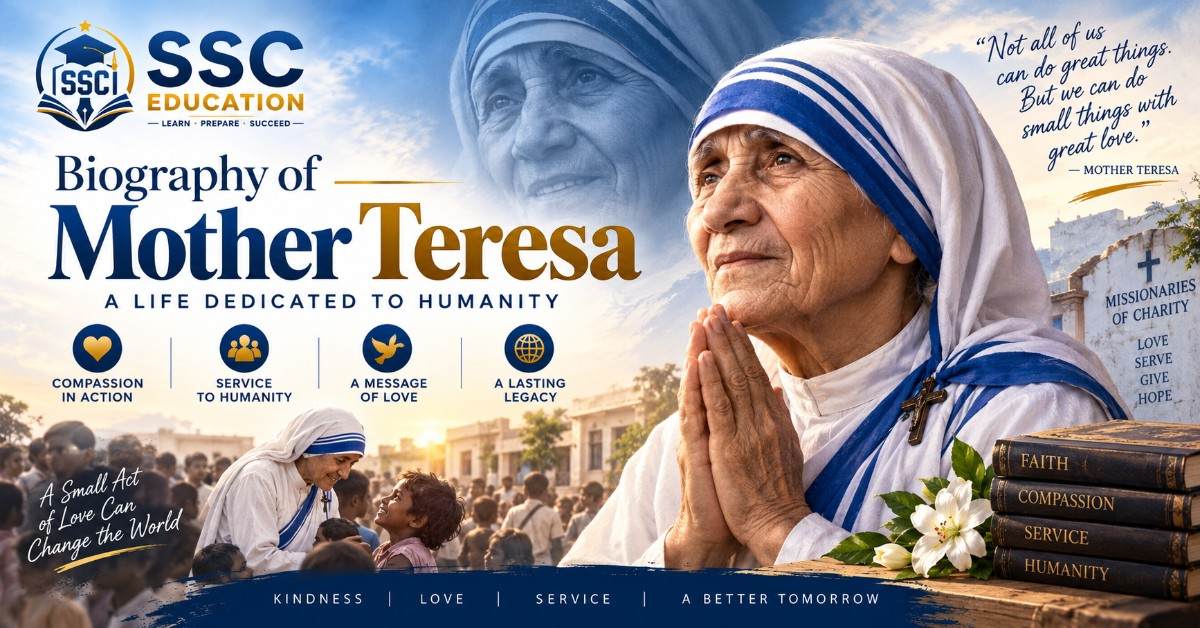
Biography of Mother Teresa
Rahul Kumar
SSC Exam Expert & Content Editor
Table of Contents
- 1.Mother Teresa Biography at a Glance (Quick Facts)
- 2.Who Was Mother Teresa?
- 3.Mother Teresa Early Life and Family
- 4.Mother Teresa Education
- 5.Joining the Sisters of Loreto
- 6.Teacher at St. Mary's School, Calcutta
- 7.The "Call Within a Call" (10 September 1946)
- 8.Starting Her Work Among the Poor (1948–1950)
- 9.Founding the Missionaries of Charity (1950)
- 10.Homes and Centres Started by Mother Teresa
- 11.Mother Teresa Nobel Peace Prize (1979)
- 12.Mother Teresa Awards and Honours
- 13.Sayings Attributed to Mother Teresa
- 14.Mother Teresa Timeline (Year-Wise History)
- 15.Mother Teresa's Inner Struggle: "Come Be My Light"
- 16.Criticism and Controversies
- 17.How Did Mother Teresa Die? (Death Reason)
- 18.Becoming a Saint: Beatification and Canonisation
- 19.Mother Teresa Contribution to India and the World
- 20.Mother Teresa Legacy: Why She Is Remembered
- 21.Interesting Facts About Mother Teresa
- 22.Mother Teresa Biography: Important Points for SSC and Other Exams
- 23.Lessons Students Can Learn from Mother Teresa
- 24.Mother Teresa's Roots: Skopje and Albania
- 25.What Is a Saint? Beatification and Canonisation Explained
- 26.Places in Kolkata Linked with Mother Teresa
- 27.Common Confusions About Mother Teresa
- 28.How to Remember the Story of Mother Teresa for Exams
- 29.Related People and Topics
- 30.Key Takeaways
- 31.Mother Teresa Biography: Frequently Asked Questions (FAQs)
Read the Mother Teresa biography in simple words: early life, call to serve the poor, Missionaries of Charity, Nobel Peace Prize, Bharat Ratna, death, sainthood, criticism and important facts.
Mother Teresa (26 August 1910 – 5 September 1997), now called Saint Teresa of Calcutta, was a Catholic nun who spent almost her whole life serving the poorest, the sick and the dying in India. This Mother Teresa biography tells her life story, history and contribution in very simple words. She was born in Skopje (now in North Macedonia), came to India in 1929 and founded the Missionaries of Charity in Kolkata in 1950. She won the Nobel Peace Prize in 1979 and India's highest civilian honour, the Bharat Ratna, in 1980. The Catholic Church declared her a saint on 4 September 2016.
Mother Teresa Biography at a Glance (Quick Facts)
| Detail | Information |
|---|---|
| Birth Name | Anjezë Gonxhe Bojaxhiu |
| Known As | Mother Teresa; Saint Teresa of Calcutta |
| Born | 26 August 1910 |
| Birthplace | Skopje (then in the Ottoman Empire, now the capital of North Macedonia) |
| Died | 5 September 1997 (aged 87) |
| Place of Death | Kolkata (Calcutta), India |
| Nationality | Albanian by ethnicity; became an Indian citizen in 1948 |
| Famous For | Founder of the Missionaries of Charity; work for the poor and the dying |
| Father | Nikollë Bojaxhiu (a businessman) |
| Mother | Dranafile Bojaxhiu |
| Religious Order | Sisters of Loreto (1928–1948); Missionaries of Charity (founded 1950) |
| Major Awards | Nobel Peace Prize (1979), Bharat Ratna (1980), Padma Shri (1962) |
| Beatified | 19 October 2003 by Pope John Paul II |
| Canonised | 4 September 2016 by Pope Francis |
| Feast Day | 5 September |
Who Was Mother Teresa?
Mother Teresa was a nun who gave up her comfortable life in a school to serve the poorest of the poor in the slums of Calcutta. She became known all over the world for her love for people who were sick, hungry, homeless or dying, and whom nobody wanted to care for.
She wore a simple white sari with a blue border, which became the dress of the sisters she founded. She lived in a very simple way and had few belongings. She often said that the greatest sickness in the world was not hunger or disease but the feeling of being unwanted and unloved.
If a student asks, "Who is Mother Teresa?", the answer is: the Catholic nun who founded the Missionaries of Charity in Kolkata, won the Nobel Peace Prize in 1979, and later became a saint.
Mother Teresa Early Life and Family
Birth and Family Background
Mother Teresa was born as Anjezë Gonxhe Bojaxhiu on 26 August 1910 in Skopje, which was then a part of the Ottoman Empire and is now the capital of North Macedonia. "Gonxhe" means "flower bud" in Albanian. She was baptised on the next day, 27 August, and she later said that she considered this her real birthday.
Her family was Albanian and Catholic. Her father, Nikollë Bojaxhiu, was a successful businessman and a builder who was also involved in local politics. Her mother, Dranafile, was a devoted woman who took care of the family and helped poor people in the town. Anjezë had an elder sister, Aga, and an elder brother, Lazar.
Childhood and a Kind Home
Anjezë had a happy childhood, but it changed when she was about 8 years old. Her father died suddenly in 1919, and the family had money problems. Her mother, a strong and religious woman, brought up the children alone. She taught them to share what they had with the poor. It is said that Drana often invited poor and sick people into her own home for a meal.
Anjezë learned to give and to serve from her mother. She also went to church regularly and joined a group that read about the life of missionaries in India. When she was about 12, she began to feel that she wanted to give her life to God and to serve people.
Mother Teresa Education
Anjezë studied at a public school in Skopje and was a good student. She loved reading, singing and writing poems. She was also a member of the church choir and a young Catholic society. She studied English before she left her country, since she wanted to go to India as a missionary and teach in English.
Joining the Sisters of Loreto
In September 1928, at the age of 18, Anjezë left her home and went to Ireland to join the Sisters of Loreto at Rathfarnham in Dublin. She never saw her mother and sister again in her life. She took the name Sister Mary Teresa, after Saint Thérèse of Lisieux, who was the patron saint of missionaries.
In December 1928, she sailed to India. She reached Calcutta in January 1929, and then went to Darjeeling to start her training. In 1931, she took her first vows as a nun, and in 1937, she took her final vows. In the tradition of the order, she was then called "Mother Teresa".
Teacher at St. Mary's School, Calcutta
For about 20 years, Sister Teresa taught geography and history at St. Mary's High School in Entally, Calcutta, a school for girls run by the Loreto sisters. She was a kind and loved teacher, and later became the principal of the school in 1944. She lived behind the school walls in the convent. But right outside the walls were the crowded slums of Calcutta, where people lived in great poverty. The Bengal famine of 1943 and the riots of 1946 made the suffering worse. She saw dying people on the streets, and it troubled her greatly.
The "Call Within a Call" (10 September 1946)
On 10 September 1946, Mother Teresa was travelling by train from Calcutta to Darjeeling for her annual retreat. During the journey, she says she heard what she called a "call within a call". She felt that God was asking her to leave the convent and to work among the poorest people, and to live with them. This day, 10 September, is still called "Inspiration Day" by the Missionaries of Charity.
She was not free to leave at once. She needed permission from the Church. She wrote to the Archbishop of Calcutta and to the leaders of her order in Rome. It took almost two years to get the permission. In 1948, Pope Pius XII allowed her to leave the Loreto convent, and to work as an independent nun among the poor.
Starting Her Work Among the Poor (1948–1950)
In August 1948, Mother Teresa left the convent. She wore a plain white cotton sari with a blue border, which she chose as her dress. She took Indian citizenship in the same year. Before starting, she spent a few months at Holy Family Hospital in Patna, where she got a basic training in nursing from the Medical Mission Sisters.
In December 1948, she went to the slums of Calcutta, without any money. She started a small open-air school in Motijheel for slum children, and taught them to read and write, using a stick to draw letters in the dust. She also began to visit the sick and the poor in their homes. Soon, some of her former students joined her to help.
Founding the Missionaries of Charity (1950)
On 7 October 1950, the Church officially recognised her group as the Missionaries of Charity, a religious congregation in the diocese of Calcutta. At first, it had only about 12 members. The sisters took the usual vows of poverty, chastity and obedience, and a fourth special vow: "wholehearted and free service to the poorest of the poor".
The sisters wore a white sari with three blue stripes on the border. They lived in a very simple way, with few belongings, and worked in the slums, without pay. In 1965, Pope Paul VI raised the group to the level of a pontifical congregation, which allowed it to work in any country. In the years that followed, the Missionaries of Charity opened houses in Venezuela, Rome, Tanzania and many other places.
Homes and Centres Started by Mother Teresa
| Centre | Year | What It Does |
|---|---|---|
| Nirmal Hriday (Home for the Dying Destitutes), Kalighat | 1952 | Gives a place to die with dignity to poor people who were found dying on the streets |
| Shishu Bhavan (Children's Home) | 1955 | Cares for abandoned, orphaned and sick children |
| Leprosy centres and Shanti Nagar (Asansol) | 1957 onwards | Treatment and care for people with leprosy, at a time when patients were often thrown out by society |
| Mobile clinics | 1950s onwards | Take basic medical care to the slums |
| Homes for the sick, the old and people with AIDS | 1980s onwards | Care for those who have no one |
| Missionaries of Charity Brothers | 1963 | A branch of brothers to do similar work |
By the time she died in 1997, the Missionaries of Charity had over 600 centres in more than 120 countries, with several thousand sisters. Today, the order continues its work in more than 130 countries.
Mother Teresa Nobel Peace Prize (1979)
In 1979, Mother Teresa was awarded the Nobel Peace Prize "for work undertaken in the struggle to overcome poverty and distress, which also constitute a threat to peace". She received it at Oslo on 10 December 1979. She said that she accepted the prize in the name of the poor.
She asked the Nobel Committee not to hold the usual grand banquet in her honour, and to give the money (about $192,000) to help the poor in India instead. In her speech, she spoke about the poor, the value of every human life, and the need for love and compassion in families and society. She also said that we must feel the pain of the poor, and not only give them money.
Mother Teresa Awards and Honours
| Award / Honour | Year |
|---|---|
| Padma Shri (India) | 1962 |
| Ramon Magsaysay Award (Philippines) | 1962 |
| Jawaharlal Nehru Award for International Understanding | 1969 |
| Templeton Prize | 1973 |
| Balzan Prize | 1978 |
| Nobel Peace Prize | 1979 |
| Bharat Ratna (India) | 1980 |
| Order of Merit (United Kingdom) | 1983 |
| Presidential Medal of Freedom (USA) | 1985 |
| Honorary citizenship of the United States | 1996 |
| Congressional Gold Medal (USA) | 1997 |
Sayings Attributed to Mother Teresa
- "Not all of us can do great things. But we can do small things with great love."
- "If you can't feed a hundred people, then feed just one."
- "The most terrible poverty is loneliness and the feeling of being unloved."
- "Peace begins with a smile."
These sayings are widely attributed to her and quoted in schools and in books. They show her simple and loving way of thinking: small acts done with love can change the world.
Mother Teresa Timeline (Year-Wise History)
| Year | Event |
|---|---|
| 1910 | Born on 26 August in Skopje |
| 1919 | Her father dies |
| 1928 | Joins the Sisters of Loreto in Ireland; comes to India |
| 1931 | Takes first vows in Darjeeling |
| 1937 | Takes final vows |
| 1944 | Becomes principal of St. Mary's High School, Calcutta |
| 10 September 1946 | Receives the "call within a call" |
| 1948 | Leaves the convent; starts work among the poor; becomes an Indian citizen |
| 7 October 1950 | Missionaries of Charity is founded |
| 1952 | Opens Nirmal Hriday, the home for the dying |
| 1979 | Wins the Nobel Peace Prize |
| 1980 | Receives the Bharat Ratna |
| 5 September 1997 | Dies in Kolkata |
| 19 October 2003 | Beatified by Pope John Paul II |
| 4 September 2016 | Declared a saint by Pope Francis |
Mother Teresa's Inner Struggle: "Come Be My Light"
After her death, some of her private letters were published in 2007 in a book called Come Be My Light. In them, Mother Teresa wrote that for almost 50 years she had felt a deep spiritual darkness and a sense of God's absence. She still continued with her work and her prayers. Many people say that these letters show her as a very human person, who kept on serving despite deep doubts. Others find in it a mark of deep faith.
Criticism and Controversies
Mother Teresa was widely admired, but she was also criticised. It is important to read both sides. The main criticisms include the following:
- Quality of care: Some doctors and journalists said that her homes for the dying did not have enough medicine, painkillers and modern medical care, and that the money received was not always used to improve them.
- Views: Some people did not agree with her firm views against abortion and contraception.
- Donations: Some critics questioned why she accepted money from some controversial donors.
- Religion: Some groups in India said that her work aimed at religious conversion. The Missionaries of Charity denied this and said that it served people of all religions.
- Books and films: The writer Christopher Hitchens wrote a critical book and made a film on her, and the Kolkata-based doctor Aroup Chatterjee also wrote a critical book.
Her supporters replied that her aim was to give comfort and dignity to people who had nobody, and that she should not be judged by the standards of a modern hospital. They also pointed to the many lives she touched. Historians and readers continue to discuss these views.
How Did Mother Teresa Die? (Death Reason)
Mother Teresa had heart problems in her later years. She had a heart attack in Rome in 1983 and needed a pacemaker in 1989. In 1991 she suffered from pneumonia and heart failure while in Mexico. In March 1997, she stepped down as the head of the Missionaries of Charity because of her health, and Sister Nirmala took over.
She died on 5 September 1997 in Calcutta, at the age of 87, of a cardiac arrest. Her death was mourned by the whole world. The Government of India gave her a state funeral, held at the Netaji Indoor Stadium in Kolkata on 13 September 1997. She was buried at the Mother House, the headquarters of the Missionaries of Charity in Kolkata, where her tomb is visited by thousands of people.
Becoming a Saint: Beatification and Canonisation
In the Catholic Church, becoming a saint takes several steps. After the death of Mother Teresa, the process began very quickly. In 2003, Pope John Paul II beatified her on 19 October 2003, which is a step before sainthood. This followed the recognition of a miracle: the healing of a woman in West Bengal named Monica Besra, from a tumour, in 1998.
A second miracle was recognised, involving a man in Brazil who was cured of brain infections in 2008. On 4 September 2016, Pope Francis declared her a saint at St. Peter's Square in the Vatican. She is now called Saint Teresa of Calcutta. Her feast day is 5 September, the day of her death. The United Nations also marks 5 September as the International Day of Charity in her memory.
Mother Teresa Contribution to India and the World
The Mother Teresa contribution can be understood in simple points:
- Care for the dying. She gave love and dignity to those who were dying on the streets.
- Care for children. Her homes cared for orphans and abandoned children.
- Care for the sick. She started clinics and leprosy centres.
- A worldwide mission. The Missionaries of Charity spread to more than 130 countries.
- A message of love. She reminded the world to care for the poor and unwanted.
- Awareness of poverty. Her work made people think about poverty and loneliness.
Mother Teresa Legacy: Why She Is Remembered
Mother Teresa remains one of the best-known women in the world. Her image, in the white sari with the blue border, is known everywhere. Many places carry her name, such as the Mother Teresa Women's University in Kodaikanal (India) and the Tirana International Airport Nënë Tereza in Albania. In Skopje, her birthplace, there is a memorial house in her honour.
Every year, on 5 September, people gather at her tomb in Kolkata and at many other places to remember her. Volunteers from all over the world come to help at the centres. Her life reminds us that even small acts of kindness can give hope to others.
Interesting Facts About Mother Teresa
- Her birth name was Anjezë Gonxhe Bojaxhiu; "Gonxhe" means "flower bud".
- She left home at 18 and never saw her mother and sister again.
- She took her name from Saint Thérèse of Lisieux.
- She became an Indian citizen in 1948.
- She started her work among the poor with very little money.
- She founded the Missionaries of Charity on 7 October 1950.
- She asked that the Nobel banquet money be given to the poor.
- She received the Bharat Ratna in 1980.
- She was declared a saint on 4 September 2016.
- 5 September is the International Day of Charity in her memory.
Mother Teresa Biography: Important Points for SSC and Other Exams
- Born on 26 August 1910 in Skopje (now in North Macedonia); died on 5 September 1997 in Kolkata.
- Founded the Missionaries of Charity in Kolkata on 7 October 1950.
- Won the Nobel Peace Prize in 1979.
- Received the Bharat Ratna in 1980 and the Padma Shri in 1962.
- Beatified in 2003 and canonised as a saint on 4 September 2016.
- Started Nirmal Hriday (1952) and Shishu Bhavan (1955) in Kolkata.
- Became an Indian citizen in 1948.
- International Day of Charity: 5 September.
- Book of her letters: "Come Be My Light" (2007).
Practice Questions (with Answers)
| Question | Answer |
|---|---|
| In which year did Mother Teresa receive the Nobel Peace Prize? | 1979 |
| Which organisation did she found in 1950? | The Missionaries of Charity |
| Which is India's highest award that she received in 1980? | The Bharat Ratna |
| What is the name of her home for the dying in Kolkata? | Nirmal Hriday |
| On which date was she declared a saint? | 4 September 2016 |
Lessons Students Can Learn from Mother Teresa
- Serve with love. Even small acts of care can make a big difference.
- Start small. She began with a few children in a slum.
- Be brave to follow your calling. She left a safe life to do what she felt was right.
- See every person as important. She gave respect to people whom others ignored.
- Work steadily. She continued her work for almost 50 years, even in hard times.
Mother Teresa's Roots: Skopje and Albania
Skopje, the birthplace of Mother Teresa, was a mixed city of many peoples and faiths in her childhood: Albanians, Macedonians, Turks, Serbs and others. She grew up in a Catholic Albanian family in this multi-religious town. This early life among many communities may have helped her to respect people of all faiths later in India.
Today, Skopje is the capital of North Macedonia. It has a memorial house dedicated to Mother Teresa, near the place where her family home stood, and a statue. Albania, where many of her people live, has named its main airport after her. She was proud of her Albanian roots, but she also said that by blood she was Albanian, by citizenship an Indian, and by faith a Catholic nun who belonged to the whole world.
What Is a Saint? Beatification and Canonisation Explained
Many students ask how a person becomes a saint. In the Catholic Church, the process has four main steps.
| Step | Title | What Happens |
|---|---|---|
| 1 | Servant of God | The Church opens a case and studies the person's life, writings and reputation |
| 2 | Venerable | The Pope declares that the person lived a life of heroic virtue |
| 3 | Blessed (Beatification) | A miracle, proved by a strict inquiry, is accepted; Mother Teresa was beatified on 19 October 2003 |
| 4 | Saint (Canonisation) | A second miracle is accepted; Mother Teresa was canonised on 4 September 2016 |
The Church normally waits some time after death before the process starts, but in Mother Teresa's case, Pope John Paul II allowed the process to begin soon after she died, because of her fame.
Places in Kolkata Linked with Mother Teresa
| Place | Why It Matters |
|---|---|
| St. Mary's High School, Entally | The school where she taught and became principal |
| Motijheel slum | Where she started her first open-air school in 1948 |
| Kalighat (Nirmal Hriday) | The home for the dying that she started in 1952 |
| Shishu Bhavan | The children's home she started in 1955 |
| Mother House, Lower Circular Road (A.J.C. Bose Road) | The headquarters of the Missionaries of Charity and the place where she is buried |
| Netaji Indoor Stadium | The place where her state funeral was held in 1997 |
Common Confusions About Mother Teresa
- She was not born in India. She was born in Skopje, and became an Indian citizen in 1948.
- She did not win the Nobel Prize in Literature. She won the Nobel Peace Prize in 1979.
- Sister Nirmala was not the founder. She was the successor who became the head of the order after Mother Teresa in 1997.
- She was not the founder of the Sisters of Loreto. She joined the Loreto order first, and then started her own order, the Missionaries of Charity.
- "Mother" is a title, not a surname. Her birth name was Anjezë Gonxhe Bojaxhiu.
- She received the Bharat Ratna in 1980, not in 1979.
How to Remember the Story of Mother Teresa for Exams
- Born: 26 August 1910, Skopje; died: 5 September 1997, Kolkata.
- Order: Sisters of Loreto (1928) and then the Missionaries of Charity (7 October 1950).
- Calling: 10 September 1946, the "call within a call".
- Homes: Nirmal Hriday (1952) and Shishu Bhavan (1955).
- Honours: Nobel Peace Prize (1979), Bharat Ratna (1980).
- Sainthood: Blessed in 2003 and saint on 4 September 2016.
Related People and Topics
You can also read about Saint Thérèse of Lisieux, Pope John Paul II, Pope Francis, Kailash Satyarthi (Nobel Peace Prize 2014), Rabindranath Tagore (Nobel 1913), Amartya Sen, the Missionaries of Charity and the Nobel Peace Prize.
Key Takeaways
- Mother Teresa (1910–1997) was a Catholic nun who served the poorest people in Kolkata.
- She founded the Missionaries of Charity in 1950.
- She won the Nobel Peace Prize in 1979 and the Bharat Ratna in 1980.
- She died in Kolkata on 5 September 1997 and became a saint in 2016.
- She is remembered for her love and service, and also studied with a balanced view of the criticism.
Mother Teresa Biography: Frequently Asked Questions (FAQs)
Q1. Who was Mother Teresa?
Mother Teresa was a Catholic nun who founded the Missionaries of Charity in Kolkata. She spent her life caring for the poor, the sick and the dying, and won the Nobel Peace Prize in 1979.
Q2. What was the real name of Mother Teresa?
Her birth name was Anjezë Gonxhe Bojaxhiu. As a nun, she took the name Sister Mary Teresa.
Q3. When and where was Mother Teresa born?
She was born on 26 August 1910 in Skopje, which is now the capital of North Macedonia.
Q4. Who were the parents of Mother Teresa?
Her father was Nikollë Bojaxhiu, a businessman, and her mother was Dranafile Bojaxhiu. Her father died in 1919.
Q5. Was Mother Teresa an Indian?
She was born in Skopje and was of Albanian origin. She became an Indian citizen in 1948 and lived in India for most of her life.
Q6. When did Mother Teresa come to India?
She came to India in January 1929 as a Loreto nun and started teaching in Calcutta.
Q7. Why is Mother Teresa famous?
She is famous for her service to the poorest of the poor in Kolkata, for founding the Missionaries of Charity and for receiving the Nobel Peace Prize.
Q8. What is the "call within a call"?
It is what Mother Teresa called an inner call she felt on 10 September 1946, during a train journey to Darjeeling. It asked her to leave the convent and to serve the poorest people.
Q9. What are the Missionaries of Charity?
It is a religious order founded by Mother Teresa in Kolkata on 7 October 1950. Its members serve the poorest and take vows of poverty, chastity, obedience and free service to the poorest.
Q10. What is Nirmal Hriday?
Nirmal Hriday is the home for the dying destitute that Mother Teresa started in 1952 in Kalighat, Kolkata. It gives care and dignity to people who are dying.
Q11. What is Shishu Bhavan?
It is a children's home started by Mother Teresa in Kolkata in 1955 for abandoned and orphaned children.
Q12. What dress did Mother Teresa wear?
She wore a white cotton sari with a blue border. It is now the dress of the sisters of the Missionaries of Charity.
Q13. When did Mother Teresa get the Nobel Peace Prize?
She received the Nobel Peace Prize in 1979 for her work to help the poor and suffering.
Q14. Which Indian awards did Mother Teresa receive?
She received the Padma Shri (1962), the Jawaharlal Nehru Award for International Understanding (1969) and the Bharat Ratna (1980).
Q15. How did Mother Teresa die?
She died on 5 September 1997 in Kolkata of a cardiac arrest, at the age of 87. She had heart problems for many years.
Q16. Where is Mother Teresa buried?
She is buried at the Mother House of the Missionaries of Charity in Kolkata, where her tomb is visited by many people.
Q17. When was Mother Teresa declared a saint?
Pope Francis declared her a saint on 4 September 2016 at the Vatican. She is called Saint Teresa of Calcutta.
Q18. What is the feast day of Saint Teresa of Calcutta?
Her feast day is 5 September, the day of her death.
Q19. What is the International Day of Charity?
It is a day observed by the United Nations on 5 September, in memory of Mother Teresa.
Q20. What was Mother Teresa's book "Come Be My Light"?
It is a book of her private letters, published in 2007. It shows that she felt a deep spiritual darkness for many years, while she continued her work.
Q21. Why was Mother Teresa criticised?
Some critics said that the medical care in her homes was poor, that she accepted money from controversial donors, and that she held very firm views on abortion and contraception. Her supporters say that she gave love and dignity to those nobody cared for.
Q22. What can students learn from Mother Teresa?
Students can learn kindness, service to others, courage to follow a calling and the value of doing small things with great love.
Rahul Kumar
SSC Exam Expert & Content Editor
Rahul is a senior SSC exam strategist with 8+ years of experience helping aspirants crack CGL, CHSL and MTS exams. He writes in-depth notification breakdowns, exam pattern guides and preparation strategies.