
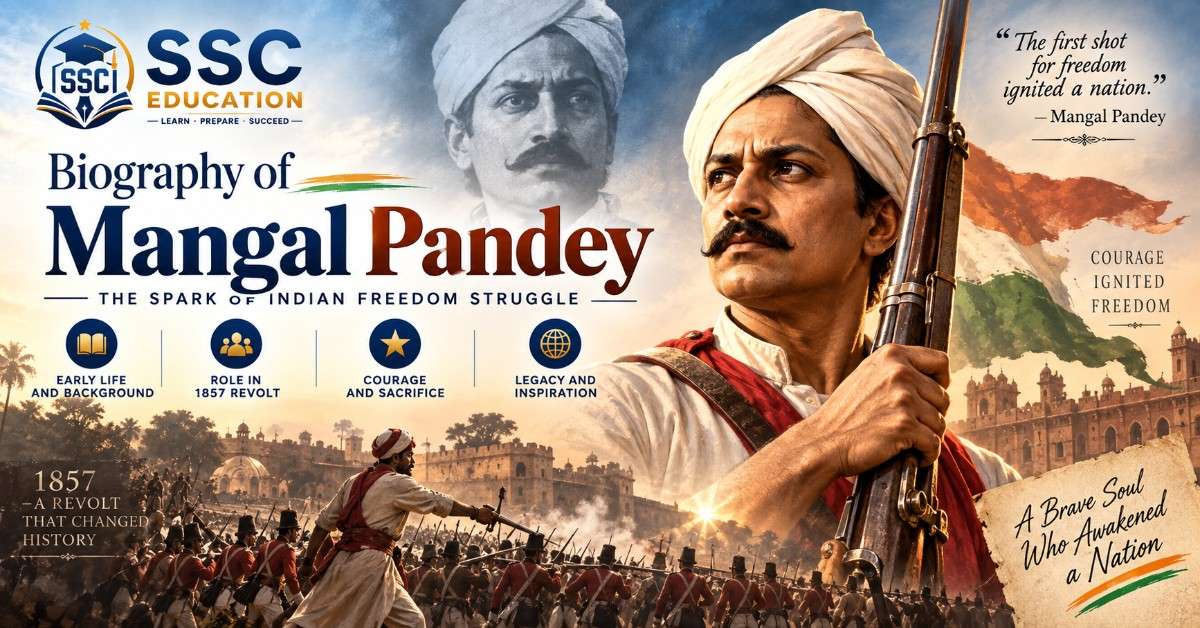
Biography of Mangal Pandey
Rahul Kumar
SSC Exam Expert & Content Editor
Table of Contents
- 1.Mangal Pandey Biography at a Glance (Quick Facts)
- 2.Who Was Mangal Pandey?
- 3.Mangal Pandey Early Life and Family
- 4.Life as a Sepoy in the East India Company Army
- 5.Why Was There Anger in the Army? The Causes Behind 1857
- 6.The Enfield Rifle and the Greased Cartridge
- 7.29 March 1857: The Barrackpore Incident
- 8.Mangal Pandey Trial and Execution
- 9.Why the British Called Rebels "Pandies"
- 10.After Mangal Pandey: The Revolt of 1857
- 11.Mangal Pandey Contribution to India
- 12.Mangal Pandey Timeline (Year-Wise History)
- 13.Mangal Pandey Awards, Honours and Memorials
- 14.Was Mangal Pandey the First Freedom Fighter of India?
- 15.Mangal Pandey in Popular Culture
- 16.Interesting Facts About Mangal Pandey
- 17.Mangal Pandey Biography: Important Points for SSC and Other Exams
- 18.Lessons Students Can Learn from Mangal Pandey
- 19.Timeline of the Revolt of 1857 (After Mangal Pandey)
- 20.Results and Impact of the Revolt of 1857
- 21.What Do Historians Say About Mangal Pandey and 1857?
- 22.Why Barrackpore Is Important in Indian History
- 23.Mangal Pandey and Other Heroes of 1857
- 24.Impact on the Army: How the British Changed After 1857
- 25.How to Remember the Story of Mangal Pandey for Exams
- 26.Related People and Topics
- 27.Key Takeaways
- 28.Mangal Pandey Biography: Frequently Asked Questions (FAQs)
Read the Mangal Pandey biography in simple words: early life, the Barrackpore incident of 1857, greased cartridge story, trial, hanging, contribution to the freedom struggle and important facts.
Mangal Pandey (19 July 1827 – 8 April 1857) was an Indian soldier in the army of the British East India Company. He is known as the sepoy whose action at Barrackpore on 29 March 1857 became a spark for the Revolt of 1857. This Mangal Pandey biography tells his life story, history and contribution in very simple words. He was hanged on 8 April 1857 for attacking British officers. Today, he is remembered as one of the first martyrs of the Indian freedom struggle, and India Post also issued a stamp in his memory.
Mangal Pandey Biography at a Glance (Quick Facts)
| Detail | Information |
|---|---|
| Full Name | Mangal Pandey |
| Born | 19 July 1827 |
| Birthplace | Nagwa village, Ballia district, Uttar Pradesh (some accounts say Faizabad) |
| Died | 8 April 1857 (aged 29), hanged |
| Place of Death | Barrackpore, near Calcutta (Bengal) |
| Famous For | Sepoy who started the revolt at Barrackpore in March 1857 |
| Father | Divakar Pandey |
| Mother | Abhaya Rani |
| Joined the Army | 1849, in the 34th Bengal Native Infantry |
| Profession | Sepoy (soldier) in the East India Company's army |
| Event | 29 March 1857 at Barrackpore |
| Related Event | Revolt of 1857 (First War of Independence) |
| Honour | Postage stamp issued by India in 1984 |
Who Was Mangal Pandey?
Mangal Pandey was a young sepoy in the 34th Bengal Native Infantry, a regiment of the East India Company's army stationed at Barrackpore near Calcutta. A sepoy is an Indian soldier who served under British officers. Mangal Pandey came from a Brahmin family in Uttar Pradesh and was a religious and disciplined soldier.
He became famous for one event: on 29 March 1857 he refused to obey British orders and attacked two British officers on the parade ground. He was arrested, tried and executed within days. Historians have different views about how much he planned this, but everyone agrees that his act shook the British army and became a symbol of resistance.
If you want a short answer to the question "Who is Mangal Pandey?", it is: the sepoy who fired the first shot of the Revolt of 1857 at Barrackpore.
Mangal Pandey Early Life and Family
Birth and Birthplace
Mangal Pandey was born on 19 July 1827. Most sources say that he was born in Nagwa village in the Ballia district of Uttar Pradesh. A few writers say that he was born in a village near Faizabad (Akbarpur). Because there are very few records of his early life, there is some confusion about the exact birthplace. In Ballia, he is treated as a local hero.
His father was Divakar Pandey and his mother was Abhaya Rani. The family was a farming family with strong religious beliefs.
Childhood and Why He Joined the Army
Not much is known about his childhood. He grew up in a village of the Awadh region, which was one of the areas from where the Company recruited most of its soldiers. Many young men from Brahmin and Rajput families joined the army because jobs were few and the salary was steady.
In 1849, when he was around 22, Mangal Pandey joined the East India Company's army. He was posted in the 34th Bengal Native Infantry (BNI) at Barrackpore.
Life as a Sepoy in the East India Company Army
The sepoys had a hard life. They were paid much less than British soldiers. They could not become high officers, and even the best Indian soldier had to obey the youngest British officer. The soldiers were also often asked to go overseas, which was against the belief of many high-caste Hindus who thought that crossing the sea would spoil their religion. In 1856, a new law, the General Service Enlistment Act, asked soldiers to be ready to go anywhere. This made many soldiers angry.
Mangal Pandey was known to be a good and disciplined soldier. There was no record of any serious complaint against him before 1857.
Why Was There Anger in the Army? The Causes Behind 1857
The Revolt of 1857 did not happen because of one thing. There were many causes, which built up over time.
| Type of Cause | Simple Explanation |
|---|---|
| Political | Lord Dalhousie's Doctrine of Lapse took over states like Satara, Jhansi and Nagpur when a ruler had no natural heir. In 1856 Awadh was taken over. Many rulers and their people were angry. |
| Economic | Heavy land tax hurt farmers. Cheap British goods destroyed the work of Indian weavers and craftsmen. |
| Social and religious | People feared that the British wanted to change their religion, because of missionary activity and new laws. |
| Military | Indian soldiers got low pay and no promotions. They were asked to serve overseas, which some considered a loss of caste. |
| The immediate cause | The new Enfield rifle and its greased cartridges |
The Enfield Rifle and the Greased Cartridge
In 1856 the British army brought a new rifle, the Enfield P-1853 rifle. To load it, a soldier had to bite off the end of the paper cartridge, which had grease on it. In early 1857, a rumour spread that the grease was made from the fat of cows and pigs.
This was a very serious matter. For Hindus, the cow is sacred. For Muslims, the pig is unclean. If a soldier bit such a cartridge, he would lose his religion in his own eyes and the eyes of his community. The rumour spread quickly through the army camps at Dum Dum, Barrackpore, Meerut and other places.
The British said the rumour was false and offered to change the way of loading. But the trust was already broken. Soldiers believed that it was part of a plan against their faith. At Barrackpore, the tension was very high in March 1857.
29 March 1857: The Barrackpore Incident
What Happened on That Afternoon
On the afternoon of 29 March 1857, Mangal Pandey came out on the parade ground of Barrackpore with a loaded musket. He called out to his fellow sepoys to rise against the British. He said that the cartridges were meant to destroy their religion.
Lieutenant Baugh, the adjutant of the regiment, heard about this and came riding on his horse. Mangal Pandey fired at him and hit his horse. Baugh fell down, got up and drew his sword. Then the Sergeant-Major Hewson also came. Mangal Pandey attacked both of them with a sword and wounded them.
Who Stood by Him and Who Did Not
A sepoy named Sheikh Paltu tried to hold Mangal Pandey back and help the British officers. The other sepoys who were standing there did not help the British; they refused to arrest Mangal Pandey. When the British commander, General Hearsey, arrived, he ordered the Indian officer in charge, Jemadar Ishwari Prasad, to arrest him. Ishwari Prasad refused.
When General Hearsey came near, Mangal Pandey turned his musket on himself and tried to shoot himself. He was wounded, but he did not die. He was taken to the hospital and later handed over for trial.
Was Mangal Pandey Under the Influence of Drugs?
The British reports said that Mangal Pandey was under the influence of bhang or opium. Some modern historians think that this was a way to make his act look like the act of a mad person and not a political protest. Others say that he may have been unwell. The truth is not fully known. What is clear is that the sepoys of his regiment sympathised with him, and that his act was seen as a protest against the cartridges.
Mangal Pandey Trial and Execution
Mangal Pandey was tried by a court martial (a military court) in early April 1857. He was asked if anyone had encouraged him. He is said to have replied that he had acted on his own and no one else had told him to do it. The court found him guilty and sentenced him to death.
He was hanged on 8 April 1857 at Barrackpore. According to some accounts, the local executioners of Barrackpore refused to carry out the sentence, and men had to be brought from Calcutta. The date was also brought forward as the British feared trouble. He was just 29 years old.
Jemadar Ishwari Prasad, who had refused to arrest him, was also tried and hanged on 21 April 1857. The British also disbanded the 34th Bengal Native Infantry in May 1857 as a punishment.
Why the British Called Rebels "Pandies"
After the incident, the British began to call all the mutinous Indian soldiers by the name "Pandy", in the belief that they were all followers of Mangal Pandey. The word remained in use in British writing for many years. Ironically, the British made the name of a simple sepoy into a word that meant "rebel" in their own language.
After Mangal Pandey: The Revolt of 1857
Just over a month after the hanging of Mangal Pandey, the revolt began at Meerut on 10 May 1857. Soldiers who had been jailed for refusing the cartridges were freed by their comrades. They killed some British officers and marched to Delhi. On 11 May they declared the old Mughal emperor Bahadur Shah Zafar as the leader of the revolt.
The revolt spread to Kanpur, Lucknow, Jhansi, Bareilly, Arrah and other places. It was not just a soldiers' revolt; farmers, artisans, and local kings and queens also joined in. After more than a year of struggle, the British won back control by 1858. But the revolt shook the British so badly that the East India Company was ended, and the Government of India Act of 1858 placed India under the direct rule of the British Crown.
| Centre of Revolt | Main Leader(s) |
|---|---|
| Delhi | Bahadur Shah Zafar, General Bakht Khan |
| Kanpur | Nana Sahib, Tantia Tope |
| Lucknow | Begum Hazrat Mahal |
| Jhansi | Rani Lakshmibai |
| Arrah (Bihar) | Kunwar Singh |
| Bareilly | Khan Bahadur Khan |
| Faizabad | Maulvi Ahmadullah Shah |
Mangal Pandey Contribution to India
The Mangal Pandey contribution to the freedom movement can be understood in these simple points:
- He showed courage. He stood alone against British officers on the parade ground.
- He became a symbol of protest. His act showed that Indian soldiers were ready to resist unfair rule.
- He was a spark. Though the main revolt began at Meerut a month later, the events at Barrackpore raised the anger and fear in the army.
- He inspired later generations. Freedom fighters like Bhagat Singh remembered the martyrs of 1857.
- He is remembered as a martyr. His sacrifice became part of the story of the First War of Independence.
Mangal Pandey Timeline (Year-Wise History)
| Year | Event |
|---|---|
| 1827 | Born on 19 July in Nagwa, Ballia |
| 1849 | Joins the East India Company's army; posted to the 34th Bengal Native Infantry |
| 1856 | Enfield rifle introduced; Awadh annexed |
| January 1857 | Rumour about greased cartridges spreads in Dum Dum |
| 29 March 1857 | Attacks British officers at Barrackpore |
| 8 April 1857 | Hanged at Barrackpore |
| 21 April 1857 | Jemadar Ishwari Prasad hanged |
| May 1857 | The 34th BNI is disbanded; the revolt starts at Meerut on 10 May |
| 1858 | British regain control; East India Company ends |
| 1984 | India Post releases a stamp in his memory |
| 2005 | Film "Mangal Pandey: The Rising" is released |
Mangal Pandey Awards, Honours and Memorials
| Honour | Details |
|---|---|
| Postage stamp | India Post issued a stamp in his honour on 5 October 1984 |
| Shaheed Mangal Pandey Maha Udyan | A memorial park at Barrackpore, West Bengal, near the place of his hanging |
| Mangal Pandey Udyan / statues | Memorials and parks in Ballia and other places in Uttar Pradesh |
| Martyrdom Day | 8 April is remembered as the day of his sacrifice |
| Film | The 2005 Hindi film "Mangal Pandey: The Rising", starring Aamir Khan, is based on his story |
Was Mangal Pandey the First Freedom Fighter of India?
Many people call Mangal Pandey the "first freedom fighter" of India. It is true that he is the best-known name from the early days of the Revolt of 1857. But historians point out that there were earlier movements, like the Sanyasi and Fakir rebellion in Bengal, the Santhal rebellion (1855), and revolts by tribal and peasant groups, which also fought British rule. Historians also say that the revolt of 1857 was not started by one man. It was the result of many years of anger.
So we can say this: Mangal Pandey is the first martyr of the Revolt of 1857, and a very strong symbol of the early freedom struggle. That is the safest and the most exam-friendly way to state it.
Mangal Pandey in Popular Culture
The story of Mangal Pandey has been told in films, plays, songs and books. The most famous is the film Mangal Pandey: The Rising (2005), directed by Ketan Mehta, in which the actor Aamir Khan played the lead role. The film mixes history with drama, and so people should not depend on it as a source of exact facts. But it did bring the story to a new generation.
In Barrackpore, the place where the event took place has a memorial park, and every year on 8 April people gather to pay tribute. In Ballia, his village, people also remember him at events on his birth and death anniversaries.
Interesting Facts About Mangal Pandey
- He was hanged at just 29 years of age.
- He joined the army in 1849 as a sepoy in the 34th Bengal Native Infantry.
- The British used the word "Pandy" for all rebels after his act.
- The revolt of 1857 began at Meerut on 10 May 1857, about six weeks after his act.
- The Enfield rifle cartridge rumour was one of the immediate causes of the revolt.
- Jemadar Ishwari Prasad was hanged for refusing to arrest him.
- Sheikh Paltu was the sepoy who tried to stop him.
- The 34th Bengal Native Infantry was disbanded as a punishment.
- India Post issued a stamp in his honour in 1984.
- A film was made on his life in 2005.
Mangal Pandey Biography: Important Points for SSC and Other Exams
- Mangal Pandey was a sepoy in the 34th Bengal Native Infantry, stationed at Barrackpore.
- He attacked Lieutenant Baugh and Sergeant-Major Hewson on 29 March 1857.
- He was hanged on 8 April 1857.
- The revolt of 1857 started at Meerut on 10 May 1857.
- Bahadur Shah Zafar was declared the leader at Delhi.
- The immediate cause of the revolt was the greased cartridge of the Enfield rifle.
- Lord Canning was the Governor-General at the time of the revolt.
- After the revolt, the Government of India Act 1858 ended the rule of the East India Company.
- Queen Victoria's Proclamation was announced on 1 November 1858.
Practice Questions (with Answers)
| Question | Answer |
|---|---|
| Where did Mangal Pandey attack British officers? | Barrackpore |
| On which date was Mangal Pandey hanged? | 8 April 1857 |
| Which regiment was Mangal Pandey a part of? | The 34th Bengal Native Infantry |
| Where did the revolt of 1857 begin? | Meerut, on 10 May 1857 |
| What was the immediate cause of the revolt? | The greased cartridge of the Enfield rifle |
Lessons Students Can Learn from Mangal Pandey
- Courage matters. He stood alone when many others were afraid.
- Respect for belief. His protest began with a matter of faith and self-respect.
- History has many sides. Read different sources before you decide what is true.
- Small acts can start big changes. A single event at Barrackpore became part of a movement that shook an empire.
Timeline of the Revolt of 1857 (After Mangal Pandey)
| Date | Event |
|---|---|
| January 1857 | Rumour of greased cartridges at the Dum Dum arsenal |
| 29 March 1857 | Mangal Pandey's act at Barrackpore |
| 10 May 1857 | Soldiers revolt at Meerut |
| 11 May 1857 | Rebels reach Delhi and declare Bahadur Shah Zafar their leader |
| June 1857 | Risings at Kanpur, Jhansi and other places; Nana Sahib leads at Kanpur |
| September 1857 | The British take back Delhi |
| 1857–58 | The fight for Lucknow; Begum Hazrat Mahal leads the rebels there |
| 1858 | Fighting at Jhansi and Gwalior; Rani Lakshmibai dies in battle in June |
| 2 August 1858 | The Government of India Act is passed; the East India Company ends |
| 1 November 1858 | Queen Victoria's Proclamation is announced |
Results and Impact of the Revolt of 1857
The revolt did not win freedom, but it changed India's history. The British learned some hard lessons from it, and they changed the way they ruled the country. These are the main results:
- The East India Company ended. The power was taken by the British Crown. Lord Canning became the first Viceroy of India.
- Queen Victoria's Proclamation (1858) promised that the government would not interfere in the religion of Indians and that the rights of Indian princes would be respected.
- The Doctrine of Lapse was ended. Rulers were allowed to adopt heirs.
- The army was reorganised. The number of British soldiers was increased, and the important weapons were kept in British hands.
- The policy of divide and rule grew. The British started to use differences between communities and regions to keep control.
- A new feeling of unity was born. Hindus and Muslims had fought side by side, and the memory became a source of inspiration for later nationalists.
What Do Historians Say About Mangal Pandey and 1857?
Historians do not agree on everything about the events of 1857 and about the role of Mangal Pandey. It is useful for students to know the main views:
- The British view: The British at that time called it the "Sepoy Mutiny", saying that it was only a revolt of soldiers.
- V. D. Savarkar's view: In his book of 1909, Savarkar called it the "First War of Indian Independence", and this name is used widely in India.
- R. C. Majumdar's view: This historian argued that it was neither the first, nor national, nor a war of independence, because it did not cover all of India and different groups had different aims.
- The wider view: Many modern historians say that it began as a soldiers' mutiny but then became a wider revolt of farmers, artisans, and displaced kings and queens.
In all these views, Mangal Pandey remains a well-known name. Whether one calls him the first martyr or one of the early rebels, the importance of his act is not denied.
Why Barrackpore Is Important in Indian History
Barrackpore is a town on the bank of the Hooghly river, close to Calcutta. In the 1800s it was one of the biggest army stations of the East India Company, and also the place of the summer house of the Governor-General. Because it was so near to the capital, any trouble there was noticed at once. This is why the events of March 1857 were taken so seriously by the British and why the name Barrackpore is linked with Mangal Pandey forever.
Mangal Pandey and Other Heroes of 1857
| Name | Role in 1857 |
|---|---|
| Mangal Pandey | Sepoy who attacked British officers at Barrackpore; hanged on 8 April 1857 |
| Bahadur Shah Zafar | The last Mughal emperor; symbolic leader of the revolt at Delhi |
| Rani Lakshmibai | Queen of Jhansi; fought the British and died in battle in 1858 |
| Nana Sahib | Led the revolt at Kanpur |
| Tantia Tope | Military leader who fought at Kanpur and in central India |
| Begum Hazrat Mahal | Led the revolt at Lucknow in the name of her son |
| Kunwar Singh | The elderly leader of the revolt in Bihar |
Impact on the Army: How the British Changed After 1857
After the revolt, the British army in India was changed in many ways. Before 1857, there were about five Indian soldiers for every European soldier. After 1858, the number of Europeans was raised, and the ratio became much closer. All the artillery (heavy guns) was kept in British hands.
The British also stopped recruiting large numbers of soldiers from Awadh and Bihar, the region from which Mangal Pandey came, because they felt these soldiers were unreliable. They began to recruit more from Punjab, and from groups like the Sikhs, Gurkhas and Pathans, which the British called the "martial races". This policy stayed for nearly a century, and it shows how deep the impact of 1857 was on the British mind.
How to Remember the Story of Mangal Pandey for Exams
- Who: Mangal Pandey, a sepoy of the 34th Bengal Native Infantry.
- Where: Barrackpore, near Calcutta.
- When: 29 March 1857 (act) and 8 April 1857 (hanging).
- Why: The greased cartridge of the Enfield rifle and the wider anger of the soldiers.
- What next: The revolt began at Meerut on 10 May 1857 and spread to Delhi, Kanpur, Lucknow and Jhansi.
- Result: The Company rule ended in 1858 and the Crown took over.
Related People and Topics
To read more about the same period, you can look at Rani Lakshmibai, Bahadur Shah Zafar, Nana Sahib, Tantia Tope, Begum Hazrat Mahal, Kunwar Singh, the Revolt of 1857, the Doctrine of Lapse and Lord Dalhousie.
Key Takeaways
- Mangal Pandey (1827–1857) was a sepoy in the East India Company's army.
- He attacked British officers at Barrackpore on 29 March 1857 and was hanged on 8 April 1857.
- His act is seen as a spark for the Revolt of 1857.
- The greased cartridge of the Enfield rifle was the immediate cause of the anger.
- He is remembered as one of the first martyrs of the freedom struggle.
Mangal Pandey Biography: Frequently Asked Questions (FAQs)
Q1. Who was Mangal Pandey?
Mangal Pandey was an Indian sepoy in the army of the British East India Company. He attacked British officers at Barrackpore on 29 March 1857, and his act became a spark for the Revolt of 1857.
Q2. When and where was Mangal Pandey born?
He was born on 19 July 1827. Most sources say he was born in Nagwa village in the Ballia district of Uttar Pradesh.
Q3. Who were the parents of Mangal Pandey?
His father was Divakar Pandey and his mother was Abhaya Rani.
Q4. Which regiment did Mangal Pandey belong to?
He belonged to the 34th Bengal Native Infantry, a regiment of the East India Company at Barrackpore.
Q5. Why is Mangal Pandey famous?
He is famous for attacking British officers on the parade ground at Barrackpore on 29 March 1857, which became a symbol of protest and a spark for the Revolt of 1857.
Q6. What did Mangal Pandey do on 29 March 1857?
He came out with a loaded musket, called the sepoys to revolt, fired at Lieutenant Baugh and wounded him and Sergeant-Major Hewson with a sword. He was then arrested.
Q7. Why did Mangal Pandey revolt?
He revolted mainly because of the rumour that the new Enfield rifle cartridges were greased with cow and pig fat. There was also a deeper anger about the unfair treatment of Indian soldiers.
Q8. What is the story of the greased cartridge?
The new Enfield rifle needed soldiers to bite the cartridge. A rumour said that it had cow and pig fat, which hurt the religious feelings of Hindu and Muslim soldiers.
Q9. Was Mangal Pandey the first freedom fighter of India?
He is called the first martyr of the Revolt of 1857 and a strong symbol of the early freedom struggle. But historians say that there were other earlier revolts too, so he is not the only first.
Q10. Who tried to stop Mangal Pandey?
A sepoy called Sheikh Paltu tried to hold him back. The Jemadar Ishwari Prasad refused to arrest him and was later hanged.
Q11. Who was Jemadar Ishwari Prasad?
He was an Indian officer of the 34th Bengal Native Infantry. He refused to arrest Mangal Pandey when General Hearsey ordered him. He was hanged on 21 April 1857.
Q12. When was Mangal Pandey hanged?
He was hanged on 8 April 1857 at Barrackpore.
Q13. How old was Mangal Pandey when he died?
He was 29 years old.
Q14. What happened to the 34th Bengal Native Infantry?
The British disbanded the regiment in May 1857 as a punishment.
Q15. Why were the rebels called "Pandies"?
After Mangal Pandey's act, the British started using the word "Pandy" for all mutinous Indian soldiers. The word came from his name.
Q16. Was Mangal Pandey under the influence of drugs?
British reports said he was under the influence of bhang or opium. Many modern historians doubt this and think it was used to reduce the political meaning of his act.
Q17. How is Mangal Pandey connected to the Revolt of 1857?
His act at Barrackpore raised the anger in the army. The main revolt broke out at Meerut on 10 May 1857, about six weeks later.
Q18. What are the main causes of the Revolt of 1857?
The main causes were political (Doctrine of Lapse), economic (heavy taxes), social and religious fears, military discontent and the greased cartridge of the Enfield rifle.
Q19. What was the result of the Revolt of 1857?
The British won back control by 1858. The rule of the East India Company ended, and India came under the direct rule of the British Crown by the Government of India Act 1858.
Q20. Was any film made on Mangal Pandey?
Yes. A film called "Mangal Pandey: The Rising" was made in 2005, with Aamir Khan in the lead role. It is a mix of history and drama.
Q21. When was a stamp issued on Mangal Pandey?
India Post issued a commemorative stamp on Mangal Pandey on 5 October 1984.
Q22. Where is the memorial of Mangal Pandey?
There is a memorial park at Barrackpore in West Bengal called the Shaheed Mangal Pandey Maha Udyan. There are also memorials in Ballia in Uttar Pradesh.
Q23. What can students learn from Mangal Pandey?
Students can learn about courage, standing up for what you believe in, and reading history from more than one source.
Rahul Kumar
SSC Exam Expert & Content Editor
Rahul is a senior SSC exam strategist with 8+ years of experience helping aspirants crack CGL, CHSL and MTS exams. He writes in-depth notification breakdowns, exam pattern guides and preparation strategies.