
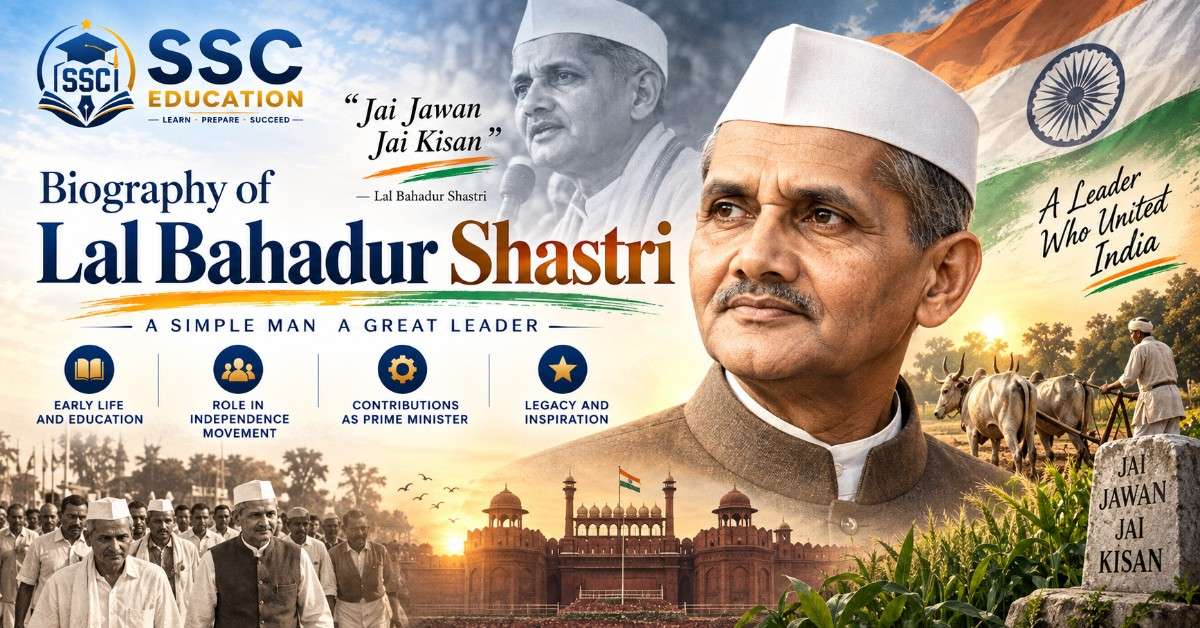
Biography of Lal Bahadur Shastri
Rahul Kumar
SSC Exam Expert & Content Editor
Table of Contents
- 1.Lal Bahadur Shastri Biography at a Glance (Quick Facts)
- 2.Who Was Lal Bahadur Shastri?
- 3.Lal Bahadur Shastri Early Life and Family
- 4.Lal Bahadur Shastri Education
- 5.Lal Bahadur Shastri in the Freedom Struggle
- 6.Lal Bahadur Shastri Political Career After Independence
- 7.Lal Bahadur Shastri as Prime Minister of India (1964–1966)
- 8.Lal Bahadur Shastri Contribution to India
- 9.Lal Bahadur Shastri Timeline (Year-Wise History)
- 10.Lal Bahadur Shastri Awards and Honours
- 11.Personality and Beliefs of Lal Bahadur Shastri
- 12.How Did Lal Bahadur Shastri Die? (Death Reason)
- 13.Lal Bahadur Shastri Legacy: Why He Is Remembered
- 14.Interesting Facts About Lal Bahadur Shastri
- 15.Lal Bahadur Shastri Biography: Important Points for SSC and Other Exams
- 16.Lessons Students Can Learn from Lal Bahadur Shastri
- 17.Related People and Topics
- 18.Key Takeaways
- 19.Lal Bahadur Shastri Biography: Frequently Asked Questions (FAQs)
Read the Lal Bahadur Shastri biography in simple words: early life, education, freedom struggle, contribution as the second Prime Minister, the 1965 war, Tashkent Agreement, death reason and important facts.
Lal Bahadur Shastri (2 October 1904 – 11 January 1966) was the second Prime Minister of India. This Lal Bahadur Shastri biography tells his life story, history and contribution in very simple words. He is famous for the slogan "Jai Jawan Jai Kisan", for leading India in the 1965 war with Pakistan, and for supporting the Green Revolution and the White Revolution. He was also the first person to get the Bharat Ratna after death. He died in Tashkent on 11 January 1966, one day after signing the Tashkent Agreement.
Lal Bahadur Shastri Biography at a Glance (Quick Facts)
| Detail | Information |
|---|---|
| Full Name | Lal Bahadur Shastri (born Lal Bahadur Srivastava) |
| Born | 2 October 1904 |
| Birthplace | Mughalsarai, near Varanasi, Uttar Pradesh (then United Provinces, British India) |
| Died | 11 January 1966 (aged 61) |
| Place of Death | Tashkent, Uzbekistan (then Soviet Union) |
| Famous For | Second Prime Minister of India, slogan "Jai Jawan Jai Kisan", 1965 war, Tashkent Agreement |
| Father | Sharada Prasad Srivastava |
| Mother | Ramdulari Devi |
| Wife | Lalita Devi (married 1928) |
| Children | Six: four sons (Hari Krishna, Anil, Sunil, Ashok) and two daughters (Kusum, Suman) |
| Education | Harish Chandra High School (Varanasi); Kashi Vidyapith, graduated in 1925 with the degree "Shastri" |
| Political Party | Indian National Congress |
| Term as Prime Minister | 9 June 1964 to 11 January 1966 |
| Major Honour | Bharat Ratna (1966, after death) |
| Memorial | Vijay Ghat, New Delhi |
Who Was Lal Bahadur Shastri?
Lal Bahadur Shastri was a freedom fighter, a Congress leader and the Prime Minister of India after Jawaharlal Nehru. He was a small man in height, only about five feet two inches, but he became one of the strongest leaders in Indian history. People remember him for his honesty, his simple life and his firm decisions in hard times.
He became Prime Minister in June 1964, when the country was in a difficult phase. Nehru had just died. India was short of food. China had defeated India in the 1962 war, and Pakistan was watching for a chance. In only 19 months, Shastri gave the country a new confidence. He handled a war, a food crisis and a language protest.
If you are looking for the Lal Bahadur Shastri history in one line, it is this: a poor village boy who lost his father at a very young age grew up to lead the world's largest democracy with truth and simplicity.
Lal Bahadur Shastri Early Life and Family
Birth and Birthplace
Lal Bahadur was born on 2 October 1904 in Mughalsarai, a railway town near Varanasi in Uttar Pradesh. This is the same date on which Mahatma Gandhi was born, 35 years earlier. Every year, 2 October is celebrated as Gandhi Jayanti, and many people also remember Shastri Ji on this day.
His family belonged to the Kayastha community and the surname of the family was Srivastava. In his childhood, the family called him "Nanhe", which means "the little one".
Parents and Childhood
His father, Sharada Prasad Srivastava, was a school teacher and later worked as a clerk in the revenue office in Allahabad. He died when Lal Bahadur was only about a year and a half old. His mother, Ramdulari Devi, had to bring up the family in very hard conditions.
Ramdulari Devi took her children to her father's house in Mughalsarai. His maternal grandfather, Hazari Lal, was a headmaster and he helped the family. Lal Bahadur grew up in this house with his two sisters. He learned early in life what poverty means, and this stayed with him for his whole life.
A story that people often tell is about his school days. It is said that the family had no money for the boat fare to cross the Ganga river, so Lal Bahadur swam across the river to reach his school. This story is a popular one and shows how much he loved to study.
Why He Dropped His Surname
When he was young, Lal Bahadur decided to leave his caste surname "Srivastava". He was against the caste system and wanted to be known only by his work. Later, when he finished his degree at Kashi Vidyapith, he got the title "Shastri", which means a scholar. From then on the world knew him as Lal Bahadur Shastri.
Lal Bahadur Shastri Education
Lal Bahadur studied in Mughalsarai at first. Then he went to Varanasi and studied at Harish Chandra High School, where he lived with his uncle. He was a shy and simple student, but he read a lot. He was inspired by the words of Swami Vivekananda, Mahatma Gandhi and Annie Besant.
In 1921, when Gandhi called for the Non-Cooperation Movement, Lal Bahadur was just 16 years old. He left his school and joined the movement. After some time, he joined Kashi Vidyapith, a national college started by freedom fighters in Varanasi. He studied philosophy and ethics there and passed in the first class in 1925. He got the degree of "Shastri" and the name became a part of his identity.
Lal Bahadur Shastri in the Freedom Struggle
The Non-Cooperation Movement (1921)
Shastri was arrested for the first time in December 1921 during the Non-Cooperation Movement. He was only 17 and, because he was a minor, the police released him soon. But this arrest showed that he was ready to give his youth to the freedom struggle.
Servants of the People Society
After his studies, Shastri joined the Servants of the People Society (Lok Sevak Mandal) in Lahore. The society was started by Lala Lajpat Rai to train young people for social and national work. Shastri worked for the welfare of the poor and the backward classes. Later he became the president of this society.
Marriage and a Simple Wedding
In 1928, Shastri married Lalita Devi from Mirzapur. The marriage is famous for its simplicity. Shastri did not take any dowry, though the bride's family offered it. It is said that he accepted only a charkha (spinning wheel) and a few yards of khadi cloth. The couple had six children: Kusum, Hari Krishna, Suman, Anil, Sunil and Ashok.
Jail Terms and Struggles
Shastri joined the Salt Satyagraha in 1930 and was sent to jail for two and a half years. He took part in the movement of farmers who refused to pay land revenue in 1932. He was jailed again in 1940–41 in the Individual Satyagraha and, in 1942, in the Quit India Movement. In total, he spent about nine years in British jails.
The jail days were not wasted. Shastri read the works of Western thinkers and social reformers. He also translated the story of the scientist Marie Curie into Hindi. His long stay in jail made him calm, patient and thoughtful.
After the Quit India Movement he stayed in jail until 1946. Then India was moving quickly towards independence, and Shastri returned to public life as a trusted worker of Nehru and Govind Ballabh Pant.
Lal Bahadur Shastri Political Career After Independence
Minister in Uttar Pradesh (1947–1951)
When India became free in 1947, Govind Ballabh Pant became the Chief Minister of Uttar Pradesh. Shastri joined his government as a Parliamentary Secretary and later as the Minister for Police and Transport. As Police Minister, he asked the police to use water jets instead of lathis to control crowds. As Transport Minister, he was the first to appoint women as conductors in public buses. These were new ideas in that time.
General Secretary of the Congress (1951)
In 1951, Nehru called Shastri to Delhi and made him the General Secretary of the All India Congress Committee. He worked hard in the first general election of 1951–52. The Congress won by a huge margin, and Shastri became a Rajya Sabha member in 1952.
Railway Minister (1952–1956)
From 1952, Shastri was the Railway Minister in Nehru's cabinet. In August 1956, a train accident took place at Mahbubnagar and Shastri offered to resign, but Nehru did not accept it. In November 1956, another big accident took place near Ariyalur in Tamil Nadu and more than 100 people lost their lives. Shastri again offered to resign and this time he insisted. Nehru accepted the resignation. He told the Parliament that he accepted it because it would set an example of moral responsibility, and not because Shastri was directly at fault.
This event made Shastri very famous for his honesty. Even today, in India, when a big accident takes place, people remember how Shastri quit his post on moral grounds.
Other Ministries (1957–1963)
After the elections of 1957, Shastri came back to the cabinet. He served as the Minister of Transport and Communications, and then as the Minister of Commerce and Industry. In April 1961, after the death of Govind Ballabh Pant, he became the Home Minister of India.
As the Home Minister, he set up the Santhanam Committee in 1962 to study corruption in public life. In 1963, under the Kamaraj Plan, many senior ministers left their posts to work for the party, and Shastri also left the cabinet. But after Nehru had a stroke in early 1964, Shastri came back as a minister without a portfolio and became his closest helper.
Lal Bahadur Shastri as Prime Minister of India (1964–1966)
How He Became the Prime Minister
Jawaharlal Nehru died on 27 May 1964. Gulzarilal Nanda worked as the acting Prime Minister for a short time. The Congress president K. Kamaraj and other senior leaders tried to find a name that all could accept. They chose Shastri because of his clean image and his gentle nature. He took oath as the second Prime Minister of India on 9 June 1964.
The Slogan "Jai Jawan Jai Kisan"
In 1965, India faced two problems at the same time. Pakistan attacked the border, and there was a food shortage at home. Shastri gave the slogan "Jai Jawan, Jai Kisan", which means "Hail the soldier, hail the farmer". It told the country that both the soldier who guards the border and the farmer who grows the food are equally important.
He also asked the people to skip one meal a week, so that the country could save food. Shastri and his family followed this rule first. People followed him in large numbers because they believed in him.
The 1965 War with Pakistan
In April 1965, there was a small fight in the Rann of Kutch. In August 1965, Pakistan sent armed men into Jammu and Kashmir in what it called Operation Gibraltar. In early September, Pakistan launched a big attack near Chhamb. Shastri gave the Indian Army full freedom to answer. On 6 September 1965, Indian troops crossed the international border towards Lahore.
The war went on for about 17 days. The battles of Haji Pir, Asal Uttar and Khem Karan are remembered from this war. A ceasefire was announced on 23 September 1965 with the help of the United Nations. Most Indians felt proud of the way Shastri led the country. People saw that this small man had the strength of a mountain.
The Tashkent Agreement (10 January 1966)
After the war, the Soviet Union invited Shastri and the Pakistani President Ayub Khan to Tashkent for talks. The Soviet Prime Minister Alexei Kosygin helped in the talks. On 10 January 1966, both leaders signed the Tashkent Agreement. They agreed to withdraw their armies to the positions held before August 1965 and to work for peaceful relations.
In India, some people did not like the return of the Haji Pir area, which India had captured. But Shastri believed that peace was more important than land gained in war.
Green Revolution and White Revolution
Shastri understood that India must produce its own food. His government supported the work of agriculture scientists and ministers like C. Subramaniam, and the use of high-yield seeds. This work started the Green Revolution in India, which later made the country self-sufficient in wheat.
In October 1964, Shastri visited the Amul dairy in Anand, Gujarat. He was so impressed by the cooperative model that he asked Dr. Verghese Kurien to spread it all over India. In 1965, the National Dairy Development Board (NDDB) was created. This became the base of the White Revolution (Operation Flood), which made India the largest milk producer in the world.
Other Work as Prime Minister
- Sri Lanka Pact (1964): The Sirima–Shastri Pact was signed to settle the matter of Indian Tamil people in Sri Lanka.
- Language protest (1965): When there were protests in Tamil Nadu over Hindi, Shastri gave the assurance that English would continue to be used as an official language.
- Food policy: The government set up the Food Corporation of India (1965) and started the system of minimum support price for farmers.
- Foreign policy: He followed the policy of non-alignment, but also improved ties with other countries.
Lal Bahadur Shastri Contribution to India
The Lal Bahadur Shastri contribution to India can be understood in five simple points:
- Strong leadership in the 1965 war: He gave the army freedom and the nation courage.
- Farmers and soldiers: He made "Jai Jawan Jai Kisan" a national mantra.
- Food security: He started the steps that led to the Green Revolution.
- Milk revolution: He backed the cooperative dairy model that led to Operation Flood.
- Clean politics: He set an example of honesty, moral responsibility and simple living.
Lal Bahadur Shastri Timeline (Year-Wise History)
| Year | Event |
|---|---|
| 1904 | Born on 2 October in Mughalsarai |
| 1906 | Father dies; family moves to maternal grandfather's house |
| 1921 | Joins the Non-Cooperation Movement and is arrested for the first time |
| 1925 | Passes from Kashi Vidyapith and gets the degree "Shastri" |
| 1928 | Marries Lalita Devi |
| 1930 | Joins the Salt Satyagraha and goes to jail |
| 1942 | Takes part in the Quit India Movement and is jailed again |
| 1947 | Becomes a minister in Uttar Pradesh after independence |
| 1951 | Becomes General Secretary of the All India Congress Committee |
| 1952 | Becomes the Railway Minister |
| 1956 | Resigns after the Ariyalur train accident |
| 1961 | Becomes the Home Minister of India |
| 1964 | Becomes the Prime Minister on 9 June |
| 1965 | Leads India in the war with Pakistan; gives the "Jai Jawan Jai Kisan" slogan |
| 1966 | Signs the Tashkent Agreement on 10 January and dies on 11 January |
Lal Bahadur Shastri Awards and Honours
| Honour | Details |
|---|---|
| Bharat Ratna (1966) | India's highest civilian award; he was the first person to get it after death |
| Vijay Ghat | His memorial on the bank of the Yamuna river in Delhi |
| Lal Bahadur Shastri National Academy of Administration | The training institute for IAS officers in Mussoorie is named after him |
| Lal Bahadur Shastri International Airport | The airport at Varanasi carries his name |
| Postage stamps | India has issued stamps in his memory |
Personality and Beliefs of Lal Bahadur Shastri
Shastri was known for his honesty. He never used his position to take any benefit for himself or his family. There is a well-known story that he took a loan of about ₹5,000 from a bank to buy a small car, even when he was the Prime Minister. After his death, his wife repaid the loan from the family pension. This story is widely told to show how simple his life was.
He was soft in speech but firm in decisions. He believed in truth, non-violence and duty. He liked to listen to everyone before he took a decision. He was also a man of faith. He respected all religions and never spoke against any community.
His idea of leadership was simple: "A leader must serve the people first." He did not like show and pomp. He wore simple khadi clothes and lived in a small house.
How Did Lal Bahadur Shastri Die? (Death Reason)
After signing the Tashkent Agreement on the evening of 10 January 1966, Shastri went to his residence (a dacha) near Tashkent. Late at night, he felt pain in his chest. He died in the early hours of 11 January 1966. The official reason for his death was a heart attack. He was 61.
His sudden death shocked the whole nation. His body was brought to Delhi and he was cremated with full state honours on 12 January 1966 at a place on the bank of the Yamuna. The place is now called Vijay Ghat.
Some people have doubted the cause of his death for many years. They ask why no post-mortem was done in India and want more details to be made public. The government has said that it does not have proof of any foul play. So the official position remains that he died of a heart attack. It is always best to read facts from reliable sources on this topic.
Lal Bahadur Shastri Legacy: Why He Is Remembered
Lal Bahadur Shastri served as the Prime Minister for just 19 months, but his impact is big even now. The slogan he gave is still used in speeches, on Republic Day and in books. His life is taught to school students as a model of honesty and hard work.
Every year, 2 October (his birthday) and 11 January (his death anniversary) are marked by tributes at Vijay Ghat. In 2019, a Hindi film called The Tashkent Files was made on the questions around his death, and it started a fresh discussion about him.
Interesting Facts About Lal Bahadur Shastri
- He was born on the same date as Mahatma Gandhi, 2 October.
- He was only about 5 feet 2 inches tall.
- His childhood nickname was "Nanhe".
- He dropped his caste surname Srivastava as he was against the caste system.
- He got the title "Shastri" from Kashi Vidyapith in 1925.
- He spent nearly nine years in jail during the freedom struggle.
- He was the first Home Minister to set up a committee (the Santhanam Committee) on corruption.
- He was the first person to receive the Bharat Ratna after death.
- He was the Prime Minister for only 19 months, from 9 June 1964 to 11 January 1966.
- He died in Tashkent, one day after signing the Tashkent Agreement.
- The Lal Bahadur Shastri National Academy of Administration in Mussoorie trains IAS officers.
- His son Anil Shastri and Sunil Shastri became politicians.
Lal Bahadur Shastri Biography: Important Points for SSC and Other Exams
- Second Prime Minister of India (9 June 1964 – 11 January 1966).
- Born in Mughalsarai (near Varanasi), Uttar Pradesh, on 2 October 1904.
- Slogan: "Jai Jawan Jai Kisan".
- Resigned as Railway Minister after the Ariyalur train accident of 1956.
- Home Minister from 1961 to 1963.
- The 1965 Indo-Pak war took place during his term.
- The Tashkent Agreement was signed on 10 January 1966 with Ayub Khan of Pakistan; the Soviet Prime Minister Kosygin helped.
- Died on 11 January 1966 in Tashkent.
- Samadhi: Vijay Ghat, New Delhi.
- First person to get the Bharat Ratna after death (1966).
- Started the National Dairy Development Board in 1965 (White Revolution).
- His party was the Indian National Congress.
Practice Questions (with Answers)
| Question | Answer |
|---|---|
| Who gave the slogan "Jai Jawan Jai Kisan"? | Lal Bahadur Shastri |
| Where was the Tashkent Agreement signed? | Tashkent (Uzbekistan, then in the Soviet Union) |
| Who was the second Prime Minister of India? | Lal Bahadur Shastri |
| Which ministry did Shastri leave after the Ariyalur accident? | Railway Ministry |
| What is the name of Shastri's memorial? | Vijay Ghat |
Lessons Students Can Learn from Lal Bahadur Shastri
- Poverty is not a barrier. Shastri was a poor child who lost his father at a very young age, and still he became the Prime Minister.
- Honesty matters. He quit his post on moral grounds, and this gave him respect for life.
- Be calm in hard times. He handled a war and a food crisis without losing his cool.
- Respect every worker. He gave equal respect to soldiers and farmers.
- Live simple, think big. He never cared about show, but his ideas were big.
Related People and Topics
If you want to read more about the same period, you can also read about Jawaharlal Nehru (the first Prime Minister), Mahatma Gandhi, Lala Lajpat Rai (the founder of the Servants of the People Society), Govind Ballabh Pant, Indira Gandhi (who became the Prime Minister after Shastri), Verghese Kurien (the milk man of India), the 1965 Indo-Pakistani War, and the Tashkent Agreement.
Key Takeaways
- Lal Bahadur Shastri (1904–1966) was the second Prime Minister of India.
- He is known for the slogan "Jai Jawan Jai Kisan", the 1965 war and the Tashkent Agreement.
- He started the steps that led to the Green Revolution and the White Revolution.
- He is remembered for honesty, simple living and moral courage.
- He died in Tashkent on 11 January 1966. The official reason is a heart attack.
Lal Bahadur Shastri Biography: Frequently Asked Questions (FAQs)
Q1. Who was Lal Bahadur Shastri?
Lal Bahadur Shastri was the second Prime Minister of India. He was also a freedom fighter and a senior Congress leader. He led the country from 9 June 1964 to 11 January 1966.
Q2. When and where was Lal Bahadur Shastri born?
He was born on 2 October 1904 in Mughalsarai, near Varanasi in Uttar Pradesh.
Q3. What was the real name of Lal Bahadur Shastri?
His birth name was Lal Bahadur Srivastava. He left the surname Srivastava, and later got the title "Shastri" from Kashi Vidyapith in 1925.
Q4. Who were the parents of Lal Bahadur Shastri?
His father was Sharada Prasad Srivastava, a school teacher, and his mother was Ramdulari Devi. His father died when he was only about a year and a half old.
Q5. Who was the wife of Lal Bahadur Shastri?
His wife was Lalita Devi. They married in 1928. They had six children, four sons and two daughters.
Q6. What is the famous slogan of Lal Bahadur Shastri?
His famous slogan is "Jai Jawan Jai Kisan". It means "Hail the soldier, hail the farmer". He gave it in 1965.
Q7. Why is Lal Bahadur Shastri famous?
He is famous for being an honest and simple Prime Minister, for the slogan "Jai Jawan Jai Kisan", for leading India in the 1965 war and for signing the Tashkent Agreement.
Q8. What was the contribution of Lal Bahadur Shastri?
He led India in the 1965 war, supported the Green Revolution, backed the White Revolution (NDDB and Operation Flood), and set a high example of honesty and moral responsibility.
Q9. How long was Lal Bahadur Shastri the Prime Minister?
He was the Prime Minister for about 19 months, from 9 June 1964 to 11 January 1966.
Q10. What did Lal Bahadur Shastri do in the freedom struggle?
He joined the Non-Cooperation Movement at the age of 16, the Salt Satyagraha in 1930, the Individual Satyagraha and the Quit India Movement. He spent about nine years in jail.
Q11. Why did Lal Bahadur Shastri resign as the Railway Minister?
He resigned in 1956 after a big train accident at Ariyalur in Tamil Nadu. He took the moral responsibility, even though he was not directly at fault.
Q12. What is the Tashkent Agreement?
It was a peace agreement between India and Pakistan signed on 10 January 1966 in Tashkent after the 1965 war. Both countries agreed to withdraw their armies to the earlier positions. The Soviet Union helped in the talks.
Q13. How did Lal Bahadur Shastri die?
He died on 11 January 1966 in Tashkent. The official cause is a heart attack. He died a day after signing the Tashkent Agreement.
Q14. Is there any mystery about the death of Lal Bahadur Shastri?
Some people have raised doubts because no post-mortem was done in India. The official position is that he died of a heart attack. The government has said that it has no proof of any other cause.
Q15. Where is the samadhi of Lal Bahadur Shastri?
His samadhi is called Vijay Ghat and is located on the bank of the Yamuna river in New Delhi.
Q16. Was Lal Bahadur Shastri given the Bharat Ratna?
Yes. He was given the Bharat Ratna in 1966 after his death. He was the first person to get the award after death.
Q17. What is the connection between Lal Bahadur Shastri and the Green Revolution?
His government supported the use of high-yield seeds and modern farming methods. This started the Green Revolution, which later made India self-reliant in food grains, especially wheat.
Q18. What is the connection between Lal Bahadur Shastri and the White Revolution?
In 1964 he visited Amul in Anand, Gujarat, and liked the cooperative model. He asked Dr. Verghese Kurien to spread it, and in 1965 the National Dairy Development Board was set up.
Q19. Which war happened during the time of Lal Bahadur Shastri?
The Indo-Pakistani War of 1965 was fought during his time as the Prime Minister. A ceasefire came on 23 September 1965.
Q20. Which institute is named after Lal Bahadur Shastri?
The Lal Bahadur Shastri National Academy of Administration in Mussoorie, which trains IAS officers, is named after him. The Varanasi airport is also named after him.
Q21. Who became the Prime Minister after Lal Bahadur Shastri?
Gulzarilal Nanda worked as the acting Prime Minister for a few days. Then Indira Gandhi became the Prime Minister on 24 January 1966.
Q22. What was Lal Bahadur Shastri's education?
He studied at Harish Chandra High School in Varanasi and then at Kashi Vidyapith, where he passed in the first class in 1925 and got the degree "Shastri".
Q23. What is the birth anniversary of Lal Bahadur Shastri?
His birth anniversary is 2 October, the same date as Gandhi Jayanti. The death anniversary is 11 January.
Q24. What can students learn from Lal Bahadur Shastri?
Students can learn honesty, simple living, courage in hard times and the idea that hard work can take a person from poverty to the highest post.
Rahul Kumar
SSC Exam Expert & Content Editor
Rahul is a senior SSC exam strategist with 8+ years of experience helping aspirants crack CGL, CHSL and MTS exams. He writes in-depth notification breakdowns, exam pattern guides and preparation strategies.