
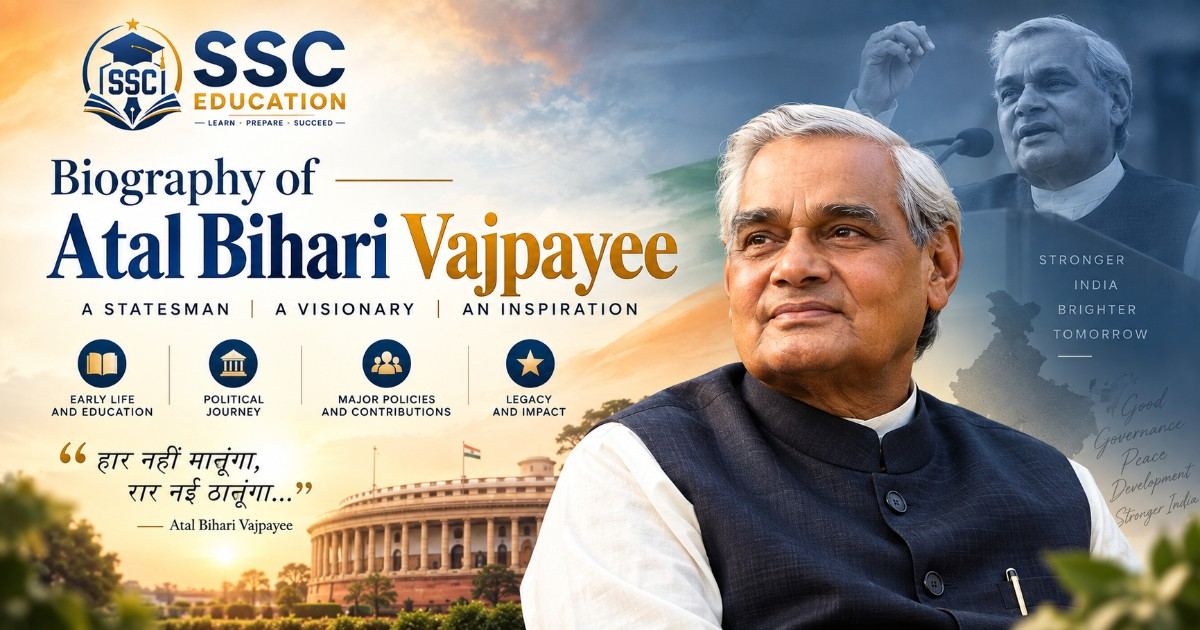
Biography of Atal Bihari Vajpayee
Rahul Kumar
SSC Exam Expert & Content Editor
Table of Contents
- 1.Introduction
- 2.Quick Facts: Atal Bihari Vajpayee
- 3.Early Life and Family
- 4.Education
- 5.The RSS and the Quit India Movement
- 6.Journalism and Poetry
- 7.The Jana Sangh and Entry into Parliament
- 8.Growing in Parliament (1957–1975)
- 9.The Emergency and the Janata Party (1975–1977)
- 10.Foreign Minister of India (1977–1979)
- 11.Founding the Bharatiya Janata Party (1980)
- 12.The Parliamentarian
- 13.Prime Minister for the First Time: The 13-Day Government (1996)
- 14.Second Term (1998–1999)
- 15.Third Term (1999–2004)
- 16.Pokhran-II: The Nuclear Tests (May 1998)
- 17.Lahore Bus Diplomacy (February 1999)
- 18.The Kargil War (May–July 1999)
- 19.Other Security Challenges
- 20.Foreign Policy: Clinton's Visit and Relations with the Major Powers
- 21.Economic Reforms and Infrastructure
- 22.Creation of Chhattisgarh, Uttarakhand and Jharkhand (2000)
- 23.Controversies of the Vajpayee Years
- 24.The 2004 Election and Retirement
- 25.Illness and Death
- 26.Vajpayee as an Orator and Poet
- 27.Personality and Personal Life
- 28.Honours and Recognition
- 29.Legacy
- 30.Lesser-Known Facts about Atal Bihari Vajpayee
- 31.Timeline of Atal Bihari Vajpayee's Life
- 32.Why Atal Bihari Vajpayee Is Important for SSC and Other Competitive Exams
- 33.Related Reading
- 34.Conclusion
- 35.Frequently Asked Questions
Complete biography of Atal Bihari Vajpayee: early life, RSS and Jana Sangh, BJP founding, three terms as Prime Minister, Pokhran-II, Lahore bus, Kargil, reforms, legacy, timeline and 25 FAQs for SSC exams.
Introduction
Atal Bihari Vajpayee (25 December 1924 – 16 August 2018) was a poet, journalist, orator and statesman who served as the Prime Minister of India three times, and who became the first leader outside the Congress to complete a full five-year term in that office. Affectionately called Atalji, he was a member of Parliament for more than four decades, the founding president of the Bharatiya Janata Party, India's Foreign Minister in 1977–79 and the man who took the country through the nuclear tests of Pokhran-II, the bus journey to Lahore and the Kargil War. In 2015 he was awarded the Bharat Ratna, India's highest civilian honour.
What made Vajpayee unusual was the combination of an uncompromising ideological background and a reputation for moderation. He grew up in the Rashtriya Swayamsevak Sangh (RSS) and led a party rooted in Hindu nationalism, yet he was known as a conciliator who led a broad coalition of many parties and earned respect from opponents. His speeches in Hindi, full of humour, poetry and pauses, were among the most admired in Indian public life. This biography follows his life from a schoolteacher's home in Gwalior to the highest office in the country, covering his early years, his career in Parliament, his three terms as Prime Minister, the major events of his tenure, the controversies and his legacy, along with a revision guide and FAQs for SSC and other competitive examinations.
Quick Facts: Atal Bihari Vajpayee
| Nationality | Indian |
|---|---|
| Best Known For | Prime Minister of India (1996, 1998–2004); Bharat Ratna recipient |
| Born | 25 December 1924, Gwalior, Madhya Pradesh (then part of the princely state of Gwalior) |
| Died | 16 August 2018, AIIMS, New Delhi (aged 93) |
| Father | Krishna Bihari Vajpayee, a schoolteacher and poet |
| Mother | Krishna Devi |
| Marital Status | Unmarried |
| Education | Victoria College, Gwalior; M.A. in Political Science from DAV College, Kanpur |
| Parties | Bharatiya Jana Sangh; Janata Party; Bharatiya Janata Party (founding president, 1980) |
| Prime Minister | 1996 (13 days), 1998–1999, 1999–2004 |
| Foreign Minister | 26 March 1977 – 28 July 1979 |
| Parliament | Elected ten times to the Lok Sabha and twice to the Rajya Sabha |
| Key Events | Pokhran-II (1998), Lahore bus journey (1999), Kargil War (1999) |
| Honours | Padma Vibhushan (1992), Lokmanya Tilak Award (1994), Best Parliamentarian (1994), Bharat Ratna (2015) |
| Birthday Observed As | Good Governance Day (25 December) |
Early Life and Family
Atal Bihari Vajpayee was born on 25 December 1924 in Gwalior, then the capital of a princely state in central India. His father, Pandit Krishna Bihari Vajpayee, was a schoolteacher who also wrote poetry in Hindi and Brajbhasha, and his mother, Krishna Devi, was a devout homemaker. The family belonged to the Kanyakubja Brahmin community, and the household, though modest, valued education and literature. His grandfather, Shyam Lal Vajpayee, had moved to Gwalior from the Morena area, and the family's ancestral village was Bateshwar near Agra.
The atmosphere at home shaped the boy in two ways. First, he grew up hearing poetry, and he began writing verse himself at an early age. Second, the family was religious and rooted in tradition, and it gave him a sense of duty to society. He was not a bookish recluse, however; friends described a cheerful boy who loved conversation, sweets and cinema, and who spoke with such confidence that he was soon known in school for his oratory.
Education
Vajpayee received his early education at the Saraswati Shishu Mandir in Gwalior and at a government school in the neighbourhood of Gorkhi. He then joined Victoria College in Gwalior (now known as Maharani Laxmibai Government College of Excellence), where he studied Hindi, English and Sanskrit and graduated with distinction. He won debating competitions and became known as a fine speaker. Since his family had little money, he studied with the help of a monthly scholarship from the ruling family of Gwalior, the Scindias, which supported talented students.
For his postgraduate studies, he moved to the DAV College in Kanpur, which was affiliated to Agra University, and completed an M.A. in Political Science in the first division. According to a story often told about his student days, he enrolled in a law course in Kanpur at the same time as his father, and the two of them attended the same class and lived in the same hostel — an episode that made them well known at the college. He did not complete the law degree, because he had by then decided to devote his life to public work.
The RSS and the Quit India Movement
Vajpayee's association with the Rashtriya Swayamsevak Sangh began in 1939, when he was about fourteen, and he attended the Sangh's shakhas in Gwalior as a swayamsevak. He took part in the RSS's officers' training camps in the early 1940s and, after finishing his studies, became a pracharak, a full-time worker, in 1947. Alongside this, in 1944 he served as the general secretary of the Arya Kumar Sabha, the youth wing of the Arya Samaj in Gwalior. The influence of the Arya Samaj and the RSS gave him a lifelong belief in cultural nationalism, discipline and service.
In August 1942, at the time of the Quit India Movement, he was arrested in Bateshwar, in Agra district, and spent about twenty-four days in custody. The details of his role in the movement and the circumstances of his release have been discussed by historians and biographers, but it is generally agreed that this was his first experience of prison, and that he was still a teenager and a student at the time. His involvement in the freedom struggle was therefore part of his early political education.
Journalism and Poetry
After becoming a pracharak, Vajpayee was sent to Lucknow to work on the RSS's publications. He worked with the leader Deendayal Upadhyaya on the Hindi monthly Rashtradharma, the weekly Panchjanya and the daily newspapers Swadesh and Veer Arjun, of which he became the editor. His writing was known for its simple language and its passion, and journalism gave him a deep understanding of political issues. He would return to writing and to poetry throughout his life. Among his poetry collections are Meri Ekyavan Kavitayen (My Fifty-One Poems), Kaidi Kaviraj Ki Kundaliyan, written while he was in prison during the Emergency, and others. Lines from his poems, such as those from "Geet Naya Gaata Hoon", in which he pledges neither to give up nor to accept defeat, are often quoted.
The Jana Sangh and Entry into Parliament
In 1951, when Syama Prasad Mookerjee founded the Bharatiya Jana Sangh as a political party, the RSS lent Vajpayee and Deendayal Upadhyaya to help organise it. Vajpayee became its national secretary for the northern region and was soon one of its best-known speakers. He worked closely with Mookerjee in the campaign about Kashmir, and was with him during the agitation in 1953, and after Mookerjee's death in detention in Kashmir in June 1953, he was among those who took the movement forward.
He lost a by-election at Lucknow in 1955, and in 1957 he contested from Mathura, Lucknow and Balrampur. He won at Balrampur in Uttar Pradesh and entered the Second Lok Sabha as one of the few representatives of the Jana Sangh, which had only four members. Despite the small number, he made a mark with his speeches on foreign policy and public affairs, and Prime Minister Jawaharlal Nehru is said to have taken note of the young member. In an anecdote told by many biographers, Nehru, while introducing Vajpayee to a foreign visitor, remarked that this young man would one day become the Prime Minister of India. Nehru and Vajpayee had many differences, but there was a mutual respect, and when Nehru died in May 1964, Vajpayee paid a moving tribute in the Rajya Sabha, calling him a man who reconciled opposites and who had accomplished things that seemed impossible.
Growing in Parliament (1957–1975)
From 1957 to 1975, Vajpayee was one of the most prominent opposition voices in Parliament. He served in the Lok Sabha for Balrampur (1957–62 and 1967–71), in the Rajya Sabha from Uttar Pradesh (1962–67) and later in the Lok Sabha from Gwalior (1971–77). He was known for his eloquence, his command of facts and his ability to criticise the government without losing courtesy. His speeches on the Indo-China war of 1962, on the Kashmir question and on economic policy made him a recognised authority on foreign affairs.
After the death of Deendayal Upadhyaya in 1968, Vajpayee became the president of the Bharatiya Jana Sangh, a position he held until 1972, and he steered the party towards a more moderate image. In this period, he tried to broaden its base and to build alliances with other opposition groups, a strategy that would become the hallmark of his political style.
The Emergency and the Janata Party (1975–1977)
On 25 June 1975, Prime Minister Indira Gandhi declared a national Emergency, suspending civil liberties, censoring the press and jailing thousands of opposition leaders. Vajpayee was arrested in Bangalore at the start of the Emergency, along with other opposition leaders, and later moved to a hospital in Delhi because of ill health. During his imprisonment, he wrote poems, some of which appeared in his collection Kaidi Kaviraj Ki Kundaliyan. In 1977, when the Emergency was lifted and elections were called, opposition groups, including the Jana Sangh, merged into the Janata Party, which won a landslide victory and formed the first non-Congress government at the Centre under Prime Minister Morarji Desai.
Foreign Minister of India (1977–1979)
Vajpayee was appointed the External Affairs Minister on 26 March 1977, and held the post until 28 July 1979. He worked to improve relations with neighbouring countries, notably Pakistan and China, and to restore the credibility of India's non-aligned foreign policy after the Emergency. He visited China in 1979, the first such high-level visit for many years, though he had to cut it short when Chinese forces attacked Vietnam.
His most remembered moment as Foreign Minister came in October 1977, when he addressed the United Nations General Assembly in Hindi — the first time that a speech in Hindi had been delivered at the world body. The speech was widely praised in India as a moment of linguistic pride and made a great impression on delegates. In 1979 the Janata government fell, after disagreements among its constituent parties, and Vajpayee resigned along with Prime Minister Desai.
Founding the Bharatiya Janata Party (1980)
When the Janata Party broke up in 1980 over the question of whether its members could continue to belong to the RSS, the former Jana Sangh members left and formed a new party, the Bharatiya Janata Party (BJP), in April 1980. Vajpayee was elected its first president and held the post until 1986. In his early speeches, he described the party's ideology as "Gandhian socialism" and "positive secularism", and he tried to give the party a broader and more moderate character than its predecessor.
The early years were disappointing. In the elections held after Indira Gandhi's assassination in 1984, the BJP won only two seats in the Lok Sabha, and Vajpayee himself was defeated in Gwalior by Madhavrao Scindia. The party then moved towards a more assertive form of Hindu nationalism under L. K. Advani, who became president in 1986, and it campaigned on the issue of the Ram temple at Ayodhya. In the 1989 elections it won 86 seats, and in 1991 it emerged as a major opposition party. Vajpayee, who had served in the Rajya Sabha from Madhya Pradesh from 1986 to 1991, was elected to the Lok Sabha from Lucknow in 1991, and represented that seat until 2009, a period of eighteen years.
The demolition of the Babri Masjid at Ayodhya on 6 December 1992 by a crowd of activists was a divisive event, and Vajpayee's speech in Lucknow the day before has been much discussed. He later expressed regret over the demolition; he was not among those charged in the criminal case, though several leaders of his party were. It remained a difficult chapter for his political legacy.
The Parliamentarian
By the 1990s Vajpayee had become one of the most respected figures in Parliament. He was elected to the Lok Sabha ten times and to the Rajya Sabha twice, and spent more than five decades in the two Houses, making him among the longest-serving parliamentarians in India's history. In 1994 he was chosen as the Best Parliamentarian, and in the same year he received the Lokmanya Tilak Award. In 1992, the government of P. V. Narasimha Rao awarded him the Padma Vibhushan, and in 1994 Rao also chose him to lead the Indian delegation to the United Nations Human Rights Commission in Geneva, a mark of the trust that even his political opponents placed in him.
Prime Minister for the First Time: The 13-Day Government (1996)
After the general elections of 1996, the BJP emerged as the largest party in the Lok Sabha, though it did not have a majority. President Shankar Dayal Sharma invited Vajpayee to form the government, and he was sworn in as Prime Minister on 16 May 1996. He was asked to prove his majority within two weeks, but could not find enough allies. On 28 May 1996, before the vote of confidence was held, he made a stirring speech in the Lok Sabha and announced his resignation. It was the shortest-lived government in India's history, with a tenure of about thirteen days, though he continued as caretaker until 1 June. In his speech he defended his party's record and declared that he would return to power with a strong mandate.
Second Term (1998–1999)
After two short-lived United Front governments, fresh elections were held in early 1998, and the BJP-led National Democratic Alliance (NDA), with more than a dozen parties, won enough seats to form a government. Vajpayee took oath as Prime Minister for the second time on 19 March 1998. His government lasted thirteen months. It came to an end on 17 April 1999, when the AIADMK led by J. Jayalalithaa withdrew its support, and Vajpayee lost the vote of confidence in the Lok Sabha by a single vote. In the next elections in September–October 1999, the NDA won a clear majority.
Third Term (1999–2004)
Vajpayee was sworn in for the third time on 13 October 1999, and served until 22 May 2004, completing a full five-year term. He was the first Prime Minister from outside the Congress to do so. He led a coalition of about two dozen parties with a common programme, the National Agenda for Governance, which set aside contentious issues such as the Ram temple, Article 370 and a uniform civil code. This political skill, holding together a diverse alliance for five years, is often counted among his main achievements. L. K. Advani served as Home Minister and, from June 2002, as Deputy Prime Minister.
Pokhran-II: The Nuclear Tests (May 1998)
Within two months of taking office in 1998, Vajpayee's government carried out a series of five underground nuclear tests at Pokhran in Rajasthan, on 11 and 13 May 1998. It came twenty-four years after India's first test, the "Smiling Buddha" of 1974, and marked the country's open entry into the club of nuclear-armed states. The tests, codenamed Operation Shakti, were prepared in secret under the guidance of scientists like A. P. J. Abdul Kalam, who was then the Scientific Adviser to the Prime Minister, and R. Chidambaram of the Atomic Energy Commission. Vajpayee announced the tests in a brief statement to the nation and later added the word Jai Vigyan ("Victory to Science") to the slogan Jai Jawan, Jai Kisan.
The reaction was strong. The United States, Japan and several other countries imposed economic sanctions, and Pakistan carried out its own tests two weeks later. Vajpayee wrote to world leaders, including US President Bill Clinton, to explain that India faced a security threat and that it would maintain a "no first use" policy and a voluntary moratorium on further testing. The sanctions were gradually eased over the next few years, and the tests are regarded by many Indians as a symbol of strategic self-confidence.
Lahore Bus Diplomacy (February 1999)
Only months after the tests, Vajpayee made a bold effort to improve relations with Pakistan. On 19 February 1999, he travelled by bus from Delhi to Lahore, on the inaugural run of a new Delhi–Lahore bus service, and was welcomed by Pakistani Prime Minister Nawaz Sharif. The two leaders signed the Lahore Declaration, which committed both countries to peaceful settlement of disputes, to reducing the risk of accidental nuclear war and to expanding trade and people-to-people contact. During the visit, Vajpayee also paid respects at the Minar-e-Pakistan, a gesture that many saw as an acceptance of Pakistan's existence. The hopes raised by Lahore, however, were soon shattered.
The Kargil War (May–July 1999)
In the spring of 1999, Pakistani soldiers and militants crossed the Line of Control and occupied heights in the Kargil sector of Jammu and Kashmir, overlooking the national highway to Leh. When the intrusion was discovered in early May, India launched Operation Vijay on 26 May. The Indian Army, supported by the Air Force, fought a difficult battle at extreme altitudes to recapture the peaks, in a conflict that cost more than five hundred Indian soldiers their lives. Vajpayee's government took the decision not to cross the Line of Control, a restraint that helped India to win international support, and the US and other countries pressed Pakistan to withdraw. By late July 1999, India had recovered the occupied positions, and 26 July is observed each year as Kargil Vijay Diwas.
Other Security Challenges
- IC-814 hijacking (December 1999): An Indian Airlines flight from Kathmandu to Delhi was hijacked and taken to Kandahar in Afghanistan. After a week of negotiations, the government released three jailed militants in exchange for the passengers, a decision that was widely debated.
- Parliament attack (13 December 2001): Terrorists attacked the Parliament building in New Delhi; security forces killed the five attackers, but several security personnel and a gardener lost their lives. India blamed Pakistan-based groups and mobilised its army along the border in Operation Parakram, leading to a tense military stand-off that lasted for many months.
- Agra Summit (July 2001): Vajpayee invited Pakistani President Pervez Musharraf, the architect of the Kargil operation, to Agra for talks, but the three-day summit ended without an agreement.
- 2003 peace initiative: In April–May 2003, Vajpayee offered "the hand of friendship" to Pakistan once again, and diplomatic ties and transport links, which had been severed after the Parliament attack, were restored, leading to a ceasefire on the Line of Control in November 2003.
Foreign Policy: Clinton's Visit and Relations with the Major Powers
Despite the sanctions after Pokhran, Vajpayee's government transformed relations with the United States. In March 2000, President Bill Clinton visited India, the first visit by a US President in twenty-two years, and the two countries signed a vision document for closer cooperation. Vajpayee's phrase describing India and the US as "natural allies" was often quoted. He also improved relations with China: during his visit to Beijing in 2003, India formally recognised Tibet as a part of China, and China in turn accepted Sikkim as part of India. He visited Russia, Europe and Southeast Asia, and strengthened ties with the countries of the Gulf and with Israel.
Economic Reforms and Infrastructure
Vajpayee's government continued and extended the economic reforms begun in 1991, with an emphasis on infrastructure, telecommunications and rural connectivity. Its main initiatives included:
- National Highways Development Project and the Golden Quadrilateral: A programme, launched in 2001, to build four- and six-lane highways connecting Delhi, Mumbai, Chennai and Kolkata, followed by North–South and East–West corridors. It is widely regarded as one of the government's greatest achievements.
- Pradhan Mantri Gram Sadak Yojana (2000): A scheme to connect villages with all-weather roads.
- Sarva Shiksha Abhiyan (2001): A national programme to make elementary education universal, which later became a flagship of education policy.
- New Telecom Policy (1999): A liberal framework that shifted the telecom sector from licence fees to revenue sharing, helped to spread mobile phones and led to a sharp fall in call rates.
- Electricity Act (2003): A law to reform the power sector and to encourage competition and private investment.
- Disinvestment: A separate ministry was created to sell government stakes in public sector companies, which led to the privatisation of enterprises such as Bharat Aluminium Company and Videsh Sanchar Nigam Limited.
- Antyodaya Anna Yojana (2000): A scheme to provide subsidised food grain to the poorest households.
- IT and technology: A strong push to the software and IT-enabled services industries, including the creation of an IT ministry and an IT Action Plan, which helped India to become a global hub for software.
The economy grew at a rate of more than seven per cent a year in the last years of the term, foreign exchange reserves increased and inflation stayed low, though critics noted that rural distress and unemployment remained serious problems.
Creation of Chhattisgarh, Uttarakhand and Jharkhand (2000)
In November 2000, Parliament created three new states through peaceful agreements: Chhattisgarh from Madhya Pradesh (1 November), Uttarakhand (then called Uttaranchal) from Uttar Pradesh (9 November) and Jharkhand from Bihar (15 November). The decision met long-standing regional demands without the violence that had marked earlier demands for statehood, and it is often cited as an example of Vajpayee's consensual style.
Controversies of the Vajpayee Years
A balanced account of his tenure must also mention the difficult episodes.
- The 2002 Gujarat violence: In February 2002, after a train coach carrying Hindu pilgrims was burned at Godhra, killing 59 people, widespread communal violence broke out in Gujarat, in which more than a thousand people, most of them Muslims, were killed. The Chief Minister, Narendra Modi, and the state government were strongly criticised. Vajpayee visited the affected areas, appealed for peace and, in a widely reported remark in Ahmedabad, reminded the Chief Minister of his raj dharma, the duty of a ruler to treat all subjects alike. He was criticised for not acting more firmly, and in later years he is reported to have expressed regret over the events.
- Prevention of Terrorism Act (2002): A strict anti-terror law passed in a joint session of Parliament after the attack on Parliament; it was criticised for misuse and repealed by the next government in 2004.
- Ayodhya tensions: Efforts by hardline groups to start construction at the disputed site in 2002 led to a tense stand-off, which was resolved without violence.
- Corruption allegations: The 2001 Tehelka sting operation on defence deals and the coffin scam involving Kargil war supplies embarrassed the government and led to the resignation of Defence Minister George Fernandes for a time.
- Curriculum and "saffronisation": Critics accused the government of introducing Hindu nationalist ideas in textbooks and institutions.
The 2004 Election and Retirement
By 2004 the government was in a strong position in public opinion, with good economic growth and a successful foreign policy. Encouraged by this, the BJP launched an advertising campaign called "India Shining" and decided to hold general elections about six months early. The result was a surprise. The BJP won 138 seats and the NDA about 185, while the Congress with 145 seats emerged as the largest party, and, with its allies in the United Progressive Alliance, was able to form a government under Manmohan Singh. Vajpayee resigned on 22 May 2004. Analysts have offered many explanations, including rural discontent, poor coalition management and the limits of the "India Shining" message.
In December 2005, at a rally in Mumbai, Vajpayee announced his retirement from active politics, saying that he would not contest future elections, and that L. K. Advani and Pramod Mahajan would be the "Ram and Lakshman" of the BJP. In 2007, he declined a suggestion of some parties that he be a candidate for the Presidency. He remained a much respected elder of Indian politics; Prime Minister Manmohan Singh once described him as the "Bhishma Pitamah" of the country's political life.
Illness and Death
In 2009, Vajpayee suffered a stroke that affected his speech and memory, and after that he stayed out of public life, living at his residence in Delhi under medical care. He made very few public appearances during his last years. In June 2018 he was admitted to the All India Institute of Medical Sciences (AIIMS) in Delhi with a kidney infection and other complications, and he died there on 16 August 2018, at the age of ninety-three. He was given a state funeral, and his last rites were performed on 17 August at the Rashtriya Smriti Sthal on the banks of the Yamuna, attended by leaders from across the political spectrum. The memorial there is called Sadaiv Atal.
Vajpayee as an Orator and Poet
Vajpayee was among the finest Hindi orators in modern India. His speeches were known for their rhythm, humour, pauses and skilful use of poetry, and he could hold audiences of lakhs as well as members of Parliament spellbound. He often attacked his opponents with wit rather than with anger, and it was said that even those who disagreed with his politics went to hear him speak. He drew upon Nehru's style and diction in his early years, but developed his own manner, with gestures, silences and a striking way of ending sentences. His speech in the Lok Sabha at the end of the 13-day government in 1996 and his tribute to Nehru in 1964 are still quoted as examples of parliamentary oratory.
His poetry reflected the same qualities. It ranged from patriotic and reflective verses to poems on personal suffering, and it was marked by simple, direct language. Several of his poems were set to music by well-known singers, including Jagjit Singh, in an album called Samvedna. Although he became a Prime Minister, he continued to describe himself as a poet who had strayed into politics.
Personality and Personal Life
Vajpayee never married. He is remembered as a warm, witty and unpretentious man who enjoyed food, music, cinema and company, and who was fond of children. He lived at the official residences allotted to him in Delhi with his foster daughter Namita, her husband Ranjan Bhattacharya and their family, who looked after him in his later years. His friends described a person who could disagree strongly without bitterness, who never allowed political conflict to spoil personal relationships and who had a rare capacity to forgive. Political opponents often spoke warmly of him, and this quality is often cited when discussing why he was able to lead a diverse coalition.
His political philosophy combined cultural nationalism, democratic pluralism and pragmatism. He believed in India's civilisational heritage but also in Parliament, coalition-building and dialogue, and he often described the country's Constitution as the basis of national unity. His emphasis on "Insaniyat, Jamhuriyat and Kashmiriyat" (humanity, democracy and Kashmir's tradition of tolerance) in the context of Kashmir became a well-known reference point for later discussions on the issue.
Honours and Recognition
- Padma Vibhushan (1992): India's second-highest civilian honour, awarded during the government of P. V. Narasimha Rao.
- Lokmanya Tilak Award (1994): Conferred by the Tilak Smarak Trust.
- Best Parliamentarian (1994): Awarded by the Indian Parliamentary Group.
- Bharat Ratna (2015): India's highest civilian honour, conferred on him in 2015, when President Pranab Mukherjee presented it at his residence because of his ill health.
- Good Governance Day: The Government of India declared his birthday, 25 December, as Good Governance Day from 2014.
- Memorials and names: Sadaiv Atal at Rashtriya Smriti Sthal in Delhi; the Atal Tunnel under the Rohtang Pass in Himachal Pradesh; the Atal Setu bridges; and schemes and institutions such as the Atal Pension Yojana and the Atal Innovation Mission carry his name.
Legacy
Vajpayee's legacy is discussed in three main areas. In domestic policy, he is credited with giving India its modern highway network and an accelerating telecom sector and with helping the economy to grow at a faster pace. In foreign and security policy, he is remembered for making India an open nuclear power while offering peace to Pakistan and building a new relationship with the United States. In politics, he is seen as the leader who made the BJP acceptable to a wider public and showed that a coalition of many parties could run a stable government for a full term. At the same time, critics argue that his government could have done more to prevent the Gujarat violence and to protect minorities, and they ask whether his moderate image was matched by the actions of his party. What is not in doubt is the deep respect he commanded across the political spectrum and the way in which his speeches, poems and public conduct became part of the country's political culture.
Lesser-Known Facts about Atal Bihari Vajpayee
- He studied law at the same college and in the same class as his father in Kanpur, according to a widely told story.
- He was the first person to speak in Hindi at the United Nations General Assembly, in 1977.
- He was elected to the Lok Sabha ten times, from Balrampur, Gwalior, New Delhi and Lucknow.
- He was the first Prime Minister from outside the Congress to serve a full five-year term.
- He led a coalition of about two dozen parties, the National Democratic Alliance.
- His first government in 1996 lasted just thirteen days.
- He travelled by bus to Lahore in February 1999, on the inaugural run of the Delhi–Lahore bus service.
- He was a poet whose collections include Meri Ekyavan Kavitayen and Kaidi Kaviraj Ki Kundaliyan.
Timeline of Atal Bihari Vajpayee's Life
| Year | Event |
|---|---|
| 1924 | Born at Gwalior on 25 December |
| 1939 | Joined the RSS as a swayamsevak |
| 1942 | Arrested during the Quit India Movement |
| 1947 | Became a pracharak of the RSS |
| 1951 | Joined the Bharatiya Jana Sangh |
| 1957 | Elected to the Lok Sabha from Balrampur |
| 1968 | Became president of the Jana Sangh |
| 1975 | Arrested during the Emergency |
| 1977 | Became Foreign Minister; addressed the UN in Hindi |
| 1980 | Became the first president of the BJP |
| 1991 | Elected to the Lok Sabha from Lucknow |
| 1996 | Prime Minister for thirteen days (May) |
| 1998 | Prime Minister again (19 March); Pokhran-II (May) |
| 1999 | Lahore bus journey (February); Kargil War (May–July); Prime Minister for the third time (13 October) |
| 2000 | Creation of Chhattisgarh, Uttarakhand and Jharkhand (November) |
| 2001 | Parliament attack (13 December) |
| 2004 | Lost the election; resigned on 22 May |
| 2015 | Awarded the Bharat Ratna |
| 2018 | Died at AIIMS, New Delhi on 16 August |
Why Atal Bihari Vajpayee Is Important for SSC and Other Competitive Exams
Vajpayee is a common subject in Indian polity, modern history and current affairs sections of SSC CGL, CHSL, MTS, GD Constable and Stenographer exams, and also in railway, banking and state-level tests. The commonly tested facts are:
- Prime Minister of India three times: 1996 (13 days), 1998–99 and 1999–2004; the first non-Congress PM to complete a full term.
- Founder-president of the Bharatiya Janata Party (1980).
- Pokhran-II nuclear tests in May 1998 (Operation Shakti); slogan "Jai Jawan, Jai Kisan, Jai Vigyan".
- Lahore bus journey and Lahore Declaration (February 1999); Kargil War (1999), Operation Vijay; Kargil Vijay Diwas on 26 July.
- Started the Golden Quadrilateral, PMGSY and Sarva Shiksha Abhiyan.
- Created the states of Chhattisgarh, Uttarakhand and Jharkhand in 2000.
- Awarded the Padma Vibhushan (1992) and the Bharat Ratna (2015); birthday, 25 December, is Good Governance Day.
- Died on 16 August 2018; memorial: Sadaiv Atal.
To remember the sequence of his terms, link them with the three big events: 1998 with Pokhran, 1999 with Lahore and Kargil, and 2004 with India Shining and the end of the NDA government.
Related Reading
Conclusion
Atal Bihari Vajpayee's life bridged the worlds of poetry and power. He rose from a schoolteacher's home in Gwalior to the highest office in the country, and, in doing so, showed that a leader with strong beliefs can also build consensus. His government took decisions that changed the country's strategic position and infrastructure, and it faced some of the hardest tests of a democracy, including war, terrorism and communal violence. Historians will continue to debate his record, but few will deny his gift for speech, his sense of humour and his ability to keep talking with those who disagreed with him. For students, his life provides a clear list of dates and events, and for all citizens, it remains a reminder of the value of dialogue in politics.
Frequently Asked Questions
Who was Atal Bihari Vajpayee?
Atal Bihari Vajpayee (1924–2018) was an Indian poet, orator and politician who served as Prime Minister three times, was the founding president of the BJP and received the Bharat Ratna in 2015.
When and where was Atal Bihari Vajpayee born?
He was born on 25 December 1924 in Gwalior, Madhya Pradesh.
How many times was Vajpayee the Prime Minister of India?
He was Prime Minister three times: for thirteen days in 1996, from March 1998 to April 1999, and from October 1999 to May 2004.
Who was the first non-Congress Prime Minister to complete a full term?
Atal Bihari Vajpayee was the first Prime Minister from outside the Congress to complete a full five-year term (1999–2004).
When was the BJP founded and who was its first president?
The Bharatiya Janata Party was founded in April 1980, and Atal Bihari Vajpayee was its first president.
What was Vajpayee's role as Foreign Minister?
He was India's External Affairs Minister from 26 March 1977 to 28 July 1979 in the Morarji Desai government, and became the first person to speak in Hindi at the UN General Assembly in 1977.
What was Pokhran-II?
Pokhran-II was a series of five nuclear tests carried out by India at Pokhran, Rajasthan, on 11 and 13 May 1998, during Vajpayee's government.
What was the Lahore bus diplomacy?
In February 1999, Vajpayee travelled by bus from Delhi to Lahore and signed the Lahore Declaration with Nawaz Sharif to promote peace and cooperation.
What happened in the Kargil War?
In 1999, Pakistani troops occupied heights in Kargil, and India launched Operation Vijay on 26 May; by late July India had recaptured them, and 26 July is observed as Kargil Vijay Diwas.
What is the Golden Quadrilateral?
It is a national highways project launched during Vajpayee's government to connect Delhi, Mumbai, Chennai and Kolkata with four- and six-lane roads.
Which states were created during Vajpayee's tenure?
Chhattisgarh, Uttarakhand and Jharkhand were created in November 2000.
What is the Sarva Shiksha Abhiyan?
It is a national programme launched in 2001 to make elementary education universal, started during Vajpayee's government.
What was the National Telecom Policy of 1999?
It was a policy that shifted telecom operators to a revenue-sharing model and helped to expand mobile services and reduce call rates.
What was the IC-814 hijacking?
In December 1999, an Indian Airlines flight was hijacked to Kandahar, Afghanistan, and the government released three militants in exchange for the passengers.
What was Operation Parakram?
It was the large-scale mobilisation of Indian troops along the border with Pakistan after the Parliament attack of 13 December 2001.
Why did the Agra Summit fail?
The July 2001 summit between Vajpayee and Pervez Musharraf ended without a joint declaration because of differences over Kashmir and terrorism.
What is meant by raj dharma in Vajpayee's speeches?
In 2002, Vajpayee reminded the Gujarat Chief Minister of his raj dharma, the duty of a ruler to treat all citizens without discrimination.
Why did the NDA lose in 2004?
The BJP-led NDA lost the 2004 election despite the India Shining campaign, and analysts point to rural discontent, coalition management and other factors.
When was Vajpayee awarded the Bharat Ratna?
He received the Bharat Ratna in 2015, presented by President Pranab Mukherjee at his residence.
What other awards did Vajpayee receive?
He received the Padma Vibhushan (1992), the Lokmanya Tilak Award (1994) and the Best Parliamentarian award (1994).
Which books of poetry did Vajpayee write?
His collections include Meri Ekyavan Kavitayen and Kaidi Kaviraj Ki Kundaliyan, among others.
Did Vajpayee ever marry?
No, Vajpayee remained unmarried throughout his life.
When did Atal Bihari Vajpayee die?
He died on 16 August 2018 at AIIMS, New Delhi, at the age of 93.
What is Sadaiv Atal?
Sadaiv Atal is the memorial to Vajpayee at Rashtriya Smriti Sthal in Delhi.
Why is 25 December celebrated as Good Governance Day?
The Government of India declared 25 December, Vajpayee's birthday, as Good Governance Day from 2014 to honour his contribution to administration.
Rahul Kumar
SSC Exam Expert & Content Editor
Rahul is a senior SSC exam strategist with 8+ years of experience helping aspirants crack CGL, CHSL and MTS exams. He writes in-depth notification breakdowns, exam pattern guides and preparation strategies.