
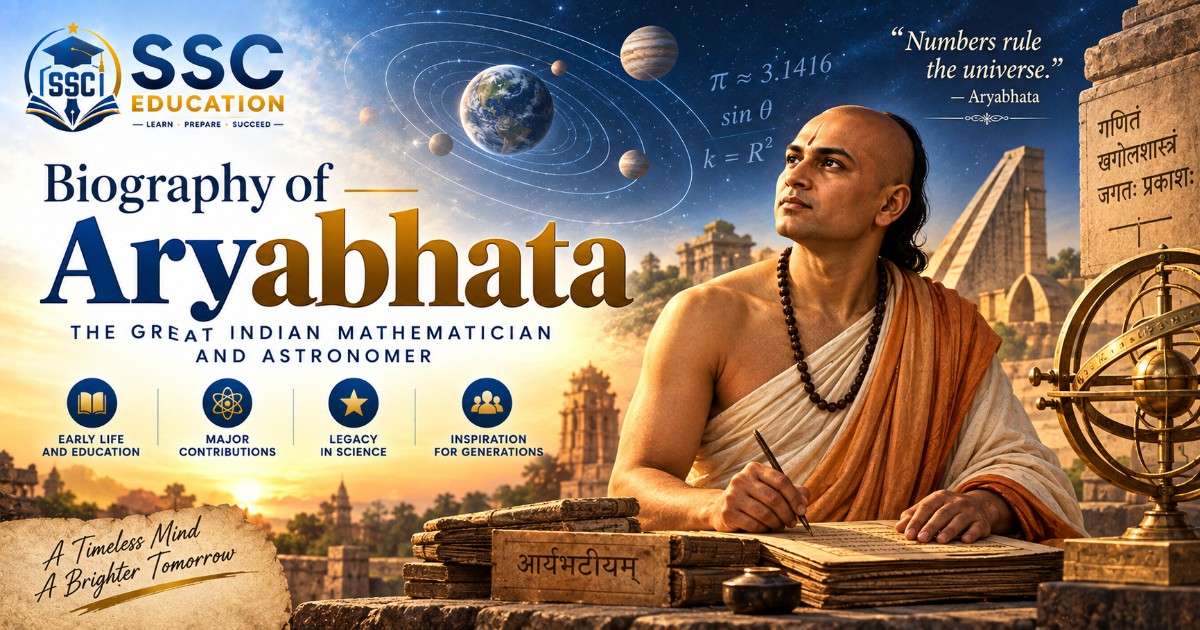
Biography of Aryabhata
Rahul Kumar
SSC Exam Expert & Content Editor
Table of Contents
- 1.Introduction
- 2.Quick Facts: Aryabhata
- 3.Who Was Aryabhata?
- 4.Birth and Early Life
- 5.Historical Background of Aryabhata's Time
- 6.Education and Intellectual Development
- 7.Aryabhata and Kusumapura
- 8.The Aryabhatiya
- 9.Aryabhata's Contributions to Mathematics
- 10.Aryabhata and the Number System
- 11.Aryabhata's Approximation of Pi
- 12.Aryabhata and Trigonometry
- 13.Geometry in Aryabhata's Work
- 14.Algebra and Indeterminate Equations
- 15.Aryabhata's Contributions to Astronomy
- 16.Aryabhata and the Rotation of the Earth
- 17.Aryabhata's Explanation of Solar and Lunar Eclipses
- 18.Astronomical Calculations
- 19.Aryabhata's Understanding of Time
- 20.Aryabhata's Scientific Approach
- 21.Aryabhata's Major Writings
- 22.Influence on Later Indian Scholars
- 23.Bhaskara I and Aryabhata's Legacy
- 24.Aryabhata's Influence Beyond India
- 25.Aryabhata's Place in the History of Mathematics
- 26.Aryabhata's Place in the History of Astronomy
- 27.What Aryabhata Did Not Do
- 28.Aryabhata's Legacy in Modern India
- 29.The Aryabhata Satellite
- 30.Aryabhata in Education
- 31.Important Facts About Aryabhata
- 32.Timeline of Aryabhata's Life and Work
- 33.Why Aryabhata Is Still Remembered
- 34.Frequently Asked Questions About Aryabhata
- 35.Related Reading
- 36.Conclusion
Aryabhata (476–550 CE) was ancient India's pioneering mathematician-astronomer who calculated an accurate value of pi, explained Earth's rotation, and authored the Aryabhatiya — the text that inspired India's first satellite.
Introduction
Aryabhata was one of the most important mathematicians and astronomers of ancient India. He lived during the fifth and early sixth centuries CE and made significant contributions to mathematics, astronomy, numerical computation, and the scientific understanding of celestial phenomena. His ideas became an important part of the intellectual history of India and influenced generations of scholars who studied his work.
Aryabhata is particularly remembered for his celebrated mathematical and astronomical treatise, the Aryabhatiya, composed in 499 CE when he was 23 years old, according to the traditional interpretation of the work's opening statement. The text is remarkably concise but covers subjects including arithmetic, algebra, geometry, trigonometry, methods of calculation, planetary movements, eclipses, and the measurement of time.
One of Aryabhata's most notable astronomical ideas was his explanation that the apparent daily movement of the stars could be understood through the rotation of the Earth. He also developed mathematical techniques for astronomical calculations and produced a highly influential approximation of the value of pi.
Although Aryabhata became famous in later centuries, surprisingly little is known with certainty about his personal life. Historical sources provide important information about his work and intellectual environment, but details such as his family background, childhood, and complete educational history remain uncertain.
His importance therefore comes primarily from his surviving mathematical and astronomical writings and from the influence those writings had on later Indian scientific traditions.
Quick Facts: Aryabhata
| Nationality | Indian |
|---|---|
| Best Known For | Ancient mathematician-astronomer, author of the Aryabhatiya |
| Full Name | Aryabhata |
| Born | c. 476 CE, Kusumapura (near modern Patna), India |
| Died | c. 550 CE |
| Profession | Mathematician and astronomer |
| Major Work | Aryabhatiya (499 CE) |
| Known For | Approximation of pi, place-value number system, theory of Earth’s rotation on its axis, early trigonometric tables |
| Honour | India’s first satellite, Aryabhata (launched 1975), is named after him |
Who Was Aryabhata?
Aryabhata was an Indian mathematician and astronomer whose work represents an important stage in the development of mathematical astronomy in South Asia.
He is generally associated with the Gupta-period intellectual environment, a period when mathematics, astronomy, literature, philosophy, and other branches of knowledge developed considerably in the Indian subcontinent.
Aryabhata's work stands out because he approached mathematical astronomy through systematic calculation. Rather than merely describing celestial events, he provided computational methods for determining astronomical quantities.
His name is sometimes written as Aryabhata I to distinguish him from a later mathematician and astronomer named Aryabhata II. The earlier Aryabhata is the scholar associated with the famous Aryabhatiya.
His major areas of contribution included:
-
Mathematics
-
Arithmetic
-
Algebra
-
Geometry
-
Trigonometry
-
Numerical approximation
-
Astronomical calculations
-
Calendar calculations
-
Planetary periods
-
Eclipse calculations
-
Mathematical treatment of time
Birth and Early Life
Aryabhata is traditionally dated to 476 CE. His exact birthplace, however, is not established with complete certainty.
The Aryabhatiya provides evidence that he was active in Kusumapura, a major intellectual centre traditionally identified with Pataliputra, present-day Patna in Bihar. Some historical interpretations suggest that Aryabhata may have been born elsewhere and later studied or worked at Kusumapura.
Because the available historical evidence is limited, statements about his childhood should be treated cautiously.
There are no reliable surviving records that provide the names of his parents, details about his family, or a complete account of his childhood education.
What can be established more confidently is that Aryabhata developed exceptional knowledge of mathematics and astronomy and became an important scholar while still relatively young.
The date 499 CE is especially significant because his Aryabhatiya was completed at an age traditionally interpreted as 23. If the traditional dating and interpretation are accepted, Aryabhata had already produced a sophisticated scientific work at a remarkably young age.
Historical Background of Aryabhata's Time
Aryabhata lived during a period of major intellectual activity in India.
The centuries around his lifetime saw important developments in Sanskrit scholarship, astronomy, mathematics, medicine, literature, and philosophy. Indian scholars had already developed sophisticated methods for mathematical calculation and astronomical observation before Aryabhata, and he inherited this established intellectual tradition.
Ancient Indian astronomy was closely connected with practical needs.
Accurate astronomical calculations were useful for:
-
Determining calendars
-
Establishing dates
-
Understanding seasons
-
Predicting eclipses
-
Calculating planetary positions
-
Organizing religious observances
-
Measuring time
Education and Intellectual Development
The exact details of Aryabhata's education are unknown.
There is no surviving biography describing where he went to school, who his teachers were, or precisely which texts he studied as a young student.
However, the sophistication of the Aryabhatiya demonstrates that he had mastered a wide range of mathematical and astronomical techniques.
His knowledge would have developed within a scholarly tradition that valued:
-
Mathematical computation
-
Astronomical observation
-
Geometry
-
Numerical methods
-
Calendar calculation
-
Sanskrit scientific literature
Kusumapura was an important centre of learning during this period and is strongly associated with Aryabhata's intellectual career.
His work also shows familiarity with earlier astronomical traditions. Rather than simply repeating inherited ideas, Aryabhata reorganized mathematical astronomy into compact computational rules.
This combination of inherited knowledge and original mathematical reasoning became one of the defining characteristics of his scholarship.
Aryabhata and Kusumapura
Kusumapura is one of the most important places associated with Aryabhata.
It is generally identified with Pataliputra, an ancient city that became an important centre of political and intellectual activity in northern India.
Aryabhata's association with Kusumapura is supported by later historical traditions and interpretations of his writings.
The city would have provided an environment where scholars could study mathematics, astronomy, literature, philosophy, and other disciplines.
Aryabhata's connection with Kusumapura also helps explain why later Indian scholars remembered him as part of an established scholarly tradition rather than as an isolated thinker.
However, the evidence does not allow historians to reconstruct exactly how long he lived there or every stage of his career.
The Aryabhatiya
Aryabhata's most famous surviving work is the Aryabhatiya.
The text was composed in 499 CE and became one of the most influential mathematical and astronomical works of classical India.
The Aryabhatiya is relatively short, but its compact format contains a remarkable amount of technical information.
The work is traditionally divided into four sections:
Gitikapada
This section contains astronomical constants and large units of time. It introduces some of the numerical framework used in Aryabhata's astronomical calculations.
Ganitapada
This section focuses on mathematics. It includes subjects such as arithmetic, geometry, algebraic procedures, and measurement.
Kalakriyapada
This part deals with calculations relating to time, calendars, and chronological systems.
Golapada
The final section deals with spherical astronomy and describes concepts concerning the Earth, celestial movements, eclipses, and related astronomical phenomena.
The structure of the text shows how closely mathematics and astronomy were connected in Aryabhata's intellectual system.
Aryabhata's Contributions to Mathematics
Aryabhata's mathematical contributions are among the most important parts of his legacy.
He developed systematic methods for solving mathematical problems that were useful for astronomy as well as for mathematical study itself.
His work included techniques involving:
-
Arithmetic
-
Fractions
-
Square roots
-
Cube roots
-
Geometric measurements
-
Series
-
Algebraic equations
-
Trigonometry
-
Indeterminate equations
One of his major strengths was his ability to express complicated mathematical procedures in concise Sanskrit verses.
These verses could be memorized and transmitted within scholarly traditions.
His approach demonstrates that mathematics in ancient India was not limited to abstract speculation. It was strongly connected to computation and practical astronomical requirements.
Aryabhata and the Number System
Aryabhata's work is associated with sophisticated numerical notation and computational methods.
However, it is important not to make the inaccurate claim that Aryabhata personally "invented the modern decimal system" in exactly the form used today.
The development of the Indian numeral system was a gradual historical process involving contributions from different scholars and periods.
Aryabhata nevertheless demonstrated advanced use of place-value ideas and numerical computation.
His astronomical calculations required handling extremely large numbers, and his methods show an impressive ability to work with such quantities.
The mathematical culture in which Aryabhata worked played an important role in the broader development of Indian numerical mathematics.
Aryabhata's Approximation of Pi
Aryabhata is famous for his approximation of pi (π).
He gave a value equivalent to approximately:
π ≈ 3.1416
This is remarkably close to the modern value:
π ≈ 3.141592653589793...
Aryabhata presented a mathematical relationship involving the circumference and diameter of a circle. His approximation was sufficiently accurate for many astronomical and mathematical calculations of his time.
The importance of this achievement lies not simply in the numerical value but also in the mathematical method used to derive it.
Accurate values of pi were essential for calculations involving circles, spheres, astronomical models, and geometric measurements.
His approximation became an important part of the history of mathematical computation.
Aryabhata and Trigonometry
Aryabhata made important contributions to trigonometry.
He developed and used tables related to the sine function, which he expressed through the Sanskrit term jya.
Trigonometric calculations were extremely important for astronomy because celestial positions could be represented through angular relationships.
Aryabhata's work provided computational methods for working with angles and chords.
His treatment helped establish a mathematical tradition in India in which trigonometric quantities were used systematically for astronomical calculations.
Later scholars expanded upon these ideas and developed increasingly sophisticated trigonometric techniques.
Geometry in Aryabhata's Work
Geometry played an important role in Aryabhata's mathematical system.
His work included calculations involving:
-
Triangles
-
Circles
-
Areas
-
Volumes
-
Geometric measurements
-
Relationships between dimensions
Some of his geometric procedures were closely connected to astronomy.
For example, astronomical models often require calculations involving circular and spherical forms.
Aryabhata's mathematical approach therefore combined theoretical geometry with practical computational needs.
Algebra and Indeterminate Equations
Aryabhata also contributed to the development of algebraic methods.
One important area associated with his mathematical tradition is the solution of indeterminate equations, particularly equations involving integer solutions.
These problems later became highly developed in Indian mathematics.
Aryabhata's work provided procedures that could be used to solve certain types of numerical problems efficiently.
His mathematical methods influenced later scholars, including Brahmagupta and Bhaskara I, who further developed Indian algebraic traditions.
Aryabhata's Contributions to Astronomy
Astronomy was arguably the central application of Aryabhata's mathematics.
He developed a mathematical framework for calculating celestial phenomena.
His astronomical work addressed:
-
Earth's rotation
-
Planetary movements
-
Solar and lunar eclipses
-
Day and night
-
Time measurement
-
Celestial coordinates
-
Planetary periods
-
Astronomical constants
Aryabhata's astronomy was mathematical rather than purely descriptive.
He sought numerical methods that could produce predictions and calculations.
This approach made his work especially influential among later Indian astronomers.
Aryabhata and the Rotation of the Earth
One of Aryabhata's most famous astronomical ideas concerns the rotation of the Earth.
The daily movement of stars across the sky might appear to suggest that the entire celestial sphere moves around Earth.
Aryabhata proposed a different interpretation.
He used an analogy involving a person travelling in a moving boat: objects outside the boat may appear to move in the opposite direction even though it is the observer who is moving.
In a similar way, Aryabhata explained the apparent westward movement of the stars as a consequence of Earth's rotation.
This was a significant conceptual achievement in the history of astronomy.
It demonstrates that Aryabhata was willing to explain apparent celestial motion through the movement of the observer rather than simply assuming that the sky itself was moving.
Aryabhata's Explanation of Solar and Lunar Eclipses
Aryabhata also provided mathematical explanations of eclipses.
Ancient cultures around the world developed different explanations for eclipses. Aryabhata treated solar and lunar eclipses as predictable astronomical events involving shadows.
A lunar eclipse occurs when the Moon enters Earth's shadow.
A solar eclipse occurs when the Moon passes between Earth and the Sun and its shadow falls on Earth.
Aryabhata developed computational methods for determining eclipse circumstances.
His treatment connected astronomical geometry with numerical prediction.
This was particularly important because eclipses could be calculated rather than treated merely as mysterious or unpredictable events.
Astronomical Calculations
Aryabhata calculated several astronomical constants and periods.
His work included numerical estimates concerning:
-
The length of the year
-
Planetary movements
-
Rotational periods
-
Celestial cycles
-
Units of time
His value for the length of the sidereal year was approximately 365 days, 6 hours, 12 minutes, and 30 seconds.
Although this differs slightly from modern measurements, it demonstrates the sophistication of his astronomical calculations.
Such calculations required systematic observation, mathematical models, and careful numerical procedures.
Aryabhata's Understanding of Time
Time measurement was an essential component of Indian astronomy.
Aryabhata used a hierarchy of time units and mathematical relationships to organize astronomical calculations.
His system connected:
Days → months → years → larger astronomical cycles
This allowed astronomical events to be expressed within a structured chronological framework.
The study of time was important not only for astronomy but also for calendar construction.
Aryabhata's work therefore contributed to the mathematical foundations of Indian calendrical traditions.
Aryabhata's Scientific Approach
One of Aryabhata's most important contributions was methodological.
He demonstrated how mathematical reasoning could be applied to natural phenomena.
Rather than treating astronomy simply as a collection of observations, he created computational models.
His approach involved:
-
Establishing numerical parameters.
-
Using mathematical relationships.
-
Calculating celestial positions.
-
Predicting astronomical events.
-
Expressing procedures in concise rules.
This approach helped strengthen the connection between mathematics and astronomy.
It also made his work easier for later scholars to use, criticize, refine, and expand.
Aryabhata's Major Writings
The Aryabhatiya is Aryabhata's major surviving work.
There are references in later literature to another work associated with Aryabhata, often called the Aryabhatasiddhanta, but it does not survive as a complete independent text.
The Aryabhatiya therefore remains the principal source for understanding Aryabhata's own ideas.
Later commentators played an important role in explaining difficult passages.
Among these commentators was Bhaskara I, who wrote an influential commentary on the Aryabhatiya in the seventh century.
Such commentaries helped preserve and transmit Aryabhata's mathematical and astronomical ideas.
Influence on Later Indian Scholars
Aryabhata's influence continued long after his lifetime.
Later Indian mathematicians and astronomers studied his work, interpreted his calculations, and developed new methods.
Important scholars influenced by the broader Aryabhata tradition included:
-
Bhaskara I
-
Brahmagupta
-
Lalla
-
Bhaskara II
-
Later Kerala-school mathematicians and astronomers
These scholars did not simply copy Aryabhata.
They often debated, modified, corrected, or extended earlier astronomical and mathematical ideas.
This intellectual debate helped Indian mathematics and astronomy continue to develop over many centuries.
Bhaskara I and Aryabhata's Legacy
Bhaskara I was one of the important early commentators on Aryabhata.
His commentary helped explain difficult mathematical and astronomical passages in the Aryabhatiya.
This is historically significant because Aryabhata's original text is extremely concise.
Without later explanations, some of its mathematical procedures would be difficult for modern readers to interpret.
Bhaskara I therefore played an important role in transmitting Aryabhata's ideas to subsequent generations.
Aryabhata's Influence Beyond India
Aryabhata's astronomical ideas eventually became known outside India.
Indian astronomical knowledge travelled through scholarly exchanges, particularly through translations and adaptations into other intellectual traditions.
His work influenced the development of mathematical astronomy in the Islamic world.
The Sanskrit astronomical tradition was studied and translated by scholars working in the Abbasid period.
Through these intellectual exchanges, Indian mathematical techniques became part of a broader history of scientific knowledge connecting South Asia, the Middle East, and later Europe.
Aryabhata's Place in the History of Mathematics
Aryabhata occupies an important position in the global history of mathematics.
His work demonstrates that advanced mathematical techniques were being developed in India during the fifth century.
His contributions to:
-
Trigonometry
-
Numerical computation
-
Algebra
-
Geometry
-
Mathematical astronomy
show the sophistication of classical Indian mathematics.
His approximation of pi and methods for astronomical calculations are particularly important examples of mathematical precision in the ancient world.
Aryabhata's Place in the History of Astronomy
Aryabhata's astronomy is notable for its mathematical character.
He attempted to explain celestial phenomena using quantitative methods.
His discussion of Earth's rotation is particularly significant because it provides a model in which apparent celestial motion can be explained through the movement of Earth.
His eclipse calculations also demonstrate how mathematical astronomy could be used to predict natural events.
These achievements made Aryabhata one of the most influential astronomers in the history of ancient India.
What Aryabhata Did Not Do
It is useful to distinguish historical evidence from popular claims.
Aryabhata should not automatically be credited with every later development in Indian mathematics.
For example, saying that he single-handedly invented the modern decimal numeral system would oversimplify a long historical development.
Similarly, the modern concept of zero as both a number and a placeholder developed through a broader Indian mathematical tradition over several centuries.
Aryabhata's work certainly belongs to that important tradition, but historical credit should be assigned carefully.
This distinction is important for producing an accurate biography rather than a collection of exaggerated claims.
Aryabhata's Legacy in Modern India
Aryabhata remains an important figure in modern Indian education and scientific history.
His name has been given to:
-
Schools and educational institutions
-
Mathematics and science programs
-
Awards and academic initiatives
-
Public monuments
-
Scientific projects
He is often introduced to students as an example of India's historical achievements in mathematics and astronomy.
His story is particularly valuable because it demonstrates how mathematical reasoning can be used to understand the natural world.
The Aryabhata Satellite
India's first satellite was named Aryabhata in his honour.
The satellite was launched on 19 April 1975 with Soviet assistance.
Naming the satellite after Aryabhata connected India's modern space program with its ancient scientific heritage.
The satellite itself belonged to a completely different technological era from Aryabhata's astronomy, but the name symbolized a historical continuity between India's mathematical tradition and its modern scientific ambitions.
Aryabhata in Education
Aryabhata's work continues to appear in discussions of:
-
Indian mathematics
-
History of science
-
Astronomy
-
Trigonometry
-
Mathematical heritage
-
Scientific education
His story provides an opportunity to show students that mathematical knowledge has developed across many civilizations.
Studying Aryabhata also helps demonstrate that the history of science is not limited to Europe or the modern period.
Indian scholars made significant contributions to mathematical and astronomical knowledge long before modern scientific institutions existed.
Important Facts About Aryabhata
Here are some important facts about Aryabhata:
-
Name: Aryabhata
-
Traditional birth year: 476 CE
-
Major work: Aryabhatiya
-
Date of Aryabhatiya: 499 CE
-
Associated scholarly centre: Kusumapura
-
Major fields: Mathematics and astronomy
-
Famous mathematical contribution: Accurate approximation of pi
-
Astronomical contribution: Mathematical treatment of celestial movements
-
Important idea: Explanation of apparent stellar motion through Earth's rotation
-
Eclipse work: Mathematical calculation of solar and lunar eclipses
-
Trigonometry: Important work involving sine calculations
-
Later influence: Indian and Islamic mathematical astronomy
-
Modern honour: India's first satellite was named Aryabhata
Timeline of Aryabhata's Life and Work
| Year | Event |
|---|---|
| 476 CE | Aryabhata is traditionally believed to have been born. |
| Late 5th Century CE | He developed his knowledge of mathematics and astronomy within the scholarly traditions of his time. |
| 499 CE | Aryabhata composed the Aryabhatiya. |
| 6th Century CE | His mathematical and astronomical ideas began influencing later scholars. |
| 7th Century CE | Bhaskara I produced an important commentary explaining Aryabhata's work. |
| Later Centuries | Aryabhata's astronomical tradition continued to influence Indian mathematical astronomy. |
| Medieval Period | Indian astronomical knowledge, including traditions associated with Aryabhata, became known in other regions through scholarly exchanges and translations. |
| 20th Century | Aryabhata became an important symbol of India's scientific heritage. |
| 19 April 1975 | India's first satellite, Aryabhata, was launched in his honour. |
Why Aryabhata Is Still Remembered
Aryabhata's legacy has survived for more than fifteen centuries because his work addressed fundamental questions about numbers, measurements, time, and the universe.
His achievements were not limited to one mathematical formula.
He created a connected system in which mathematics could be used to understand astronomy.
His work on numerical calculation made astronomical predictions possible. His trigonometric methods provided tools for celestial calculations. His explanation of Earth's rotation offered a different interpretation of apparent stellar movement. His eclipse calculations showed how mathematical astronomy could explain apparently dramatic celestial events.
Most importantly, his work became part of a continuing intellectual tradition.
Later scholars studied his writings, commented on them, challenged some of his ideas, and developed new mathematical techniques.
That continuing scholarly conversation is an important part of Aryabhata's historical significance.
Frequently Asked Questions About Aryabhata
Who was Aryabhata?
Aryabhata was an influential Indian mathematician and astronomer who lived during the fifth and early sixth centuries CE. He is best known for his Aryabhatiya, a major work covering mathematics and astronomy.
When was Aryabhata born?
Aryabhata is traditionally dated to 476 CE. The exact location of his birth is uncertain.
What is Aryabhata famous for?
He is particularly famous for his work in mathematics and astronomy, his approximation of pi, trigonometric calculations, eclipse computation, and his explanation of the apparent daily movement of stars through Earth's rotation.
What did Aryabhata write?
His principal surviving work is the Aryabhatiya, composed in 499 CE.
Where did Aryabhata live?
Aryabhata is strongly associated with Kusumapura, generally identified with ancient Pataliputra. The exact details of his residence and movements are not fully known.
Did Aryabhata discover zero?
It is more accurate to say that Aryabhata worked within an advanced Indian numerical tradition, but there is insufficient evidence to credit him alone with the invention of zero in its later fully developed numerical form.
What value of pi did Aryabhata calculate?
Aryabhata gave a value equivalent to approximately 3.1416, which is remarkably close to the modern value of pi.
What did Aryabhata say about Earth?
Aryabhata explained the apparent daily movement of the stars by proposing that Earth rotates on its axis.
Did Aryabhata predict eclipses?
His astronomical system included mathematical methods for calculating solar and lunar eclipses.
Why is Aryabhata important today?
Aryabhata is remembered as one of the major mathematicians and astronomers of ancient India. His work is important to the history of mathematics, astronomy, and scientific thought.
Related Reading
Conclusion
Aryabhata was a pioneering mathematician and astronomer whose work transformed mathematical astronomy in ancient India. Living more than 1,500 years ago, he developed sophisticated computational methods for studying numbers, geometry, trigonometry, time, and celestial movements.
His Aryabhatiya, composed in 499 CE, became a foundational text in the Indian mathematical and astronomical tradition. Its concise verses contained methods that later scholars studied, explained, expanded, and debated.
Aryabhata's approximation of pi demonstrated remarkable numerical accuracy. His work with sine calculations contributed to the development of trigonometry. His astronomical calculations addressed planetary movements, time, and eclipses. His explanation of apparent stellar motion through Earth's rotation remains one of the most recognizable aspects of his astronomical thought.
At the same time, an accurate biography must recognize the limits of historical evidence. Many details about Aryabhata's personal life, including his family and childhood, remain unknown. His historical importance comes primarily from his surviving work and the extensive intellectual tradition that developed around it.
Aryabhata's influence continued through later Indian scholars and eventually became part of wider scientific exchanges beyond India. Centuries after his death, his name was chosen for India's first satellite, symbolizing the country's connection between its ancient mathematical heritage and modern scientific achievements.
Today, Aryabhata remains an enduring figure in the history of mathematics and astronomy. His life and work demonstrate the power of mathematical reasoning to investigate the natural world and provide a lasting example of the sophistication of India's classical scientific traditions.
Rahul Kumar
SSC Exam Expert & Content Editor
Rahul is a senior SSC exam strategist with 8+ years of experience helping aspirants crack CGL, CHSL and MTS exams. He writes in-depth notification breakdowns, exam pattern guides and preparation strategies.