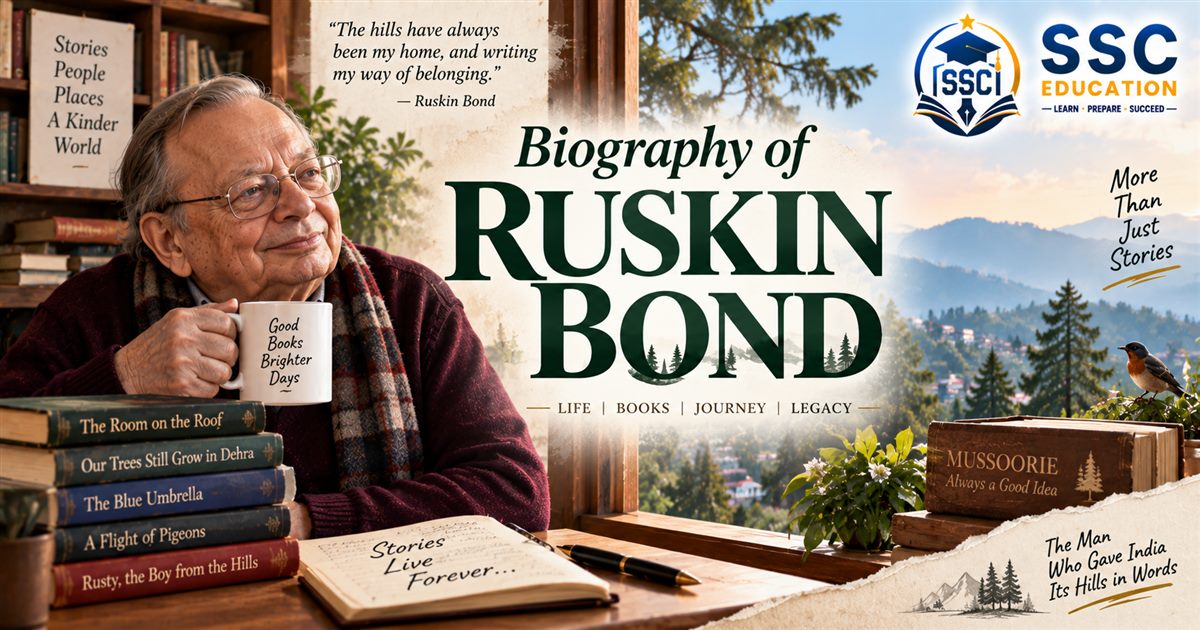
Ruskin Bond
Rahul Kumar
SSC Exam Expert & Content Editor
Table of Contents
- 1.Introduction
- 2.Who Is Ruskin Bond?
- 3.Early Life and Family Background
- 4.Childhood in India and Boarding School Life
- 5.Education at Bishop Cotton School, Shimla
- 6.The Channel Islands, London, and the Return to India
- 7.Career Beginnings in Delhi and Dehradun
- 8.Move to Mussoorie and Life in Landour
- 9.Famous Books and Writing Style
- 10.The Rusty Character: Bond's Fictional Alter Ego
- 11.Ruskin Bond on Film and Television
- 12.Awards and Honours
- 13.Personal Life
- 14.Ruskin Bond Today
- 15.Legacy and Influence on Indian Writing in English
- 16.Conclusion
- 17.Frequently Asked Questions About Ruskin Bond
The real, fact-checked life story of Ruskin Bond — his childhood loss, his broke years in London writing The Room on the Roof, his return to India, and seven decades in the hills of Landour, updated with his 2024 Sahitya Akademi Fellowship and 2026 milestones.
Introduction
Ruskin Bond is the writer most Indians grow up with. Long before "young adult fiction" was a marketing category, his stories about a lonely Anglo-Indian boy in the Doon Valley, a leopard on a Himalayan trail, or a ghost on a Mussoorie hillside were already teaching generations of readers that a good story doesn't need a big plot — it just needs an honest eye. Now in his nineties and still writing from his home in Landour, Bond has spent more than seventy years turning the hills above Dehradun into one of the most beloved literary landscapes in Indian writing.
This is the complete story of his life: where he came from, the loss and loneliness that shaped his early years, how a broke twenty-something in London wrote his way back to India, and how he became — almost by accident — the closest thing India has to a national grandfather of literature.
Quick Facts
- Full Name: Ruskin Bond
- Date of Birth: 19 May 1934
- Birthplace: Kasauli, Punjab States Agency, British India (present-day Himachal Pradesh)
- Nationality: Indian
- Heritage: Anglo-Indian
- Occupation: Author, essayist, short-story writer
- Notable For: The Room on the Roof, The Blue Umbrella, the "Rusty" stories
- First Novel: The Room on the Roof (1956)
- Major Awards: John Llewellyn Rhys Prize (1957), Sahitya Akademi Award (1992), Padma Shri (1999), Padma Bhushan (2014), Sahitya Akademi Fellowship (2024)
- Residence: Ivy Cottage, Landour, Mussoorie, Uttarakhand (since 1980)
Who Is Ruskin Bond?
Ruskin Bond is an Indian author of British descent, widely regarded as one of the pioneers of modern Indian writing in English for children and young readers — though his adult fiction and essays are just as widely read. Over a writing career spanning more than seven decades, he has published upward of 500 short stories, essays and novels, including around 69 books written specifically for younger readers.
What sets Bond apart from most literary figures of his stature is how unshowy his writing is. He rarely tackles grand political themes; instead he writes about a train journey, a jackfruit tree, a neighbour's dog, a memory of his father. That restraint is precisely what has kept his work in school syllabi, in railway-station bookstalls, and on bedside tables across India for three generations.
Early Life and Family Background
Ruskin Bond was born on 19 May 1934 in Kasauli, a small hill station in what was then the Punjab States Agency of British India. His father, Aubrey Alexander Bond, was British and had himself been born in a military camp at Shahjahanpur in North India; his mother, Edith Clarke, was Anglo-Indian. Ruskin had two siblings — a sister, Ellen, and a brother, William, who later settled in Canada.
For the first few years of his life, the family lived at the palace in Jamnagar, Gujarat, where Aubrey Bond worked as a tutor of English to the daughters of the ruling family. Bond has written fondly of this period — palace gardens, warm afternoons, and a small boy's curiosity about a world of princesses and courtiers that vanished from his life almost as soon as he could remember it.
In 1939, with the outbreak of the Second World War, Aubrey Bond joined the Royal Air Force, and the family moved to Dehradun, a town that would become far more important to Ruskin's imagination than any place he had lived before. It was around this time, when Ruskin was about eight years old, that his parents' marriage broke down. His mother remarried — a Punjabi Hindu businessman named Hari — and Ruskin found himself, almost overnight, a visitor in his own family. He was largely raised thereafter by his father, with whom he shared what he has since called the happiest years of his childhood: long afternoons spent reading together, trips to the cinema, and a companionship he never quite found again with any other adult.
That happiness was short-lived. In 1944, when Ruskin was just ten years old, Aubrey Bond died of malaria while posted with the RAF in Calcutta. He is buried in the Bhowanipore War Cemetery. Ruskin, away at boarding school at the time, was told the news by a teacher — a moment he has revisited in his writing again and again, describing the particular, disorienting quiet of a schoolroom the instant after such news arrives. The grief and rootlessness of that year would go on to shape almost everything he later wrote: his fiction returns obsessively to themes of absent parents, solitary children, and the search for a place to belong. It is not an exaggeration to say that a ten-year-old's loss at a Calcutta cantonment became, indirectly, the emotional engine of an entire literary career.
Childhood in India and Boarding School Life
After his father's death, young Ruskin was raised by his mother and stepfather, moving between Dehradun and various relatives, with long stretches spent at boarding school in the hills above Mussoorie. It was not an easy adjustment. He has described himself as a quiet, somewhat withdrawn child who never quite felt he fitted the boisterous, sports-obsessed culture of an Anglo-Indian boarding school.
What boarding school life did give him, however, was solitude — and solitude, for Bond, became a kind of apprenticeship. Cut off from the easy company other children seemed to find effortless, he turned to books and, before long, to his own writing. He has often said that loneliness taught him to observe: the changing light on a hillside, the particular sound of a train at night, the small cruelties and kindnesses of schoolboy life. These became the raw material of nearly everything he wrote in adulthood.
Dehradun itself — with its tree-lined avenues, its bazaars, and its nearness to the hills — became a kind of emotional home base even during these unsettled years, and it would later supply the setting for his most famous novel. He has recalled cycling through the town's quieter lanes, watching the fruit-sellers and rickshaw-pullers, and filing away details he would not consciously use for another decade. Even as a schoolboy shuttled between guardians, he seems to have understood, instinctively, that he was collecting material.
Education at Bishop Cotton School, Shimla
Bond's formal schooling took place at the Bishop Cotton School in Shimla, one of India's oldest boarding schools, where he studied until his graduation in 1951. It was here that his writing first found an audience beyond himself. He won two school literary prizes — the Irwin Divinity Prize and the Hailey Literature Prize — and, at the age of sixteen, wrote one of his earliest short stories, titled "Untouchable."
He was, by his own account, an average student outside the English classroom, more drawn to the school library than to the playing field. He read widely and unsystematically: Charles Dickens taught him how ordinary lives could carry a whole novel; the Brontë sisters showed him what atmosphere and landscape could do to a story; Rudyard Kipling, despite the colonial baggage Bond would later distance himself from, gave him a template for writing about India's hills and forests with real texture; and T. E. Lawrence's prose left him with a lasting taste for spare, unadorned sentences. It was at Bishop Cotton that he began to think of writing not as a hobby but as something he might actually do with his life.
By the time he left school in 1951, Bond had already decided, with the slightly reckless confidence of a teenager, that he wanted to be a writer. What he lacked was any clear idea of how a person actually became one, or how he would support himself while he found out.
The Channel Islands, London, and the Return to India
After school, like many Anglo-Indian families of the period, Bond's relatives urged him toward England, where they believed a young man with his background might find better prospects. He spent roughly two years, from 1951 to 1953, living with relatives in the Channel Islands before moving on to London.
England did not agree with him. He took whatever work he could find — including a stint developing prints at a photography studio — while the cold, the unfamiliar rhythms of English life, and above all a deep homesickness for India wore at him. Money was tight enough that he sometimes skipped meals to save on rent, and he has described the London of those years as grey in every sense — grey skies, grey buildings, and a grey, closed-off social life that never let him feel at home.
It was during these lean years, living in a small bedsit and writing in whatever spare time he could find after work, that he began the novel that would define his career: The Room on the Roof, the story of Rusty, a restless Anglo-Indian teenager who runs away from his guardian's strict household in Dehradun to live among Indian friends in the bazaar. Bond has said plainly that writing it was an act of homesickness — a way of living, on the page, in the India he had left behind. Every lane, every character, and every small rebellion in the novel was drawn almost directly from his own adolescence.
The novel was published in 1956, when Bond was twenty-two, and in 1957 it won the John Llewellyn Rhys Prize, a prestigious award for Commonwealth writers under thirty. The prize money did more than validate his ambition — it gave him, quite literally, the fare home. Bond used it to return to India for good, a decision he has never once suggested he regretted. "My return to India," he later wrote, "made me the writer I am. If I'd stayed in England, I don't think I'd have written another book."
Career Beginnings in Delhi and Dehradun
Back in India in the mid-1950s, Bond discovered that a prize-winning first novel does not pay the rent. He spent the next several years shuttling between Delhi and Dehradun, scraping together a living as a freelance writer — short stories, essays, and the occasional piece of journalism, sold to whichever newspaper or magazine editor would buy them that month. Payments were small and irregular, and by his own description these were lean, uncertain years, spent in a series of modest rented rooms with little furniture beyond a writing table.
They were also, he has said, some of the freest years of his life. Without a fixed job or a family of his own to support, he was able to write on his own terms, and it was during this period that he built the habits — daily writing, close observation of ordinary life, a refusal to chase literary fashion — that would define his work for the next six decades. He continued to mine his own life and surroundings for material: small-town India, railway platforms, the people who passed briefly through his days and stayed permanently in his stories. More than once he could have taken a steadier, better-paid job and given up freelancing altogether; he chose, each time, to keep his mornings free for writing instead — a trade-off he has never once described as a sacrifice.
Move to Mussoorie and Life in Landour
In 1963, Bond moved to Mussoorie, taking a job editing a local magazine for around four years — his only real stretch of salaried employment as an adult — before deciding the security wasn't worth the time it took from his own writing, and returning to full-time freelance work. This was also the decade in which his career as a children's writer properly began: in 1972 he published Angry River, his first book written specifically for younger readers, and children's fiction would go on to become one of the largest and most enduring parts of his body of work.
In 1980, Bond settled permanently into Ivy Cottage, a small house in Landour, the quiet cantonment town just above Mussoorie, and it has remained his home ever since — well over four decades now. Landour's mist, deodar forests, and slower rhythm of life seeped directly into his fiction: the hills stopped being a backdrop and became, in a real sense, a character in his stories. His writing desk, by most accounts, looks out over exactly the kind of hillside that fills his essays — changing light, wandering fruit-sellers, the odd langur crossing the tin roof.
Bond never married. Instead, he built his family in Landour itself: he has lived for decades with an adopted family, sharing Ivy Cottage with them across generations, and by now several generations of that family have grown up under his roof. Visitors and fans still travel to Landour hoping for a glimpse of him, and locals describe an author who, despite his fame, has remained approachable — happy to sign a book or chat with a stranger at a local bookshop, in a way that has made him something like an informal town landmark.
Famous Books and Writing Style
Bond's bibliography is enormous — more than 500 short stories, essays and novels — but a handful of books capture the full range of what he does best.
The Room on the Roof (1956) remains his signature work — the semi-autobiographical story of Rusty, written when Bond was barely out of his teens, that launched both his career and the fictional alter ego he would return to across an entire series of follow-up books.
The Blue Umbrella, set in a small Himalayan village, follows a young girl named Binya and the prized umbrella that becomes the object of a neighbour's envy. Its simplicity is deceptive — underneath a children's story sits a quietly sharp study of desire and guilt, and it was later adapted into an award-winning film.
A Flight of Pigeons, set against the 1857 uprising, is one of Bond's rare forays into historical fiction, focused on a British family sheltered by an Indian household during the conflict — a story about loyalty across the very divides the rebellion was fought over. It later formed the basis of Shyam Benegal's film Junoon.
Our Trees Still Grow in Dehra, a short-story collection steeped in nostalgia for the Dehradun of his youth, won him the Sahitya Akademi Award in 1992. The Night Train at Deoli, meanwhile, is often cited as one of the finest short stories in Indian English literature — a few pages built around a fleeting railway-platform encounter that Bond never over-explains, letting the silence do the emotional work.
Susanna's Seven Husbands, a darkly comic novella about a woman whose husbands keep meeting untimely ends, shows a very different, sharper-edged side of Bond's writing, and was later expanded into the film 7 Khoon Maaf. Angry River, his first children's book, follows a young girl stranded on a river island during a flood, and set the template for the gentle, nature-driven adventure stories he would go on to write for younger readers over the following decades.
Beyond fiction, Bond has written extensively about nature and memory in essay form — collections like Rain in the Mountains gather decades of observation about the Himalayan seasons, wildlife, and small-town life — and he has published two volumes of autobiography, Scenes from a Writer's Life (covering his first twenty-one years) and Lone Fox Dancing, along with the reflective essay collection The Lamp Is Lit. Across all of it, his style stays remarkably consistent: short sentences, unforced emotion, and an almost complete absence of literary showing-off.
The Rusty Character: Bond's Fictional Alter Ego
No discussion of Bond's writing is complete without Rusty — the lonely, half-English, half-Indian teenager who first appeared in The Room on the Roof and became, over the following decades, Bond's most enduring fictional creation. Rusty is not a disguised version of Bond so much as a slightly reorganised one: an orphaned or semi-orphaned Anglo-Indian boy, uneasy in the world of strict guardians and colonial-era conventions, who finds freedom and belonging among ordinary Indian friends in Dehradun's bazaars and back lanes.
Bond returned to the character across numerous books — among them Vagrants in the Valley, Rusty and the Leopard, Rusty Runs Away, Rusty Goes to London, Rusty Comes Home, and Rusty and the Magic Mountain — effectively building a coming-of-age saga in instalments, written and published across a span of more than fifty years. For many Indian readers, Rusty was their first fictional friend: a character who grows up, leaves, comes back, and keeps discovering that home is less a place than a feeling.
Ruskin Bond on Film and Television
Several of Bond's stories have made the jump to screen, which has introduced his work to audiences who may never have picked up one of his books.
- Junoon (1978) — Shyam Benegal's acclaimed film, produced by and starring Shashi Kapoor, was based on A Flight of Pigeons.
- The Blue Umbrella (2005) — Vishal Bhardwaj's film adaptation won the National Film Award for Best Children's Film.
- 7 Khoon Maaf (2011) — based on Bond's story "Susanna's Seven Husbands," this film gave Bond himself a rare on-screen cameo, playing a bishop.
- Ek Tha Rusty — a Doordarshan television series built around his most famous fictional creation.
- Parchhayee: Ghost Stories by Ruskin Bond — a Zee5 anthology series adapting several of his supernatural short stories.
These adaptations underline something worth noting about Bond's fiction: its visual, atmospheric quality — the mist, the mountain light, the sense of place — translates almost as naturally to screen as it does to the page.
Awards and Honours
Bond's recognition has arrived steadily across his career rather than in one sudden burst, which is fitting for a writer whose reputation was built the same way.
- 1957 — John Llewellyn Rhys Prize, for The Room on the Roof
- 1992 — Sahitya Akademi Award, for Our Trees Still Grow in Dehra
- 1999 — Padma Shri, one of India's highest civilian honours
- 2012 — Sahitya Akademi's Bal Sahitya Puraskar, recognising his contribution to children's literature
- 2014 — Padma Bhushan, India's third-highest civilian award
- 2024 — Sahitya Akademi Fellowship, the Akademi's highest honour, presented to Bond at his Landour home on 11 May 2024 (the ceremony was brought to him in view of his age and health)
Together, these awards trace an unusual arc — from a young prize for a first novel to, seven decades later, a lifetime achievement honour delivered not on a stage in Delhi but at the writer's own front door in the hills he never really left. It is also worth noting how evenly they are spread across his life: unlike writers whose recognition arrives in a single career-defining rush, Bond has now been formally honoured in five separate decades, from his twenties to his nineties — a rare kind of sustained, lifelong acknowledgment.
Personal Life
Ruskin Bond never married, choosing instead a life built around writing and a small, close circle of people in Landour. He has lived for decades with an adopted Punjabi family at Ivy Cottage — a household that has, over the years, grown to include children and grandchildren he considers his own, even though none are related to him by blood. He has spoken warmly, in interviews and essays, about the noise and chaos a large adopted family brings to a writer's otherwise solitary life, and has generally suggested he would not have wanted it any other way.
His routine, by most accounts, has stayed remarkably stable across the decades: mornings given to reading and writing, afternoons for visitors and the occasional walk, evenings spent quietly at home. He remains a familiar, approachable figure in Landour and Mussoorie — readers who make the trip up the hill still stand a reasonable chance of finding him at a local bookshop, signing books and trading a few words with strangers who grew up on his stories. Locals and long-time visitors describe him as unfailingly polite even with uninvited fans, a trait fairly rare among writers of his level of fame.
Ruskin Bond Today
Bond turned 92 on 19 May 2026, an occasion marked by HarperCollins with cake-cuttings at 92 bookstores across India — a fittingly quiet, book-shaped way to celebrate a writer who has spent his whole life avoiding grand gestures. He remains active: Life's Magic Moments was published in January 2025, and his 92nd birthday itself saw two new releases, All-Time Favourite Friendship Stories (Puffin Books) and How to Laugh (HarperCollins India). Even in his nineties, Bond continues to write daily, granting interviews from Ivy Cottage and remaining, by every account, sharp, warm, and characteristically unimpressed with his own fame.
Legacy and Influence on Indian Writing in English
It's difficult to overstate how many Indian readers had their first real encounter with English-language fiction through a Ruskin Bond story in a school textbook. That alone would secure his place in Indian literary history — but his influence runs deeper than syllabi. He helped establish that Indian writing in English didn't need to imitate the West or perform its Indianness for an international audience; it could simply describe a Dehradun bazaar, a Himalayan monsoon, or a lonely schoolboy's afternoon, and let the writing's honesty carry it.
That example has shaped a generation of Indian writers who came after him, particularly in children's and young-adult fiction, a genre Bond did more than almost anyone to legitimise in the Indian market. Publishers and editors have repeatedly credited him with proving that Indian children's writing in English could sell on its own terms, without leaning on Western settings or imported tropes.
His stories are still assigned in classrooms, still handed down between siblings, and still — remarkably, for an author first published in the 1950s — discovered fresh by new readers every year. Few living writers anywhere in the world can claim readers spanning four full generations of the same country, from grandparents who read him as schoolchildren to their grandchildren picking up the same stories today.
Conclusion
Ruskin Bond's life reads almost like one of his own short stories: a difficult, rootless childhood; a stubborn decision to become a writer against fairly hopeless odds; a long, quiet, unglamorous middle stretch of freelance work; and, eventually, a settled old age in the one place that ever felt like home. What makes that life worth reading about isn't drama — it's the same thing that makes his fiction worth reading. He noticed things, he stayed honest about what he noticed, and he kept doing it for seventy years. Few writers, anywhere, have earned their readers' trust as thoroughly or as quietly.
Frequently Asked Questions About Ruskin Bond
How old is Ruskin Bond?
Ruskin Bond was born on 19 May 1934 and turned 92 on 19 May 2026. He remains active and continues to write from his home in Landour.
Where does Ruskin Bond live now?
He lives at Ivy Cottage in Landour, a small cantonment town above Mussoorie in Uttarakhand, where he has made his home since 1980.
Is Ruskin Bond still alive?
Yes. As of 2026, Ruskin Bond is alive, based in Landour, and continues to write and publish new books.
What is Ruskin Bond's most famous book?
The Room on the Roof (1956), his semi-autobiographical debut novel about the fictional Rusty, is generally considered his most famous and influential work.
What awards has Ruskin Bond won?
His major honours include the John Llewellyn Rhys Prize (1957), the Sahitya Akademi Award (1992), the Padma Shri (1999), the Sahitya Akademi's Bal Sahitya Puraskar (2012), the Padma Bhushan (2014), and the Sahitya Akademi Fellowship (2024).
Did Ruskin Bond ever marry or have children?
No, Ruskin Bond never married. He has instead lived for decades with an adopted family in Landour, whom he considers his own.
What happened to Ruskin Bond's parents?
His parents separated when he was about eight years old. His father, Aubrey Bond, died of malaria in 1944 while serving with the Royal Air Force in Calcutta, when Ruskin was just ten.
Which Ruskin Bond books were made into films?
Notable adaptations include Junoon (1978, based on A Flight of Pigeons), The Blue Umbrella (2005, National Award winner), and 7 Khoon Maaf (2011, based on "Susanna's Seven Husbands," in which Bond himself had a cameo).
Where did Ruskin Bond study?
He attended Bishop Cotton School in Shimla, graduating in 1951, where he won the Irwin Divinity Prize and the Hailey Literature Prize for his early writing.
How many books has Ruskin Bond written?
Over a career spanning more than seven decades, he has written upward of 500 short stories, essays and novels, including around 69 books for children.
What is Ruskin Bond's writing style known for?
His style is simple, understated and deeply observational, favouring small, everyday moments over dramatic plots — a quality that has made his work accessible to readers of all ages.
Has Ruskin Bond published any new books recently?
Yes. In January 2025 he published Life's Magic Moments, and in May 2026, to mark his 92nd birthday, he released two new titles: All-Time Favourite Friendship Stories and How to Laugh.
Who is Rusty in Ruskin Bond's stories?
Rusty is Bond's recurring fictional alter ego — a lonely Anglo-Indian teenager in Dehradun, introduced in The Room on the Roof and revisited across more than a dozen later books spanning his entire career.
What is Ruskin Bond's connection to Dehradun?
Dehradun was where Bond spent much of his childhood after his parents separated, and it later became the setting for The Room on the Roof and many of his other stories, making it one of the most significant places in his life and fiction.
Rahul Kumar
SSC Exam Expert & Content Editor
Rahul is a senior SSC exam strategist with 8+ years of experience helping aspirants crack CGL, CHSL and MTS exams. He writes in-depth notification breakdowns, exam pattern guides and preparation strategies.